After playing bass for fifty years, and realizing that I still have so much to learn, I can mainly just agree with several other replies to your question:
1. A good guitar cable! Make sure it's long enough to suit your needs, but not so long that you're constantly tripping over it! Also, I strongly suggest getting the largest wire gauge available (Remember, smaller # = thicker cable!), and be sure that the connectors are the best available (I suggest Neutrik as a minimum standard).
2. A good speaker cable! As you probably know, all cables are not created equal! Using a guitar cable to connect head to speakers, for instance, will not only adversely affect your sound, it will eventually beat the final output section of your head into submission!
3. A comfortable strap! As I'm sure you've found, basses are much heavier than 6-strings (Duh! LOL). Your shoulder is going to bark after awhile, if you use the same strap(s) that you use(d) on guitar. I use a 4" wide, padded suede strap, and wouldn't use anything less on my aging frame!
4. A reliable, accurate tuner! Lately, I've been using a TC Polytune and love it!
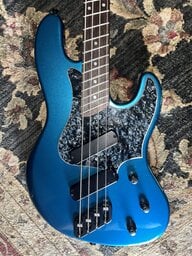
5. A good, solid case! I have a 5-string MIM Jazz Bass. Just because it's MIM doesn't mean that it deserves any less protection than a 'Super-whiz-bang-autographed-modified-USA' version! Treat her well and she'll treat you well (...well, usually anyway!).
6. Whatever you need to keep guitar and strings clean, lubricated (when and where necessary), and hydrated (depending on your climate, and the season, this becomes more or less of an issue. I try to keep my instruments, including bass, guitar, drums, and a C2 Hammond organ at around 50-55% humidity. Others may disagree with those numbers, but they've always served me well). Also, when choosing a case, try to get something that will give you at least a little room for cables, strap, etc. The fewer things you have to carry, the better!
From there, it's a lot of personal preference (type and size of head, and how much are you willing/able to haul around for speakers) vs. budgetary restrictions, the style of music and type of gigs you play, and your personal playing style. Then, of course, there's that most valuable of all assets: Time...to practice, practice, practice, and develop your style and ability! I don't know why, but I'm assuming (always dangerous!) that you're a converted, or converting, guitarist. With that in mind, relatively few guitarists really 'get' bass! Aside from the skill and manual dexterity part, bass is an attitude (go ahead, guys, open fire! LOL). I suggest spending as much time as you possibly can with a good human drummer (not a machine!)...and preferably one with experience...then concentrate on your fingers 'hooking up' with the drummer's kick foot. Remember what you always wanted a rhythm section to sound like, and make that happen!! Not everything you need, as a bass player, comes under the heading of 'stuff!'
Good luck!