I don't think I shared this earlier - last Christmas my daughter gave me this book,
Exercised. The author, Daniel Lieberman, is an anthropologist, and I learned a huge amount from it about how we're physically evolved and how exercise relates to culture. A few major insights:
1) Exercise isn't natural - not in the sense of performing strenuous activity voluntarily. Our ancestors, and people living in low-tech cultures like hunter-gatherers and herding people, only do it when they have to. So there's nothing surprising about not feeling motivated to exercise. There ARE reward hormones for exercising (runner's high is a dramatic example, but also more moderate ones), which probably exist in order to enable us to overcome the pain and strain of when it IS necessary, but if never used, the mechanisms to use them atrophy. So exercise is just hard and unrewarding hormonally until after you've been doing it for a few weeks and dusted those mechanisms off.
2) The human physical superpower is sweat. Even Usain Bolt can't outsprint hardly any four-footed animal. But humans are unusual in having sweat glands all over our bodies, which lets us regulate body temperature better than most animals. As a result, we can outlast almost anything at moderate strain levels, like jogging. Even before they had bows and arrows, homo erectus could throw a rock at an antelope and make it start running, then jog after it. The antelope would zip away fast, but as long as they didn't lose the trail, the hominids could just keep jogging after it all day. After a few hours of sprint and pause, gasping, sprint and pause again, the antelope would collapse of exhaustion and they could just walk up and bonk it on the head, take it home for dinner. The author tells a story of a race he was in between people on foot and people on horseback - in the desert and over some hills. At first the riders galloped off and left the runners in the dust. Ten or fifteen miles later the runners starting overtaking them.
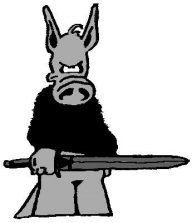
3) Conan the Barbarian or Tarzan is not what actual human beings living in nature look like. They tend to be lean, small, and sprightly. Bulking up with lots of muscle takes a huge investment of resources, from an evolutionary perspective; enormous intake of protein and lots of time expended on repetitive actions that don't immediately secure more food or a mate (though culturally, I guess they might do so indirectly). Looked at that way, a muscular physique is a privilege of resource-rich cultures.
4) Humans are pretty much the only species where grandparents can contribute to the care of offspring. In most creatures, the combination of shorter lifespans and faster maturing mean there isn't much role for them, but humans both live longer than most and take longer to grow up. As a result, we've got various heal-and-repair mechanisms in our bodies that get triggered by physical activity, and counteract the breakdown effects of aging. If an older human is out being physical, the body figures grandpa is hunting with the men or grandma is digging tubers with the women to help feed the babies, and that's good for evolutionary success, so the activity gets rewarded with spending resources on the repair.









 I’d go back to cutting mine every two weeks if it was cost-effective.


