• TalkBass has been independent since 1998. Add your voice.
    Create a free account to reply to discussions, view embedded media, and browse with fewer display ads.
    Join freeLog in
    Want zero display ads or expanded classifieds tools? Compare plans.

Double Bass False nut question

I'm think of trying to have a false nut put on to shorten the string length on my 1920-30 German bass. After struggling with the 43.5+ mensure I'm wondering if anyone has had experience with their bass losing punch or volume after doing this. I'll be removing the extension also so I'm wondering if this might be another variable..
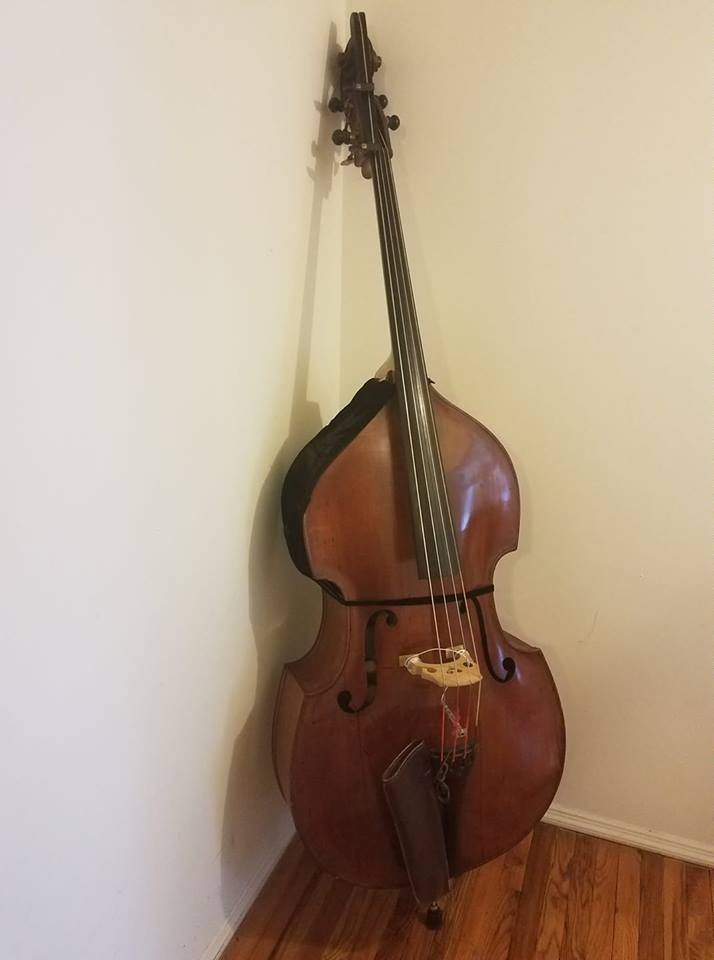
Mittenwald.jpeg
 
  • Like
Reactions: zootsaxes
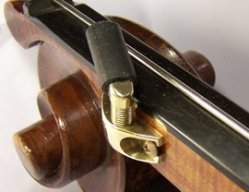
Yes, I'm thinking of a strip cut from an old credit card placed where you want your nut moved, and then a big cable tie pulls the strings down tight just behind it. A long cable tie, so it can wrap around the bottom button of the pegbox, since the back of the neck will be sloping up at that spot and not allow for this.
 
+1 to what @johnny_bolt said above. Many years back, long before Keiran O’Hara replaced the neck, I had David Gage cheat the bridge on my somewhat smaller 3/4 German shop hybrid bass down to make the string length slightly longer, so perhaps a similar thing could be done here in the opposite direction.
 
If you shorten the string length with a false nut this will move note positions closer to the bridge, won't it? If my math is correct the D harmonic sounds at 1/3rd the length of the G string. So, if you reduce 43 1/2" to 42" this should move the G octave 3/4" closer to the bridge and D 1/2". Will this make the notes of 4th and 5th Positions (Simandl) harder to play on your bass? I have never tried to compensate this by moving the bridge up.
 
False nut at 1/2 inch and bridge 1 inch closer to the fingerboard (don‘t forget to move the soundpost too!) gets you 42“ and keeps the note/intonation at the neck heel (fifth) in place.

But if you want to sell the bass, a potential buyer might not like the moved bridge. Better explain what can be done and if the buyer wants to test move the bridge only (but explain that the soundpost needs to be moved too for better sound and safety) and put something pressing on the fingerboard to simulate the false nut. Then let the buyer make the modification at his luthier.
 
Last edited:
  • Like
Reactions: zootsaxes
On reflection I think I have got my math above wrong. Please advise me. Open G shortened 1 1/2" with false nut moves D 1 inch towards bridge, octave G 3/4", second D 1/2". Mark the fingerboard with pencil under the D fingered with your index and thumb in the base of the neck (4th Position, Simandl) then make a mark 1" closer to the bridge and see how this will effect the comfort of reaching D, E and F. I think Double Midi might be closer to a solution.
 
When carrying the nut, the bridge must be moved twice as far. This will change the overall bass setting and where the bow is applied relative to the waist. How the sound will change is unknown.
The reverse conversion will be much more difficult or impossible.
By removing the extension, you lose some of your investment in bass. You will spend effort and money trying to get the wrong bass. I think there is someone who will like the enormous length of the string.
The market for 4/4 bass is very small. This means that few people want to use a bass with a 43 inches strings. But it also means that finding such bass is more difficult. Longlenght strings have some positives, such as clear tone and range. They are still in demand by some musicians. In addition, older double basses with very long strings are appreciated for converting into five-string versions.
My advice is to trust the manufacturer and keep the bass in the right (original) shape. You can sell or exchange it for whatever suits you.

Just my opinion!