• TalkBass has been independent since 1998. Add your voice.
    Create a free account to reply to discussions, view embedded media, and browse with fewer display ads.
    Join freeLog in
    Want zero display ads or expanded classifieds tools? Compare plans.

fat E = blah, skinny E = nice! why?

in trying to get the right sounds out of the strings which came on my new '90s vintage Cort PJ I tossed the large gauge E from the mystery set and moved the A up then tossed another suitable A in there and I'm happy enuf for the honeymoon but what bugs me is how the fat E (maybe a 105) which I'm definitely not used to not only sounded v meh with only fair lows yet yielded a higher pitched sheen that made it sound less hearty than even the D! the set which came on the bass have a nice dimensional range with an underlying gut punch of low end ...except for the E, there's no depth, no character, no nothing, just a resonating blump. how can a much smaller string have way more balls, real bottom and beauty, than from what should be the proper gauge? - I have no clue what any of these strings gauges or brand are, but they're softer rounds.
 
Last edited:
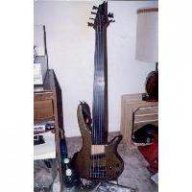
IME thicker strings give more fundamental. Thinner strings give less fundamental and more overtones. Which can sound more ballsy depending on the bass. For example on my short scale bass, I put std gauge Boomers on it and I got a lot of clang and some thud. Hated them. Later on I put light gauge Boomers on it and I get a ton of note definition, lows if I want them, but a much better balance of fundamental and overtones. I also notice this on my 7 string as I've been playing with gauges. Lighter gauge strings give it less low end but more mid definition. It's just all what you prefer, and how they sound on your particular bass.

I would suggest getting a cheap caliper and measuring your strings, so at least you have an idea what gauges you're working with. Also if you post a pic of each end of the string, somebody may be able to ID it.
 
Strings that 'come on a bass', whether a new bass or secondhand, can be old or defective, always replace them. Maybe this is why?
However, E strings are where the thickness of the string starts to cause a problematic amount of stiffness, affecting tone quality, thinner gauges are more flexible, clearer and more harmonic. I like .070-.080 for E.
 
  • Like
Reactions: Bass V and Mushroo
Strings that 'come on a bass', whether a new bass or secondhand, can be old or defective, always replace them. Maybe this is why?

^^This^^ The strings on any bass (or guitar, for that matter) I buy, very seldom last longer than the function check when I get it home. Unless the bass has to sit for a while, to acclimate to life here in the desert, they get yanked off the bass ASAP. The only exception would be if they were flats and still tuned up OK. Otherwise? Say hello to the garbage can...
Sounds to me like that E string is simply dead. When rounds die, the E string is very often the one that goes first. I'd consider that a wake up call, and start looking for the new strings of your choice. Personally, I have no problem with a "Standard" gauge E string. Mine run from the .096 in the Rickenbacker Light Nickel Rounds on my 4003, to the .110 in the Roto 77SH flats on my Kramer 450B. Most, though , are .105s...:thumbsup:
 
  • Like
Reactions: Bass V
This should read, "Say hello to the recycling bin...", shouldn't it? ;)
yes, MY recycling bin! I'm sure it's considered bad form but I'd happily donate $100 to tb to be the trash bin for everybody's old strings just to figure out what suits each bass for it's best abilities without breaking the bank and my sanity.
after going back to the skinny E it sounds SO much better..., the fatty may have been dead but I like dead strings, yet I think the shop just thru on some new cheapos. I always keep whatever is on the bass I buy and try to work with it to maybe discover their benefits, it's payed off many times. I generally put flats on everything but I've come to appreciate some rounds, like Slinkys which don't have that overbearing sproinginess so common today. with all the different cores and wrapping methods it's impossible to know but I'd bet what came on the bass were hex or similar type cores, they give an impression of a 3D sound instead of much less. but then, I prefer the more basic tone of the oddball I have as the A, it's not as alive compared to the others but it's a more satisfying vintage tone. at least I can get on with this set and bass, it deserves the best I can put on, I can tell it has more to give. sorry for no pics, I knew there'd be those who could look and ID these ;)
 

Latest posts
