• TalkBass has been independent since 1998. Add your voice.
    Create a free account to reply to discussions, view embedded media, and browse with fewer display ads.
    Join freeLog in
    Want zero display ads or expanded classifieds tools? Compare plans.

Fender Headstock Break Angle

I like the idea, but wouldn't want to pay for it. The blank would have to be thicker and more wood trimmed off. That would mean a significant increase in the price of the neck. Even worse, once the penny pinchers got involved the wood grain would be reoriented to slope downward weakening the neck significantly. That would reduce the cost of the neck some, but the price would already have been jacked up and I don't see Fender passing the savings of the weaker necks on the the consumer.
 
This ^ I couple of years ago I had a neck made with a slightly shorter scale for one of my basses. The neck has a tilt back headstock. As @sissy kathy posted, it cost more. But to keep the bass looking stock, I did pay for the upcharge, since this bass is my primary gig bass, and the gigs paid for neck.
 
  • Like
Reactions: Bassatronic
I've been building bass necks for other Luthiers for many years. Most of us prefer tilt-back headstocks for a combination of reasons. We only use flat Fender-style headstocks if we specifically want the Fender look.

My favorite combination is 7 degrees back and 1/4" offset down. That works very well getting a nice even string break angle to all the tuners, and good clearance for truss rod access. No significant loss in strength on the headstock with the grain angle at only 7 degrees.

It also doesn't really waste much wood, because we cut the necks two at a time, back to back, from 8/4 stock maple.

Here are two examples. On the one in the back, you can see what that combination of 7 degrees tilt and 1/4" offset looks like. It's not radical looking, and it works very well functionally.

The one in the foreground is also 7 degrees x 1/4", but it has a decorative cap and the scoop isn't cut as tight.

IMG_0668B.jpg
 
I like the idea, but wouldn't want to pay for it. The blank would have to be thicker and more wood trimmed off. That would mean a significant increase in the price of the neck. Even worse, once the penny pinchers got involved the wood grain would be reoriented to slope downward weakening the neck significantly. That would reduce the cost of the neck some, but the price would already have been jacked up and I don't see Fender passing the savings of the weaker necks on the the consumer.

Yeah I can see how wood would be wasted just for the angle of the headstock.
 
Bruce, thanks Mate!!
This is just what I was thinking. Very interesting.The cap is a nice touch.
Two Questions -

Does it change the string tension much? I'm working on a Mustang style 30' bass.

Can you lay the instrument flat on a table? (on it's back?)

:)
 
Bruce, thanks Mate!!
This is just what I was thinking. Very interesting.The cap is a nice touch.
Two Questions -

Does it change the string tension much? I'm working on a Mustang style 30' bass.

Can you lay the instrument flat on a table? (on it's back?)

:)

Tilting the headstock back doesn't change the string tension at all. Increasing the break angle of the string over the nut increases the download of the string on the nut, which helps the string seat better and may, in some cases, clear up the sound.

Yes, that 7 degree 1/4" offset geometry usually keeps the tip of the headstock clear of the table, with the body flat on its back. If the body is normal Fender-like thickness.
 
  • Like
Reactions: iiipopes
HI Bruce, I've thinking about that headstock you posted with the veneer on top. I really like the idea. Is it hard to get right?

Also, is there a link somewhere I can see your work? Cheers! :)
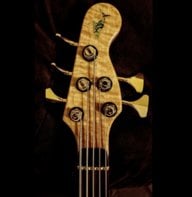
That's not actually a veneer on that headstock, it's a shaped cap. A slice of the decorative wood, about 1/4" thick, is glued on, and then routed down to about 1/8" thick with a curved slope going up to the nut. That's done with router fixtures, while the headstock is still rectangular.

If you are interested in getting into serious neck building, we have a long thread on here all about Router Planing, and the crazy fixtures that we come up with to do it. Somewhere in that thread are my fixtures for surfacing headstocks and headstock caps.

https://www.talkbass.com/threads/router-planing-fixtures.1267460/

You can also put a veneer on a headstock. Glue down a thin sheet of veneer and trim it carefully around the edges and holes. Hand file the perimeter to a slight bevel.

A link to my work? I've been writing prolifically here on TalkBass for about 15 years, showing off my shop, machines, tools and processes. Hundreds of threads. Covering almost everything about building electric basses.

My own specialty are the Ampeg-derived Scroll Basses, which I've been building since 1997. Here's a 400+ page thread all about them:

https://www.talkbass.com/threads/love-of-ampeg-and-other-scroll-basses-part-2.1044767/
 
  • Like
Reactions: Bassatronic

Latest posts