• TalkBass has been independent since 1998. Add your voice.
    Create a free account to reply to discussions, view embedded media, and browse with fewer display ads.
    Join freeLog in
    Want zero display ads or expanded classifieds tools? Compare plans.

Double Bass Fingers 3 & 4 in RH 2-finger pizz

Stev187

Peavey MegaBass Club!
Jan 11, 2011
965
130
Lansing, MI
Before I ask my question, I gotta say a few things:
  1. TB is great. I can't tell you how cool it is to have this resource as I try to get back into playing DB. Thanks to everyone who works to make this cool
  2. I searched the archives for some discussion on this specific point and couldn't come up with anything (found lots of other great stuff, but not this); perhaps I missed something
  3. I fully realize that there is no single "right" or "correct" way to answer to my question; lots of players do it lots of different ways
With that out of the way, here we go:

Q. What do you do with fingers 3 and 4 if you're using a 2-finger approach to RH pizz?

My personal favorite answer to questions like this is "it depends." And it's true. I find that I do different things with fingers 3 & 4 depending on what I am playing. But if that answer satisfied me, I wouldn't be asking y'all, would I? So here's my issue:

My ideal RH position for DB--drilled into me by my excellent teacher in college and frozen in my mind thanks to very large photos from Ron Carter's 1966 Building a Jazz Bass Line method book--looks like this:
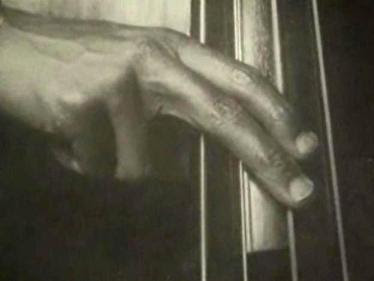
roncarterrh.jpg


Now, I have what I think are average-sized hands. They aren't small, but they aren't big, either. It takes work to curl fingers 3 & 4 under like the photo here and keep them there. I can do it--sometimes quite easily, but they often slip down and hang out there "free." From watching players live, watching my teachers, and checking out videos online, I see so many approaches to this. Some players are absolutely rigid in keeping 3 & 4 tucked away. Others leave them hanging out there all the time. [Note: remember that I'm only talking about 2-finger pizz people, not the folks who actually use one or both of those to pluck the strings.]

I guess a related question is: what's the purpose of tucking fingers 3 & 4 under?

Because this issue is so visual, I put together a short video to illustrate what I am talking about. [WARNING: This video contains a short snip of me playing, and my playing is nothing special, believe me.]

YouTube - RH Pizz Question

You can notice from the video that the "natural" way for me to play is with my hand relaxed and 3 & 4 just hanging out there. I can't say that I notice any difference in tone or speed either way, so I tend to leave them out. My first teacher didn't think this was a big deal; my present teacher doesn't care (he's a very dedicated member of the "whatever works for you, man" school of teaching).

My theory about why it's easier for me is this: my fingers aren't long enough to curl up under the palm of my hand without some muscular "help," which takes work. This work does not contribute to the music, so my tendency is to let it go.

Now, having said all that, perhaps there is some negative impact of the hanging 3 & 4 that I am not aware of; maybe I should be working on it or thinking about it. Heaven knows there are other technical things I could be/should be working on with my playing, but I keep coming back to this question in my mind. And now I am a part of this cool discussion board full of bass players who think about this stuff and know more than I do and have lots of cool experience to draw from, so I just wanted to ask. And now I have. :D

--Steve

P.S. That 1966 Ron Carter book is cool, huh? It's a gift from my first teacher.

 
Seems quite unnatural to me to curl up the third and fourth fingers. I tend to follow my idol on this. :)

I'm curious-- what's your string height? Was the bass amplified in your video?
 
I'm curious-- what's your string height? Was the bass amplified in your video?

Whoa, that's some video, Les! Thanks.

No, the bass wasn't amplified there. I don't have a pickup or amp anymore. That's just an old Sony camcorder set on the shelf (with the crummy built-in condenser mic). I don't have a specific measurement of the current string height. It's a little less than a No. 2 pencil right now. I'm currently having some set-up issues with the bass... perhaps the subject for another thread. The fingerboard was planed recently, and I had adjusters installed. But the bridge is in the wrong place and there are some other issues that need to be addressed.

--Steve

P.S. I bought a micrometer recently to measure string height, and it's clearly not the right kind. I can't get an accurate measurement. What should I get to do the measurement?
 
Good video Steve. Nice and clear way to ask your question. Your bass sounds nice.

I also wandered this myself. I think it also depends whether you play with two fingers or with one finger. With the more 90 degree to strings (fast solo) two finger attack I tend to automatically curl my 3rd and 4th finger inward. But with the more old school one finger approach I keep the 3rd and 4th finger more loose. But I never hold the 3rd and 4th finger very tight in my hand.

I think one is not better or worse than the other. The fact that most of the great players all use a different right hand approach proves this point. Just do what feels natural or use the one which has the most speed.
 
Steve, all I can tell you—from my strange perspective—is that I've watched a lot of live bass as an audience member and to me you look and sound natural and relaxed with your 3 and 4 fingers free. If they don't get in your way at all, I'd rather watch you that way. I wish I moved across the strings as easily as you seem to do. I like your sound. And a nice vid.
 
When I was a teenager, I used to play with my 3 and 4 fingers in a curl. A former teacher suggested that I let those fingers relax.

His point was that tucking the fingers in the hard curl adds tension to the hand. His other main point was to minimize excess motion. The idea was that the more the who apparatus moves, the harder it is to refine, for faster passages.

He used to have me spend large amounts of time "grooving the stroke" on open strings, with the right hand alone, in front of a mirror, to try to minimize excess arm and hand flop. Thirty years later, I still do it.

Here's recent a clip of him. The pizz starts at about 2:45.

YouTube - Terry Plumeri Trio Live - Autumn Leaves

I was also lucky enough to have a few lessons with George Mraz, long ago. He had an identical approach; relax the other fingers, be accurate, get a full sound, and minimize excess motion.

YouTube - Tommy Flanagan Trio - Tin Tin Deo

Of course, they are both playing amplified here. I can report that acoustically, they both have a full, loud sound, with no amp.

Here's Eddie Gomez, with the same relaxed right hand:

 
I was also lucky enough to have a few lessons with George Mraz, long ago. He had an identical approach; relax the other fingers, be accurate, get a full sound, and minimize excess motion.

YouTube - Tommy Flanagan Trio - Tin Tin Deo


Here's Eddie Gomez, with the same relaxed right hand:

YouTube - Eddie Gomez - Double Bass Solo

In that video George Mraz is curling his 3rd and 4th finger too.
And Eddie Gomez is playing with a raised (and seperated) 4th finger. So both have a different approach.
 
In that video George Mraz is curling his 3rd and 4th finger too.
And Eddie Gomez is playing with a raised (and seperated) 4th finger. So both have a different approach.

Both Mr. Gomez and Mr. Mraz play with a very relaxed right hands. Sometimes the 3 + 4 fingers curl gently, sometimes not. The point I was trying to make is the relaxation vs. the rigid curl. The hand is always relaxed and controlled.

The hand shapes are different; the relaxation and accuracy are the constants.

Of course, it all depends on what is most relaxing for each players physiology.

Here's another Mraz clip, with both curled and open right hand:

YouTube - Blue Bird
 
In that video George Mraz is curling his 3rd and 4th finger too.

I noticed that, too (check him out at 4:46). His hand looks very relaxed and natural, but I'd call those fingers curled back. That kind of look is always what I have in my mind as the "right" way to do it. Can't argue with his results, either--what a monster!

I didn't get a good look at Eddie's hand in that other video, but you get a nice look at it here at about 2:04:

YouTube - Alex Riel - Eddie Gomez - Bill Evans

Looks like Eddie curls 3 & 4 while walking and then lets it all hang out during faster passages. You can also see that thumb plant for stability when he's really flying. Man, it's helpful to have YouTube out there for questions like this. Somebody should make an annotated list of YouTube vids for RH and LH examples. Does that mean I just volunteered?

--Steve
 
You bring up a good point; the thumb "plant" location.

Some use the fingerboard edge, some the E string (unless playing there, of course).

Seems a personal thing. I used to use the fingerboard edge, now I use the E string. For me, that creates less hand tension.

Lots of player who blow me away use the fingerboard. Seems to vary with the player and the type of playing.
 
I didn't get a good look at Eddie's hand in that other video, but you get a nice look at it here at about 2:04:

YouTube - Alex Riel - Eddie Gomez - Bill Evans

Looks like Eddie curls 3 & 4 while walking and then lets it all hang out during faster passages. You can also see that thumb plant for stability when he's really flying. Man, it's helpful to have YouTube out there for questions like this. Somebody should make an annotated list of YouTube vids for RH and LH examples. Does that mean I just volunteered?

Yes, that is my favorite Eddie Gomez clip. I was (and still am) very impressed when I saw this for the first time. I think he has the fastest and most accurate right hand attack I have seen so far. I like the double stops at 1:45. Are that supposed to be octaves?
I also like how he goes from low to high up the neck so fast with his left hand. Good stuff!
 
It's funny, for me curling the two fingers under felt weird at first, but I kept playing with it and after a few days, it felt fine, and I actually like the feeling, it feels natural to me now. Now for faster passages especially in a solo, I think it is a bit easier to let them hang, and also rotate the hand slightly more perpendicular to the strings (I've watched Dave Holland do this a lot, he plays mostly with the two fingers curled, but for solos goes more perp. to the string and lets the fingers free)
 
My ring and pinky relax and do some muting here and there. Sometimes if I'm playing something that involves the G string, the pinky or ring will be waiting to snap the A or E string. This is something I've always naturally done on electric bass.

If I'm walking a certain way and it turns into a single finger technique (with index and middle doubling up), they do curl up a little bit.
 
I usually use one finger paralell and let the rest hang. If I have to play a faster passage, Two finger perpendicular, and 3 & 4 curl. Sometimes I use 1 & 2 together, and on rare occassions, I actually use all four fingers of my RH, just to get some meat on the strings. I have also noticed that it depends on who I am playing with, how my RH technique changes.
 
I like to opt for the closest thing to natural hand position at rest. Any good teacher will tell you over and over that tension is bad, that tension is bad, and that tension is really, really bad. Anything that creates tension will hinder your playing. I don't curl back; I let my fingers rest naturally in line with the rest of my hand. I also use my ring finger sometimes for fast things (think fingerstyle metal technique for electric...on upright) so I like to have it available.

As far as thumb plant position, I have a really long thumb, so I actually rest against the back of the fingerboard. People with non-freak hands like mine may find this uncomfortable, however.
 
As far as thumb plant position, I have a really long thumb, so I actually rest against the back of the fingerboard. People with non-freak hands like mine may find this uncomfortable, however.

I noticed myself doing that at a rehearsal last night. My thumbs are normal size (I think). Fast passage, and the thumb went around back of the fingerboard. Seemed unusual once I realized I was doing it, but not uncomfortable.
 

Latest posts