• TalkBass has been independent since 1998. Add your voice.
    Create a free account to reply to discussions, view embedded media, and browse with fewer display ads.
    Join freeLog in
    Want zero display ads or expanded classifieds tools? Compare plans.

First Build

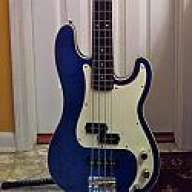
After doing a good bit of research on here, I've decided on my first bass build. The first pieces came in a few weeks ago, but I just got home from college to see them. The body, bridge, and bridge cover is off of a Squier CV 60's P in Sonic Blue. The PG is a BWB Fender with some yellowing that I liked.

This is the first time I've ever tried anything like this, it will probably be a project that lasts me at least through the summer, depending on finances (I have an engagement ring to finish paying for). I will definitely be asking for help as I stumble my way through this, so any advice will be greatly appreciated
 
IMG_0480_zpsfea16598.jpg


IMG_0481_zpse283d3fc.jpg


Of course, crappy iPhone pics and poor lighting do not do the color justice
 
So first question, I got some copper shielding tape from basspartsresource.com and I've searched on here, but I can't find exactly what I'm supposed to do. Some people were talking about there already being shielding paint? I've seen some with shielding on the back of the PG, some with it throughout the cavity, and some with none at all. I also read that shielding a P-bass is pointless because the P pickup is already hum-canceling in nature. So what should I do?
 
Line the entire cavity with the copper tape, including up the sides. The tape has to come up and over the edge of the cavity by about 1/4" onto the front of the bass. Some copper tape is conductive on the back, some isn't. In either case, it's best to hit each seam with some solder. The idea is you want zero resistance from any two points on the tape.

Line the back of the pickguard with the copper tape in the areas that will cover the control cavity. You're making a lid for the "sealed box" of the cavity. You'll want this copper tape to contact the 1/4" of the tape along the edge of the cavity.

When you install the pots and input jack, all this copper will be grounded. Any electronic "noise" will be intercepted by the shielding and get sent to ground, and not into your pickups / wiring which goes to the amplifier.

Work slowly and neatly. That's all the advice I have.

And hum and noise are two slightly different things. You should shield even though you're using a hum cancelling pickup.
 
Shielding isn't there to get rid of hum, it's there to reduce noise.

Hum comes from the 60Hz cycle of the power we use (in the US anyway), and noise is caused by electromagnetic interference (some radios, cell phones, etc.)

Shielding helps reduce noise from interference. Those cavities *look* like they're shielded with conductive paint from here, but it might just be black paint. The way to check would be to use a continuity tester or multimeter to see if electricity is being conducted by the black paint.

If the cavities are conductive, you may still want to shield the back of that pick guard. The copper shielding tape you have is good for that.
 
I see your what I would call local, and congrats on both points.

It looks to me that you may have shielding paint in that cavity, and yes, P pickups are considered hum-canceling in nature. you could use it anyway, save it or wait to see if it hums when your done and go from there.
 
Shielding isn't there to get rid of hum, it's there to reduce noise.

Hum comes from the 60Hz cycle of the power we use (in the US anyway), and noise is caused by electromagnetic interference (some radios, cell phones, etc.)

Shielding helps reduce noise from interference. Those cavities *look* like they're shielded with conductive paint from here, but it might just be black paint. The way to check would be to use a continuity tester or multimeter to see if electricity is being conducted by the black paint.

If the cavities are conductive, you may still want to shield the back of that pick guard. The copper shielding tape you have is good for that.

That too. ^^^

I think we were all typing at the same time... LOL :p
 
It may or may not be necessary. If the adhesive side of the tape allows for conductivity, maybe not. However, it's not a big deal. At each seam, overlap the tape by a half inch or so. Then, just a small blob of solder to electrically connect the two pieces is all you need. Remember, you want to make sure any nose intercepted by the copper gets shunted to ground through the pots and jack.
 
Like MrArose said, there is already shielding paint in that cavity, so using lining it with copper would probably not really gain you much. If its not already done (probably is), I would go ahead and apply the copper to the back of the pick guard where it goes over the cavity.
 
So it's been a while since I posted, but here she is as of about 20 min ago. I got a tort PG, pickup from a CV P, and some 250K pots. Then I had to go buy a soldering iron and learn to solder :hiding:

So here she is:

IMG_0516_zps352e681e.jpg


I think I've decided on buying a Squier Affinity P/J and using that neck. I played one in Ken Stanton the other day and loved how it felt so I'll probably get that next week.
 
So I actually finished this about two weeks ago, but it has been super busy (got engaged, fiance had surgery) so I haven't been able to sit down and upload pics and everything.

The neck is off a Squier Affinity P/J. I was in a music store and this caught my eye, and when I sat down with it, it felt so good I couldn't leave the store without it. So I took the neck off it for this project and I think I'll throw a fretless on the body, but that's a whole other story.

String are GHS Precision flats, its my first try with these and I absolutely love them. The only other flats I've tried are Chromes and I definitely prefer the GHS, much smoother feeling to me.

So here the finished product :D
IMG_0523_zps9bcd124e.jpg