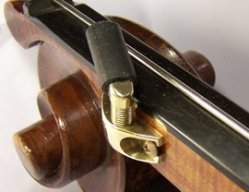
Just wanted to echo this opinion.
I ordered a new bass. It came with brass adjusters. The bass
never sounded right. On a lark, we tried aluminum adjusters.
It made a world of difference. The weight and lack of sound
transfer from the brass adjusters seem to "kill" the sound of
the bass. Just one mans experience.
I just read about the Moser adjusters for the first time a minute ago. I just posted a description of another adjuster which employs the ball and socket idea, but I think is aluminum and is simpler, lighter, and likely much cheaper, but I don't know who makes it.
I like regular aluminum adjusters. BM told me that they brighten the bass because their flexibility allows the bridge to move forwards and backwards, freeing the string to shorten and lengthen slightly during the vibrational period. He said that every customer who had him to change out the aluminum adjusters for wood soon returned to have the aluminum ones put back in, which he attributed to the stiffness of the wood studs. If this is true, then the Moser design should be an improvement. I suspect however, that reduced weight is probably a bigger factor than vibrational or bending properties. This doesn't mean you should shave you bridge down to nothing. You still need stiffness, and really thin bridge tops never seem to succeed, even if they don't bend and break. The legs, however, seem to perform well when a big section is chopped out, and an aluminum adjuster with lots of thread showing is installed.
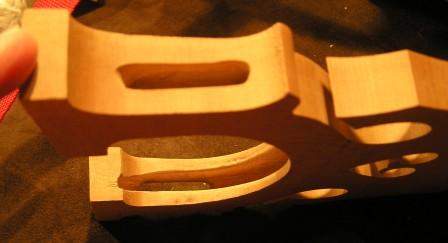
MollyKay's idea looks really interesting to me. Here, you reduce leg mass but don't allow the flexing you get with adjusters. Another approach would be to simply bore a large hole up into the leg, so that you wouldn't even see the alteration. You could even plug the foot if you were worried about contact area. If someone would try this on a classical bass and compare it to regular aluminum, or Moser adjusters, we could really learn a lot.
I personally don't really need adjusters. The humidity is pretty constant here, and classical players and luthiers really look down their noses at people who have them. Everyone here KNOWS that they kill the sound, even though no one has ever actually tried them. I think they are a real improvement over a solid bridge, but I don't know why. So, I am looking forward to reading about any experiments, new ideas, tests, or opinions which are surely forthcoming!