Can you point me to instructional videos of this? I'll look around but I figure you might know of some particularly good ones.Left hand mostly, like on upright. Sometimes right hand.

Enjoy the benefits of a premium membership!
Upgrade Account
-
TalkBass has been independent since 1998. Add your voice.
Create a free account to reply to discussions, view embedded media, and browse with fewer display ads.
Join free Log in
Want zero display ads or expanded classifieds tools? Compare plans.
You are using an out of date browser. It may not display this or other websites correctly.
You should upgrade or use an alternative browser.
You should upgrade or use an alternative browser.
floating thumb techniqe
- Thread starter Torvus
- Start date
More options
Who Replied?
Sorry, no idea on videos. I am an untrained electric player though with formal training on upright, and I pretty much play them the same way. This, I know, is NOT optimum for electric bass, but I play so little electric that I haven't been willing to acquire proper EB technique.
My initial comment had to do with pointing out the disparity between "floating thumb" on EB and standard pizz technique on upright with the thumb anchored under the edge of the fingerboard - and questioning the assumption that the thumb needs to move all round on EB. If upright players can reach all the way over to their G string, EB players ought to be able to. When I play EB, I rest my right thumb on the very end of the fretboard or the pickup, and have no trouble reaching any of the four strings.
Of course, the six string bass might be a different story.
And those with real EB training could potentially weigh in and explain why the need for "floating thumb" - but that hasn't happened in this thread yet.
My initial comment had to do with pointing out the disparity between "floating thumb" on EB and standard pizz technique on upright with the thumb anchored under the edge of the fingerboard - and questioning the assumption that the thumb needs to move all round on EB. If upright players can reach all the way over to their G string, EB players ought to be able to. When I play EB, I rest my right thumb on the very end of the fretboard or the pickup, and have no trouble reaching any of the four strings.
Of course, the six string bass might be a different story.
And those with real EB training could potentially weigh in and explain why the need for "floating thumb" - but that hasn't happened in this thread yet.

The main purpose of "floating thumb" is to mute the unplayed strings below the one being plucked -- e.g. to prevent the A or E string from ringing out while plucking the G. I don't play double bass, but presume that there are other right-hand techniques for accomplishing this: maybe using the ring finger and pinky of the plucking hand?And those with real EB training could potentially weigh in and explain why the need for "floating thumb" - but that hasn't happened in this thread yet.
Well, stopped strings don't ring on upright, because they're stopped with your soft finger. Open strings do ring, and generally I mute them with my left hand.
Thanks Turf3. It's not the reaching that puzzles me or causes grief, but how one would mute open strings. At this point I've taken the baby step back from floating thumb to Ed Friedland's instructions on Page Six of MB 1, and I like that better then floating thumb.

to prevent ... ringing out while plucking the G.
And those with real EB training could potentially weigh in and explain why the need for "floating thumb" - but that hasn't happened in this thread yet.
Compared to the >30s sustain of an electric bass, the sustain of a plucked string bass is relatively short, say 3-5s on a good day. Unlike the string bass, the electric bass has no moving bridge or absorbent top so the energy in the unmuted strings has nowhere to go - sympathetic resonance may continue long after the 'driving' note has stopped, and can make things very messy very quickly, especially if it involves dissonant harmonics. Imagine you are playing a staccato A on the G string only to have the C# harmonic of the A string and/or high E of the E string speaking on afterwards - attached.
As for the floating thumb, I can't say there is any compelling 'need' - other muting methods are available, and FT doesn't cover 100% of the job all of the time - the left hand continues to play an important role as it does with other methods. But my experience, and that is all I can speak from, is that the FT has proved more reliable and effective than all the others, thanks mainly to the great natural ergonomics. As soon as you release the anchor you see that the thumb is perfectly placed to drape over the strings and provide a natural mute without really having to do very much - it repositions with the hand, is always pointing in the right direction and conforms naturally to the bridge/saddle/string radius.
Attachments
I've ve been taught that the proper technique should mean that you do not use the pickup as an anchor point with your thumb when plucking the E and should just have it floating when playing A, D, and G you can use the string above an an anchor point. Also, pluck with your index and middle fingers alternatively at 90 degrees to the strings close to the bridge. It's hard to begin with but this makes such a difference.
What do you think?
I learned this way, too.
Now I play a 5 string so rarely visiting the pickup or otherwise just a brief free float above the b.
when on a 4 i would hang out on the pickup only when up hammering out punk rock 16th notes ad nauseam.
Last edited:
I was glad to have shifted from floating thumb to the method in Ed's Method Book 1 but I still wasn't settled or entirely happy with it; I could have stayed with it, worked out a couple of trouble spots and been fine but I still preferred the idea of reduced bulk hand movement. The notion of limiting thumb positions to the PU or A string (I'll never play more than 4-strings) remained attractive but I couldn't grock how to mute the A-string when plucking the G-string. Finally I came across this guy who not only explains how mute A but why one might prefer one technique over the other, and why he prefers his choice of the three. I greatly appreciate instructors who, when relevant to the learning a subject or skill, present multiple approaches and explain the differences, relative advantages and compromises. I'm about 4 days into transitioning and can already tell that I've finally found my plucking "home". I'd imagine it will be a few weeks before my right ring finger reliably and MOL automatically does what it needs to do, but it's coming along well.Thanks Turf3. It's not the reaching that puzzles me or causes grief, but how one would mute open strings. At this point I've taken the baby step back from floating thumb to Ed Friedland's instructions on Page Six of MB 1, and I like that better then floating thumb.
For the time being I'm just practicing the right hand on open strings and will continue on this little detour until my capability is solid enough to support continuing with Bass Method Book 2 which I recently started.
More generally, I like the guy's on-line instructional videos.
LoveThatBass
Supporting Member
My version of floating thumb is let the side of my thumb rest on the unused string/strings and it slides across the unused strings muting them while playing. At first it was a little weird but now second nature. I never have liked the thumb hung on the top edge of the pickup or some other item.
I meant to say "limiting thumb position to the PU or E-string", not "the A-string".
At about 3 weeks into this transition the muting is starting to be somewhat second nature, modestly reliable and not the kinesthetically challenging activity it was at the outset. I'm very glad to have made the change. The Racing Car metaphor would be to say that there is a lot less unsprung weight in the suspension than there was previously
At about 3 weeks into this transition the muting is starting to be somewhat second nature, modestly reliable and not the kinesthetically challenging activity it was at the outset. I'm very glad to have made the change. The Racing Car metaphor would be to say that there is a lot less unsprung weight in the suspension than there was previously
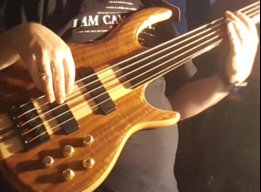
yea, I actually do the same thing when I'm playing 5 or 6 string, because otherwise my standard muting technique from 4 string will always end up leaving one string ringing. I'm not certain what the technique is called, but it is VERY common on 5 and 6 string basses since it is the only way to mute all of the thicker strings when playing on the thinner strings. Unless you are one of those folks to likes to tie something around the neck at fret 1.My version of floating thumb is let the side of my thumb rest on the unused string/strings and it slides across the unused strings muting them while playing. At first it was a little weird but now second nature. I never have liked the thumb hung on the top edge of the pickup or some other item.

As long as I've been primarily using my fingers for plucking the strings of my bass I've used floating thumb technique, I didn't even know it was an actual named technique until at a later point, it just came naturally to me.
And yes, I do have a fairly light touch, just stroking the strings, more so than really striking, pulling or plucking them, with the outmost tip of my fingers/nails, in a slightly inwards light slapping motion (well that is my primary plucking technique, though I do occasionally incorporate double thumbing, as well as flamenco guitar style finger flicking technique).
I've found that this gives me a much richer, but actually also more aggressive sound, than plucking the strings harder with larger portion of my fingers, which to me tends to ending up sounding thuddy and dull, plus stroking the strings lightly gives you much more control and wider dynamic range.
And the floating thumb thing gives me much more, and not least more natural and intuitive, control over muting (however it does happen occasionally that I'll have to incorporate other fingers, on the fretting hand mainly, for muting the higher strings, bellow the strings am playing/fretting).
And yes, I do have a fairly light touch, just stroking the strings, more so than really striking, pulling or plucking them, with the outmost tip of my fingers/nails, in a slightly inwards light slapping motion (well that is my primary plucking technique, though I do occasionally incorporate double thumbing, as well as flamenco guitar style finger flicking technique).
I've found that this gives me a much richer, but actually also more aggressive sound, than plucking the strings harder with larger portion of my fingers, which to me tends to ending up sounding thuddy and dull, plus stroking the strings lightly gives you much more control and wider dynamic range.
And the floating thumb thing gives me much more, and not least more natural and intuitive, control over muting (however it does happen occasionally that I'll have to incorporate other fingers, on the fretting hand mainly, for muting the higher strings, bellow the strings am playing/fretting).
Last edited:

For me, whenever I play a 5-string, I have to shift to this technique. Primarily for the muting, but also moving an anchor around always gets me confused as to where I'm at, string-wise. Nothing like tossing a clam out there because that WASN'T the E string you just nailed after all ...
The one challenge for me personally is playing really tight, percussive 16th note grooves (e.g. What Is Hip, etc.) without an anchor for my thumb. I can pretty much pull it off, but it always feels a bit wishy-washy and loose.
The one challenge for me personally is playing really tight, percussive 16th note grooves (e.g. What Is Hip, etc.) without an anchor for my thumb. I can pretty much pull it off, but it always feels a bit wishy-washy and loose.

I follow a top Bass player on yt.
Sometimes he places his thumb on the string but not anchored: only touching with the side.
Is this a good technique?
Sometimes he places his thumb on the string but not anchored: only touching with the side.
Is this a good technique?

This is what I was taught. Basically, use the side of the thumb instead of the tip. No anchor.My version of floating thumb is let the side of my thumb rest on the unused string/strings and it slides across the unused strings muting them while playing. At first it was a little weird but now second nature. I never have liked the thumb hung on the top edge of the pickup or some other item.
To retain this habit, I was taught to even "anchor" my thumb on the pickup with the side of my thumb, not the tip. Thereby, my thumb is pretty much never anchored, it always floats.
Been doing it that way since 1988!here a clear image
View attachment 7513006
The thumb is only muting the string
I think it is useful for a faster string skipping of the right hand


