• TalkBass has been independent since 1998. Add your voice.
    Create a free account to reply to discussions, view embedded media, and browse with fewer display ads.
    Join freeLog in
    Want zero display ads or expanded classifieds tools? Compare plans.

Double Bass Found a 1960 King Morotone for sale...

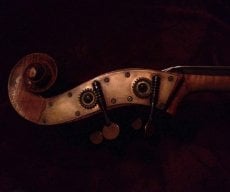
Found a 1960 Blonde King Morotone 3/4 upright...Fella wants $2000.
Have never heard of Morotone before. I would be upgrading from a Cremona sb-2
Typically, the band that I am in plays rockabilly, folk, and jazz.

Is this a good deal? What are your thoughts on King Morotone basses?
I attached the picture of it.
Thanks!

*edit* More pictures attached. Is this wear and tear normal for a bass of this age?
*edit 2*
Was also informed that It’s "had a neck set". What does this mean?


View attachment 2916101


View attachment 2916099
View attachment 2916100
 

Attachments

  • 23167536_10214375901808749_4252531529474765619_n.jpg
    23167536_10214375901808749_4252531529474765619_n.jpg
    157.6 KB · Views: 61
  • 23167536_10214375901808749_4252531529474765619_n.jpg
    23167536_10214375901808749_4252531529474765619_n.jpg
    157.6 KB · Views: 33
Last edited:
Looks to be in good shape, and KFS is right about the "vintage mojo value". Do these basses have the same ultra thin neck profile as some of their contemporaries (old Kays, American Standards, etc.)? What about neck heel issues that the Kays always seem to have?
The neck on my 61 Mortone is not thin at all. I’ve played Kays and Engelhardts that are much thinner. Mine was a high school rescue where the neck had, I assume, been broken out and put back in with 19 nails and crooked to boot. 10 days in the hands of Chris Roberts at the Cincinnati Bass Cellar fixed all that, including improving the overstand angle, and now it’s in excellent condition. If that instrument is like mine, it will be VERY loud acoustically. Perfect for Bluegrass etc.
 
Thanks for the thus far, everyone!
Was able to get a few more pictures; attached them to the original post.Was also informed that It’s "had a neck set". What does this mean?
 

Attachments

  • 1.jpg
    1.jpg
    195.2 KB · Views: 78
  • 2.jpg
    2.jpg
    217.6 KB · Views: 84
  • 3.jpg
    3.jpg
    217.3 KB · Views: 78
  • 4.jpg
    4.jpg
    235.8 KB · Views: 53
  • 1.jpg
    1.jpg
    195.2 KB · Views: 48
  • 1.jpg
    1.jpg
    195.2 KB · Views: 44
  • 3.jpg
    3.jpg
    217.3 KB · Views: 47
Last edited:
For what it is worth. I bought my 61 Mortone 2 years ago for $1800, it was listed at $2000. No repairs had been done to it. Very pleased with it. I'd ask for a lower price to get the neck done properly, get an estimate and see if he would drop the price by 50% of that cost.
 
Question from a newbie: why is that neck repair a bad one?

I'm thinking that from the perspective of woodworking, a pinned mortise & tenon joint should be stronger than a standard mortise & tenon. At least, that's what I think was done on the repair: three dowels pinning the tenon on the mortise... Of course, there's the aesthetics of the holes on the ribs.
 
Question from a newbie: why is that neck repair a bad one?

You can see why a lot of non-luthiers approach the problem of a loose neck with reengineering ideas. It seems like a simple problem: have the neck stay in the right place. On that criterion alone, this is not a bad repair. But there are other important parameters that are neglected. The aesthetics of a nice clean joint and smooth lines are obvious, but before that comes repairability. When you start driving screws and dowels into the joint, you make repair a much bigger and more difficult job. Further, you haven't actually addressed the real problem and it's likely to recur, making your repairability problem more pertinent.

When a dovetail joint pops and the neck tilts forward, the tension is compressing both the dovetail and the cheeks of the mortise, permanently changing the internal dimensions of the joint. Applying glue and pushing the neck back in place can't work, because the joint can no longer resist the tension. So the second time the non-luthier tries to fix it, if he understands carpentry he'll pop a dowel or two in there, if he doesn't it'll be bolts and screws. Both these guys forget that it's not the fastener that bears the tension, it's the joint.

The engineering of stringed instruments evolved over hundreds of years and has been working well for hundreds more. The dovetail joint taken up by US manufacturers in the first third of the last century was an innovation to make the instruments cheaper and easier to make. To that extent it was successful, but the instruments weren't expected to last very long either, so as they age the weakness makes itself known. Good practice demands that the luthier rebuild that joint so someone else won't have to fix the same failure.
 
Ok. Thanks. It makes sense.

I was thinking of a joint where you have a good mortise and good tenon, and then pinning it with a dowel makes it even stronger. But it's most likely that the repair was made on a damaged tenon/mortise or dovetail, so the dowel is not holding much of the tenon or the dovetail on the neck... I see now.
 
I was thinking of a joint where you have a good mortise and good tenon,

It almost certainly has neither.

The ‘39 I dragged home years ago had some truly awful neck repairs and needed a reset. When I finally got the neck out I was shocked at how sloppy the fit was. Tiny tenon, tight on one side, 1/8” of air space on the other. When the glue fails all that’s holding the neck in place is the mortise cheeks. Big problem.
 
  • Like
Reactions: s0707