Hello. I am not sure if this is the right forum to ask this, but here goes. I would like to find a pro luthier who could do a great job converting ibanez mikro bass to headless, but I have no idea where to start. Not much info on the nets about something like this. Any advice, ideas? Thank you.

Enjoy the benefits of a premium membership!
Upgrade Account
-
TalkBass has been independent since 1998. Add your voice.
Create a free account to reply to discussions, view embedded media, and browse with fewer display ads.
Join free Log in
Want zero display ads or expanded classifieds tools? Compare plans.
You are using an out of date browser. It may not display this or other websites correctly.
You should upgrade or use an alternative browser.
You should upgrade or use an alternative browser.
Frankenstien Ibby Mikro into a Headless?
- Thread starter ThinCrappyTone
- Start date
More options
Who Replied?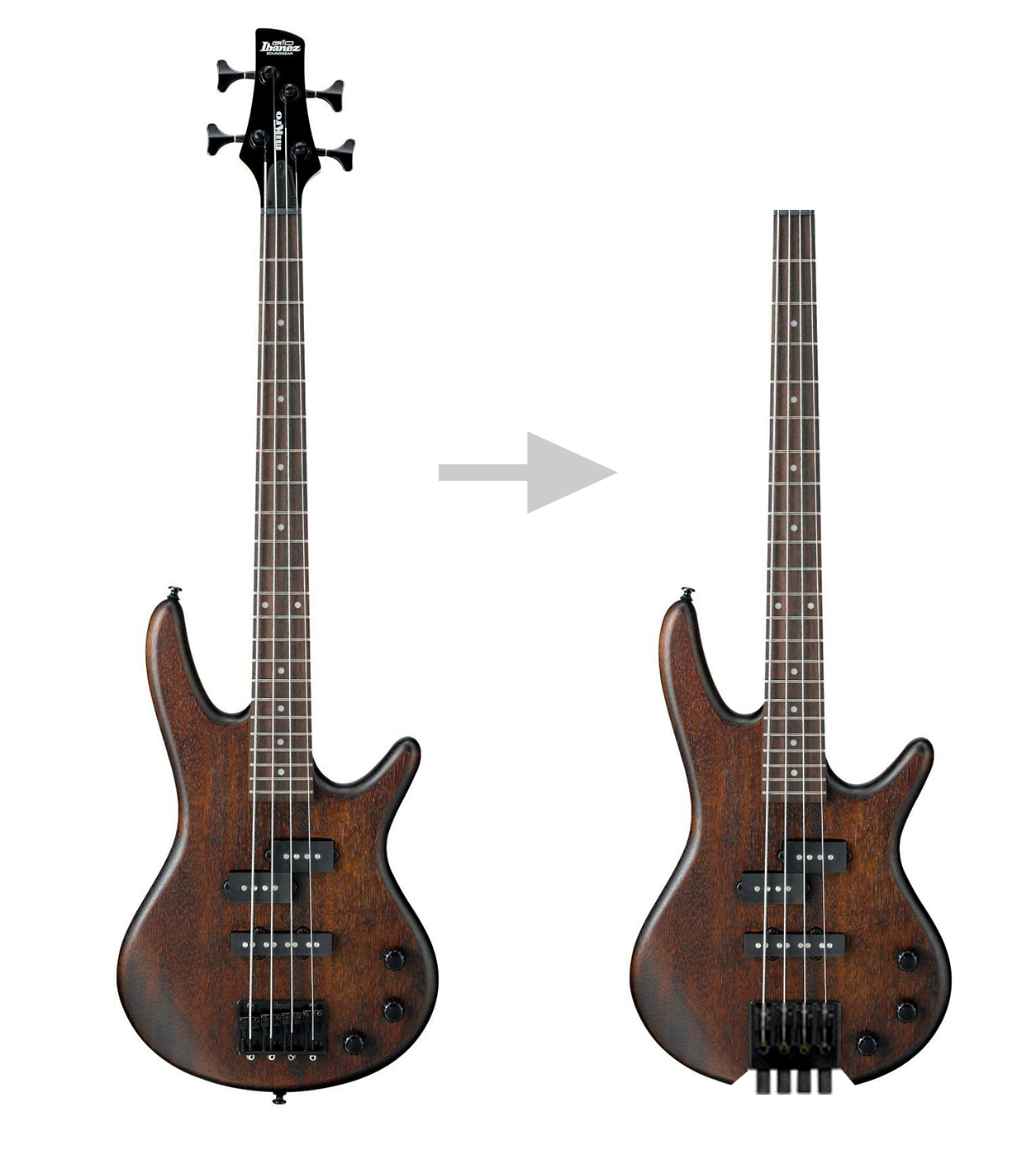

This is the right forum. I would do something like that on a bass I owned first before charging someone, but maybe there's someone on here who can help out. Obviously there's a good chance of messing up on a job like that the first time you do it. You'd have to do a complete refinish besides the hardware changes and chopping off the headstock. Hopefully someone here will respond, I'd love to see that completed.

I really like this idea. I have never done anything like this, but it doesn't seem too complicated. The two main things would be buying and installing the Steinberg bridge and nut for the double ball end strings. I would be curious to know if they make the double ball strings short enough for this project. That is going to be a seriously short scale.
You don't need to use double ball strings. The stubby in my avatar has a 17" scale. I used normal strings. The bridge basically wraps the string around a cylinder that spins to tune it. It holds tune really well, it doesn't slip at all. I used a China direct bridge (not a "Overlord" one, this one has no markings on it), it was around $90 from ebay. Hipshot also makes one: 4 String Bass Headless System > Store > Hipshot Products.
Thanks for the info. I've been wanting to build a headless. Does a genuine Steinberger system work the same way as the Hipshot?You don't need to use double ball strings. The stubby in my avatar has a 17" scale. I used normal strings. The bridge basically wraps the string around a cylinder that spins to tune it. It holds tune really well, it doesn't slip at all. I used a China direct bridge (not a "Overlord" one, this one has no markings on it), it was around $90 from ebay. Hipshot also makes one: 4 String Bass Headless System > Store > Hipshot Products.
The Steinberger system using double ball strings is really simple, a pawl at the bridge end has the tuner screw passing through it. The pawl has a cutout that accepts one ball end. Turning the tuner knob applies direct straight-line pull on the string with no twisting force at all on the string, which is why they stay in tune so well, its like the straight pull on a bow. Any of the cheaper variants that wind around a post of any kind will twist the string to some extent, which is what traditional tuners do. There are some licensed copies and chinese knockoffs out there, cant speak to the quality of the parts. The pawl is the part that breaks, though mine havent in 31 years. There are some locking nut hardware sets that make it possible to use single ball strings, but the double ball system works best IMO. People often say double ball are hard to find, which is hogwash if you use anything like standard guages. I use super light .030 to .090 sets, never had trouble getting them on line. Cool project, good luck with it.

I seriously considered this really identic plan. The only problem, regardless of the bridge/tuner unit you'll choose, will be build a headpiece with not only the locking sistema for the strings but also the propre access to the trussrod nut.
It's not that obvious and the only way to take proper measure is to have the instrument in hands.
A pro luthier will very probably be able to do this for you but the price tag would easily raise to 3, 4 times the street price of an Ibby Mikro
It's not that obvious and the only way to take proper measure is to have the instrument in hands.
A pro luthier will very probably be able to do this for you but the price tag would easily raise to 3, 4 times the street price of an Ibby Mikro
I made a new body for my Steinberger XP-2 to replace the original mimimalist "flying vee" body shape. Everything else is original parts. The composite neck has no trussrod, the relief is cast into it. In the case of an altered Mikro neck, you have to retain enough of the headstock to house the trussrod nut. If you have a zero fret, the strings could extend beyond it to anchor in the headstock. That way you might be able to use medium scale double balls. Some people have done similar builds where the "headstock" is just a decorative object used for string anchorage, usually as a string-through design. Try searching the Headless Club for some inspiration.
Hybrid Steinberger
Hybrid Steinberger
Regarding the photochop in the first post - the divot in the butt end of the body will need to be at least an inch deeper to work with a headless bridge. In addition, the headstock would have to have about an inch of meat beyond the end of the nut in order to help manage the trussrod nut. Otherwise, as mentioned, you'd have to custom build a headpiece that could accommodate the location of the TR nut and provide access. I can't find it now, but there is a thread here where a guy did this very conversion with a jazz bass, and he also fabbed up a custom headpiece out of billet aluminum...
Well done. That is beautiful.I made a new body for my Steinberger XP-2 to replace the original mimimalist "flying vee" body shape. Everything else is original parts. The composite neck has no trussrod, the relief is cast into it. In the case of an altered Mikro neck, you have to retain enough of the headstock to house the trussrod nut. If you have a zero fret, the strings could extend beyond it to anchor in the headstock. That way you might be able to use medium scale double balls. Some people have done similar builds where the "headstock" is just a decorative object used for string anchorage, usually as a string-through design. Try searching the Headless Club for some inspiration.
Hybrid Steinberger
Thank you. Excellent observations. I also wonder how well the hipshot end-cap/nut thingee will fit the chopped neck end. And if some sort of filler will need to be used. That's probably why that guy you're referring to fashioned his own plate. Starting to think this is definitely a job for a pro.Regarding the photochop in the first post - the divot in the butt end of the body will need to be at least an inch deeper to work with a headless bridge. In addition, the headstock would have to have about an inch of meat beyond the end of the nut in order to help manage the trussrod nut. Otherwise, as mentioned, you'd have to custom build a headpiece that could accommodate the location of the TR nut and provide access. I can't find it now, but there is a thread here where a guy did this very conversion with a jazz bass, and he also fabbed up a custom headpiece out of billet aluminum...
As an eBay Associate, TalkBass may earn a commission from qualifying purchases.

Without looking up any specs, I'm wondering if string spacing might be an issue on the Mikro. If so you might need to shift to an individual bridge/tuner system (such as Invalid Link Removed rather than a complete unit.
Thanks for the tip. Great idea. Didn't know these existed.Without looking up any specs, I'm wondering if string spacing might be an issue on the Mikro. If so you might need to shift to an individual bridge/tuner system (such as Invalid Link Removed rather than a complete unit.
What a great idea. My reason for wanting to do this is not so much to create a headless, but to have tuners at the bridge, so they're easier to reach. Seems like approaching it this way would be the easiest/safest way to accomplish that.Some people have done similar builds where the "headstock" is just a decorative object used for string anchorage, usually as a string-through design.
Hybrid Steinberger
Check out the "headstock" on this one, still pretty minimal, but only by choice. The challenge is to come up with some kind of string retainer in the headstock. Somebody did this recently in Luthiers Corner, I'll see if I can find it.
Invalid Link Removed
Invalid Link Removed
that is a thing of beautyCheck out the "headstock" on this one, still pretty minimal, but only by choice. The challenge is to come up with some kind of string retainer in the headstock. Somebody did this recently in Luthiers Corner, I'll see if I can find it.
Invalid Link Removed

I have been wanting to do a headless for little while. Now the string spacing on the Ibanez is 19mm and Hipshot makes 4 headless bass bridge in a 19mm. they also include the headpiece when you get the bridge. This is about the lowest cost option I have found over ebay china made stuff. However its all about your budget.
Invalid Link Removed
Invalid Link Removed


