• TalkBass has been independent since 1998. Add your voice.
    Create a free account to reply to discussions, view embedded media, and browse with fewer display ads.
    Join freeLog in
    Want zero display ads or expanded classifieds tools? Compare plans.

fretboard radius (fretboard arch height) compensation

Dear TB Mates
I am building my first PB neck.
Need your expertise on the fretboard radius (fretboard arch height) compensation.
Say the 1st fret arch height is ~0,9mm the 20th fret arch height is ~2.1mm and the total fretboard thickness on the 1st fret is 4,9mm and 6,1, with the height difference ~1,2mm.
What is the right (common) practice in the height compensation?
- To keep the bottom of the fretboard and top of the neck board horizontal and to do height compensation on the bridge saddles. Honestly, I do not like this approach.
- To cut the fret board bottom 0 to 1,2mm from 1st to 20th and keep neck board top surface horizontal. I do not like this way, as the fretboard would not look solid from the side view due to the side height difference.
- To cut the neck board 0 to 1,2mm from 1st to 20th to keep the fret board look consistent from the side, and the neck board height difference would not be much noticeable due to its tall height, bottom side cut and neck foot attached to the body.
What would be your opinion and advice?
Thank you.
 
Dear TB Mates
I am building my first PB neck.
Need your expertise on the fretboard radius (fretboard arch height) compensation.
Say the 1st fret arch height is ~0,9mm the 20th fret arch height is ~2.1mm and the total fretboard thickness on the 1st fret is 4,9mm and 6,1, with the height difference ~1,2mm.
What is the right (common) practice in the height compensation?
- To keep the bottom of the fretboard and top of the neck board horizontal and to do height compensation on the bridge saddles. Honestly, I do not like this approach.
- To cut the fret board bottom 0 to 1,2mm from 1st to 20th and keep neck board top surface horizontal. I do not like this way, as the fretboard would not look solid from the side view due to the side height difference.
- To cut the neck board 0 to 1,2mm from 1st to 20th to keep the fret board look consistent from the side, and the neck board height difference would not be much noticeable due to its tall height, bottom side cut and neck foot attached to the body.
What would be your opinion and advice?
Thank you.

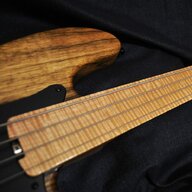
What you are describing, we normally call the Thickness Taper of the fingerboard. When we cut the top surface to a radius, the normal practice is to also cut a small taper in the thickness of the fingerboard. Most fingerboards, I cut to 0.250" (6.35 mm) at the heel, tapering to 0.220" (5.56 mm) at the nut. The reason is as you describe. Because the fingerboard tapers in width, when you cut a radius on the top surface without tapering the thickness, the edges of the fingerboard will taper, getting thinner toward the heel. That doesn't look as nice. So, we taper the thickness of the fingerboard a little bit to correct for that.

You've got the right idea. The amount of taper that you need to make the correction will depend on what radius you are cutting. But it will probably be around 1mm.
 
Bruce, thank you for reply.
Yes, you got my concern.
But the second part of the question was, what is the "right" way to compensate taper?
I feel like neck board need to be cut with taper from nut to heel to about 1mm, as you mentioned.
Am i right in my conclusion?
 
Bruce, thank you for reply.
Yes, you got my concern.
But the second part of the question was, what is the "right" way to compensate taper?
I feel like neck board need to be cut with taper from nut to heel to about 1mm, as you mentioned.
Am i right in my conclusion?

Do you mean how to cut the taper in the thickness of the fingerboard? It depends on how you are shaping the radiused surface. I cut the radius on my fingerboards using a router in a special fixture. So, I tilt the neck/fingerboard in the fixture, raising the nut end 0.020"-0.030" higher than the heel end.

If you are shaping the radiused surface with sandpaper on a radius block, then you have to sand more at the nut end, to make it thinner. Keep watching the thickness with calipers and the surface with a straightedge. Bring it to the amount of taper that you want to make the edges look good.
 
IMO the "right" way to do this is to make the board compound radius ruled surface. A CNC can do that, but by hand will be tricky.

? A compound radius fingerboard has the same problem. If you want the edges of the fingerboard to look straight and parallel, you have to add a little bit of taper to the thickness of the fingerboard. A compound radius may reduce the amount of taper you need, but it usually won't eliminate it. Tapering the thickness of the fingerboard is less work than cutting it to a compound radius.
 
Bruce, thank you for reply.
Yes, you got my concern.
But the second part of the question was, what is the "right" way to compensate taper?
I feel like neck board need to be cut with taper from nut to heel to about 1mm, as you mentioned.
Am i right in my conclusion?

If you want to cut a tapper so the sides of the fingerboard look consistent form the nut to the heel, you have to cut it into the fretboard, not the neck board.

In the few instruments I built, I never did that though; I like my fretboard edges rolled quite a bit, I guess that makes the edge getting thinner a lot less noticeable and it never bothered me.
 
Do you mean how to cut the taper in the thickness of the fingerboard? It depends on how you are shaping the radiused surface. I cut the radius on my fingerboards using a router in a special fixture. So, I tilt the neck/fingerboard in the fixture, raising the nut end 0.020"-0.030" higher than the heel end.

If you are shaping the radiused surface with sandpaper on a radius block, then you have to sand more at the nut end, to make it thinner. Keep watching the thickness with calipers and the surface with a straightedge. Bring it to the amount of taper that you want to make the edges look good.

Bruce, appreciate your intention to explaine this case.
To cut the fingerboard is not the issue with CNC
But when glue taped fingerboard board to the neck board the heel side become higher +0,030" and becone "non-horizontal".
My question was, should i do taper compentation on the neck board, say, keep nut side on the maple neckboard as 0.00" and down to - 0.030" at the heel side.
This way I keep fingerboard look nice, will not lift saddles up on the bridge, and this - 0.030" wont ne noticed on the neck board.
Sorry for my bad English.
 
  • Like
Reactions: Beej
Bruce, appreciate your intention to explaine this case.
To cut the fingerboard is not the issue with CNC
But when glue taped fingerboard board to the neck board the heel side become higher +0,030" and becone "non-horizontal".
My question was, should i do taper compentation on the neck board, say, keep nut side on the maple neckboard as 0.00" and down to - 0.030" at the heel side.
This way I keep fingerboard look nice, will not lift saddles up on the bridge, and this - 0.030" wont ne noticed on the neck board.
Sorry for my bad English.

Okay, I think I understand your question. You are asking if, after you have put some taper in the fingerboard (thinner at the nut), should you cut a reverse to that taper into the neck? That is, cut the heel of the neck 0.030" lower. So the center of the fingerboard surface remains flat to the body. Is that what you are asking?

You can if you want to. I normally don't. Most of the instruments that I repair and build are Flat geometry. That is, the surface of the neck (the glue line) is flat and parallel to the top surface of the body. And I cut the fingerboard surface with 0.020"-0.030" (0.6mm) of taper. That will raise the strings maybe 0.015" (0.38mm) at the bridge. That's okay.
 
  • Like
Reactions: kosscher and Beej
? A compound radius fingerboard has the same problem. If you want the edges of the fingerboard to look straight and parallel, you have to add a little bit of taper to the thickness of the fingerboard. A compound radius may reduce the amount of taper you need, but it usually won't eliminate it. Tapering the thickness of the fingerboard is less work than cutting it to a compound radius.

The script I wrote will automatically tell you what the "end" radius should be given a "start" (nut) radius such that the height difference between the center and the edges of the board is identical down its entire length. If you choose those radii the board is the ideal shape so no tapering is required.

I do agree that it is less work by hand to taper than to compound radius, but it effectively angles back the fretboard resulting in higher bridge saddles along the centerline.
 
  • Like
Reactions: kosscher