• TalkBass has been independent since 1998. Add your voice.
    Create a free account to reply to discussions, view embedded media, and browse with fewer display ads.
    Join freeLog in
    Want zero display ads or expanded classifieds tools? Compare plans.

Fretless Fingerboard UNFINISHED

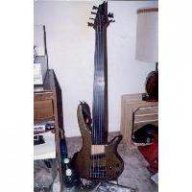
While doing some clean-up on my 20 year old Ken Bebensee 6 String Fretless:
I was buffing the fingerboard - and decided to go from 1500 grit to 3000 - then to 8000 grit
and my ebony looked like glass - - - Beautiful - - - BUT: The sound had changed to a more snappy and bright attack - good sustain - but less of a "blossom" or swell in the mwah department -It's like you hear more strings and less wood? It was also more sticky (glossy) to my fingers - - - So I lightly buffed it back to 1500 grit Rubbed in some oil - and once again; THIS BABY GROWLS - - - The "finish" is still silky smooth (more of a satin feel) - - - But I wonder if maybe the string and the wood are "communicating" better than with the super glassy finish (like many phenolic fingerboards) - - -

Any "Scientists" or Luthiers here that can explain this?

Here's the beast:
22154426_1515541505147970_3808614893218665889_n.jpg
 
Last edited:
Similar to why roundwounds on a fretless give more growl than flats. Because of the raised part of the windings, your point of contact is not defined in one precise point, but multiple points that are close enough to give just a hint of vibration. With a less precise finish on the board, the point of contact is not as precise, and you get more vibrations from all the micro contact points at the board.

Maybe think of a machine where the floor is off just a bit (like the imperfect finish on the fingerboard). When the machine runs and vibrates (like strings being played), instead of being perfectly and evenly supported, the legs chatter against the floor and it can be pretty audible (the fretless growl).

I don't remember exactly what grit I used on mine, but it was no finer than 400.
 
  • Like
Reactions: All Time Low
That probably works better for how you play. I keep my action low so I get lots of growl/mwah when I want it but I also don't when I don't want it. I only use rounds.

The glossy board sharpened the focus, the less glossy dialed that back.

Your string height can be a factor in how difficult if is to get growl/ mwah.
 
  • Like
Reactions: All Time Low
here is my science guess. The principle of "Slip and stick" may be at work here. Not unlike when you try to make a sound on the lip of a glass when it is dry there is nothing making it vibrate until you lubricate your finger and then rub it on the lip of the glass is vibrates and makes a tone. I believe this is also how a bow with rosin operates as well. I find that that oiling the fingerboard on my fretless or simply just changing the strings always changes the tone.
 
  • Like
Reactions: All Time Low
here is my science guess. The principle of "Slip and stick" may be at work here. Not unlike when you try to make a sound on the lip of a glass when it is dry there is nothing making it vibrate until you lubricate your finger and then rub it on the lip of the glass is vibrates and makes a tone. I believe this is also how a bow with rosin operates as well. I find that that oiling the fingerboard on my fretless or simply just changing the strings always changes the tone.

But when the fingerboard was glossy - I heard more of the strings/pickups/hardware - - - Now that it's satin: I can hear the wood - - - Does that make sense? Same new strings - But totally woody tone
 
  • Like
Reactions: farshore

Latest posts