
quick question on this, my bass has the dots on the side of the neck as well as the lines...when setting up the intotnation, should I be going by the lines or these dots? I set it up via the lines. jw though

TalkBass has been independent since 1998. Add your voice.
Create a free account to reply to discussions, view embedded media, and browse with fewer display ads.
Join free Log in
Want zero display ads or expanded classifieds tools? Compare plans.
If you're setting intonation by the 12th fret position you shouldn't need dots or lines. Just "fret" the position where you'd play the octave harmonic.quick question on this, my bass has the dots on the side of the neck as well as the lines...when setting up the intotnation, should I be going by the lines or these dots? I set it up via the lines. jw though
In terms of testing the intonation elsewhere on the fingerboard the intonation varies so much by finger position (tip vs flesh) lines don't make much of a difference.
I still love them though, they make me fee safe.

On my line less fretless, I intonated it where lines (or frets) would have been
View attachment 947985
are you saying the side dots are off from the lines?my bass has the dots on the side of the neck as well as the lines...when setting up the intotnation, should I be going by the lines or these dots?
are you saying the side dots are off from the lines?
usually, on proper fretless necks they move the dots so they correspond directly with the lines, or where the lines would be for unlined.
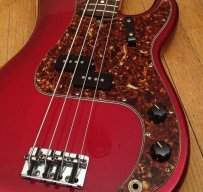
so they just put the dots where they were for the fretted neck? disappointing.Here's how they look
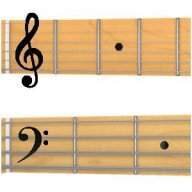

so they just put the dots where they were for the fretted neck? disappointing.
that makes the dots worse than useless, but actually misleading; better to have just left them off entirely.
As already mentioned, the lines should be used when setting intonation. The line position is based on the scale length, just as the fret position is based on the scale length on a fretted bass.
Unlike a fretted bass, which is somewhat forgiving of finger tip position in relation to the fret, the fretless is very sensitive to finger tip position. Since your fretless bass does have lines and adjustable saddles, it would be an advantage to set it up so that the intonation is correct for the same finger tip position in relation to all the fret lines.
For example, if your finger wants to be just behind the fret line at the lower frets for a correct pitch, then you want your finger to also be just behind the fret line at the higher frets. Or if your finger wants to be right on the fret line at the lower frets for a correct pitch, then you want your finger to also be right on the fret line at the higher frets.
It is a characteristic of saddle adjusted intonation that the adjustment has the least effect on the lower frets, and the most effect on the higher frets. This means that wherever you have to place your finger in relation to the first few frets for correct pitch, that placement will change very little with any intonation adjustment. Therefore, you want to adjust your intonation using the same relative finger placement at the 12th fret as you have at the lowest frets.
I would first preset the saddles according to the Fender setup guide. It results in the very characteristic pattern seen in the photo you supplied just above.
Then determine where you have to place your finger tips in relation to the lower frets for correct pitch. This will be your "standard" for all fret line fingering.
Then just use the same finger placement at the 12th fret line to make final intonation adjustments.
-
They (manufacturers) also have a bad habit of using the stock fretted bass molded nuts, which are much to high on a fretless.
-
so they just put the dots where they were for the fretted neck? disappointing.
that makes the dots worse than useless, but actually misleading; better to have just left them off entirely.
no, it's the factory using the same machine to drill the dots for both fretted and fretless necks. resetting the machines would cost an extra $5 per neck or whatever, so it doesn't happen.Should i be concerned about the dots not lining up with the fretlines? Is it perhaps a mistake
no, it's the factory using the same machine to drill the dots for both fretted and fretless necks. resetting the machines would cost an extra $5 per neck or whatever, so it doesn't happen.
either way ignore them; if you're gonna look, look at the fret lines.
that won't work at all!is it unheard of to set the intonation so that it's centered at the middle of the fret instead of directly on the line? just curious
that won't work at all!
remember, the nut is kind of a "fret" too. for the open tuning to be right and the intonation to be right, it is supposed to line up with the fret lines.
(think about it, when you play fretted, you might press in the middle but the string hits the frets, so it again stops right at the fret lines.)
if you set the intonation so that say the 12th was in the middle between two lines, then all the other notes would be varying degrees of off from the lines, nothing would line up visually with anything.


