
Not the... BPEA!Totally cheating.
I'm reporting you to the Bass Player's Ethics Association immediately

TalkBass has been independent since 1998. Add your voice.
Create a free account to reply to discussions, view embedded media, and browse with fewer display ads.
Join free Log in
Want zero display ads or expanded classifieds tools? Compare plans.
Not the... BPEA!Totally cheating.
I'm reporting you to the Bass Player's Ethics Association immediately
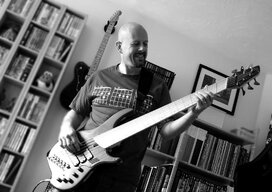
Haven't had a great deal of luck with active/passive options and tone management. I can slightly take the edge off but the harmonics are still really blatant.If the bass has an active/passive switch is there a big difference in volume between the two? If so, does it ring out as much in passive mode? If the bass has an internal trim pot, lower that and see if the results are the same. Aside from that, the bass may produce more harmonics which will require an improved muting technique. You can try an LPF or turn down your tone knob and see if that helps.


Is it cheating? Let’s say you’re out at a party and someone has a bass and they say, hey, Tommy plays bass. (Not sure what your name is, so substitute as needed.) They hand you a bass and your response is, nah, I don’t have my fret wrap. Yes, it’s cheating, but sometimes cheating is perfectly fine. But if you’re reliant on a thingy, then you’re just hurting yourself.
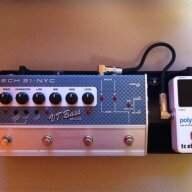



?? This isn't true in least in my experience. I have great palm muting technique, years of switching professionally between bass and guitar. On my Yamaha JP2 6 strings (35" 19mm) its not physically possible to mute sympathetic tones, all the time...even with accurate playing across 6 strings This includes left and right hand muting. If I am recording or playing higher dynamic lower volume music, a fret wrap is a bonafide solution and one of my JP2 will have one on it 100% of the time, even if it is usually above the nut.Unless one is tapping, it's a shortcut that cheats the user of learning proper technique.


Yes, I've just started working on that - currently in that weird limbo space between floating thumb and accidentally dropping back into moving anchor when I'm not concentrating enough. I suspect the right hand mute for the harmonics is going to be really hard, but that's what practice is for.As someone mentioned above, muting harmonics with your fretting hand can be very difficult. This is one area where the floating thumb technique can be really useful.
I wouldn’t be thinking about whether or not using a fret wrap is cheating, I’d be thinking about the experience you might be missing out on if you use a fret wrap as a substitute for working on technique. Spending time on your bass trying to solve problems may lead you to discover things that you otherwise might not.
As someone mentioned above, muting harmonics with your fretting hand can be very difficult. This is one area where the floating thumb technique can be really useful.
I have a 6 and it can be done. Perfect? No, but way good enough. Play the bass high. Use left hand obviously, then use pinky and ring like fingerstlyle guitarists do. And for the denuemont so to speak, use your right forearm as a third muter.?? This isn't true in least in my experience. I have great palm muting technique, years of switching professionally between bass and guitar. On my Yamaha JP2 6 strings (35" 19mm) its not physically possible to mute sympathetic tones, all the time...even with accurate playing across 6 strings This includes left and right hand muting. If I am recording or playing higher dynamic lower volume music, a fret wrap is a bonafide solution and one of my JP2 will have one on it 100% of the time, even if it is usually above the nut.
LOL, and chew gum while standing on one leg? If you can sustain that sequence of playing position for even one recording session (shoot even one song 'way good enough') you are a rare quality of player and I would love to see a demonstration.I have a 6 and it can be done. Perfect? No, but way good enough. Play the bass high. Use left hand obviously, then use pinky and ring like fingerstlyle guitarists do. And for the denuemont so to speak, use your right forearm as a third muter.




