
Enjoy the benefits of a premium membership!
Upgrade Account
-
TalkBass has been independent since 1998. Add your voice.
Create a free account to reply to discussions, view embedded media, and browse with fewer display ads.
Join free Log in
Want zero display ads or expanded classifieds tools? Compare plans.
You are using an out of date browser. It may not display this or other websites correctly.
You should upgrade or use an alternative browser.
You should upgrade or use an alternative browser.
Gallien Krueger 2001 rb
- Thread starter Vesko Vlchev
- Start date
More options
Who Replied?

I’m not familiar with these pieces of equipment, but I’m looking forward to the responses. Hope you get the info you need..Hi. I just bought GK 2001 rb and I have GK 410sbx. What is the best way to connect them? Bridge mode, dual mono ? With Bi amp speakon cabble ?Regards

Ref: https://www.zikinf.com/manuels/gallien-krueger-410sbx-plus-manuel-utilisateur-en-71597.pdf
The spec sheet for the 410SBX indicates it is an 8 ohm cab rated for 400W. It can be run full-range or biamped. The cab has a switch for biamp or full-range. To use biamp mode you need a 4-wire speakON with NL4 plugs.
Ref: https://static1.squarespace.com/sta...6939260/160-0290-B+2001RB+Complete+Manual.pdf
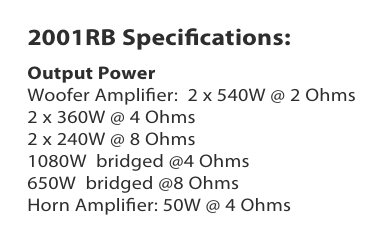
One side of the 2001RB is only 240W at 8 ohms. This is about 2.2dB down from the cab's 400W power rating. However due to power compression, the difference will be less.
You could bridge for 650w at 8 ohms, but you need to be mindful that the amp can produce significantly more power than the cab is rated for. It's relatively safe if the cab easily gets louder than you need. If the cab is not loud enough, the risk of damage is fairly high, unless you use appropriate restraint.
The sensitivity rating of the cab is 102dB 1W/1m
Calculated SPL
The spec sheet for the 410SBX indicates it is an 8 ohm cab rated for 400W. It can be run full-range or biamped. The cab has a switch for biamp or full-range. To use biamp mode you need a 4-wire speakON with NL4 plugs.
Ref: https://static1.squarespace.com/sta...6939260/160-0290-B+2001RB+Complete+Manual.pdf
One side of the 2001RB is only 240W at 8 ohms. This is about 2.2dB down from the cab's 400W power rating. However due to power compression, the difference will be less.
You could bridge for 650w at 8 ohms, but you need to be mindful that the amp can produce significantly more power than the cab is rated for. It's relatively safe if the cab easily gets louder than you need. If the cab is not loud enough, the risk of damage is fairly high, unless you use appropriate restraint.
The sensitivity rating of the cab is 102dB 1W/1m
Calculated SPL
- W/400W = ~128dB
- W240W = ~125.8dB
Thanks. So if I understand, it`s not recomendet to use Bridget with 1 cabbinet, just dual mono ? I have 4-wire speakON with NL4 plugs. RegardsRef: https://www.zikinf.com/manuels/gallien-krueger-410sbx-plus-manuel-utilisateur-en-71597.pdf
The spec sheet for the 410SBX indicates it is an 8 ohm cab rated for 400W. It can be run full-range or biamped. The cab has a switch for biamp or full-range. To use biamp mode you need a 4-wire speakON with NL4 plugs.
Ref: https://static1.squarespace.com/sta...6939260/160-0290-B+2001RB+Complete+Manual.pdf
View attachment 7297668
One side of the 2001RB is only 240W at 8 ohms. This is about 2.2dB down from the cab's 400W power rating. However due to power compression, the difference will be less.
You could bridge for 650w at 8 ohms, but you need to be mindful that the amp can produce significantly more power than the cab is rated for. It's relatively safe if the cab easily gets louder than you need. If the cab is not loud enough, the risk of damage is fairly high, unless you use appropriate restraint.
The sensitivity rating of the cab is 102dB 1W/1m
Calculated SPL
I would try it on one side of the amp. If it's loud enough, you're good to go. If it's not close, get a second cab. If it's almost loud enough, try bridge mode and use discretion. Make sure to follow the directions for bridge mode operation in the manual.
- W/400W = ~128dB
- W240W = ~125.8dB

- Feb 12, 2006
- 60,963
- 5
- 220,646
- Disclosures
- Development Engineer-Mesa Boogie, Development Engineer-Genzler (pedals), Product Support-Genz Benz
Too much power bridged with that cabinet, imo.

Forget about the bi-amping option; it's not worth the effort -- emphatically so, IMO. I'd run the amp in bridged mono, but as @Wasnex said, be mindful that it's a bit too much power for that 400-watt cab.
Last edited:
Forget about the bi-amping option; it's not worth the effort
It's not really much effort. You simply plug in the cab with a 4 wire speakON and make sure the switch on the back of the cab is set to biamp.
Biamp basically allows you to adjust the tweeter level from front of the amp rather than having to go around to the back of the cab. Having the control in front means you can hear how adjustments impact the sound as you make them.
The other potential advantage GK mentions: The Drive circuit is not in the signal path for the tweeter. So if you gain up the Drive circuit to get a bit of grind from the woofer, the tweeter will remain clean/undistorted. The prevents the tweeter from producing fizz.
The one extra hassle IMHO: This amp basically has four volume controls. 1. Input Volume, 2. Drive, 3. Woofer Master, 4. Tweeter Master. Normally one changes volume on stage by adjusting an amp's Master. Since there are two Masters, it can be a bit of a hassle to re-establish the desired balance between woofer and tweeter. This is rarely a problem for me because I don't push the Drive circuit over the edge. As long as my initial settings for the Master are high enough, I can change volume by adjusting the input Volume or Drive controls; rather than having to fiddle with the Masters.

Still not worth the effort, IMHO.
You are certainly entitled to your opinion on this matter. Then again, so is the OP. Perhaps the OP should try it and judge for himself
 .
.
I agree with you that not having the HF device in the 'Drive' circuitry is probably a good enough reason to use the biamp function... if one does that sort of thing.
ThamksIt's not really much effort. You simply plug in the cab with a 4 wire speakON and make sure the switch on the back of the cab is set to biamp.
Biamp basically allows you to adjust the tweeter level from front of the amp rather than having to go around to the back of the cab. Having the control in front means you can hear how adjustments impact the sound as you make them.
The other potential advantage GK mentions: The Drive circuit is not in the signal path for the tweeter. So if you gain up the Drive circuit to get a bit of grind from the woofer, the tweeter will remain clean/undistorted. The prevents the tweeter from producing fizz.
The one extra hassle IMHO: This amp basically has four volume controls. 1. Input Volume, 2. Drive, 3. Woofer Master, 4. Tweeter Master. Normally one changes volume on stage by adjusting an amp's Master. Since there are two Masters, it can be a bit of a hassle to re-establish the desired balance between woofer and tweeter. This is rarely a problem for me because I don't push the Drive circuit over the edge. As long as my initial settings for the Master are high enough, I can change volume by adjusting the input Volume or Drive controls; rather than having to fiddle with the Masters.
Latest posts
-
 Adding J pup to P bass, should I go 60’s or 70’s spacing?
- Latest: Gianni "Orlandez" Orlati
-
-

-
