- Jun 29, 2006
- 5,148
- 3,217
- Disclosures
- President, CEO, CFO, CIO, Chief Engineer, Technician, Janitor - Reiner Amplification
My preferences for overdrive and distortion tend to lean towards the classic end of the spectrum rather than the clanky, modern sounds - I always use the first Audioslave record as a reference. I have been through a lot of pedals, and finding ones that don't get fatiguing, can do lower gain always-on tones, and sound integrated with the tone rather than tacked on top of it is an ongoing challenge. I have to say the two new Genzler pedals that @agedhorse designed are game changers for me. They integrate so well like a great compressor where you forget that they are on until you turn them off.
I was doing a random search a few weeks back and stumbled across the Genzler 4OTF and CB4 pedals - when I saw the way the pedals were designed with pre-distortion high pass and post-distortion low pass, plus dual volumes to mix clean and dirty, my initial thought was that the design was brilliant, why didn't someone do it sooner? I've designed a lot of tube circuits and a few SS and have a pretty good understanding of how the manipulation of these parameters shape the overdrive and distortion characteristics, and the ability to manipulate them without a soldering iron sucked me right in. I ordered a 4OTF and it worked exactly the way I imagined it would, and I ended up ordering the CB4 a couple of days later.
I really like the distortion circuits in both pedals, but IMO the genius is the circuitry surrounding it. I would love to see them make a pedal having this architecture but no gain, and instead with a loop so you could use other pedals to apply the filtering and clean/dirty mix; I think it would make a lot of other dirt pedals way more useable for bass. And I am sure myself and five other people would buy it.. . It would also be a cool addition to the Re/Q pedal as well. Anyway, the amount of low end entering a circuit has a big effect on how and when the circuit clips, so there is a nice range of character that can be manipulated with the high pass control along with the level of gain. I find that too much low end can make things sound splatty, and like to run the high pass at higher settings the higher I set the gain; and even on cleaner settings I don't go lower that the first harmonic - you can and it will give you some cool, compressed, vintage sounds, but that isn't what I am going for. The clean volume makes it very easy to dial low end back in. Having the low pass at the end of the circuit is essential for taming any fizz, especially if you are running direct or into a full range cab. I can get some really cool Audioslave Gasoline tones with it all the way down to 1KHz on the CB4 because you can restore top end on the clean side to balance the tone.
The high and low pass filters and the clean and dirty volumes are extremely well integrated in terms of range and levels, and no matter where I set things, there are never any strange phase issues - everything just works. A big thing that jumped out at me is how quiet these are. The low noise floor led me to try cascading them which is something I typically don't do, and they do that extremely well - with still very low noise. Also very good dynamic range to both of the distortion circuits- not overly compressed (unless you want it to be, even when stacking) so you can get more or less dirt based on how hard you play. I am finding great uses setting either as an always-on depending on what I am going for, and then kicking the other one in for heavier stuff.
Another option I like is the ability to run from 9-18 volts - there are a lot of subtleties to explore at different voltages, and when cascading them each running at different voltages. I got some cool results running the 4OTF at 12V feeding the CB4 running at 18V. Running at low voltages give a bit more warmth, midrange, and dirt while higher voltages are a bit cleaner with more attack and aggression at the top end. I look at these boxes as individual gain stages where the designer has allowed me manipulate all the parameters without a soldering iron (or scrolling through menus, or having to hook up to a computer). Shaping the low and high pass, clean/dirty mix, clipping type with the four drive selects, and voltage levels are the majority of key parameters one will tweak when designing something. All that said, I find them very intuitive to dial in based on how well the circuitry surrounding the dirt circuits is designed and integrated.
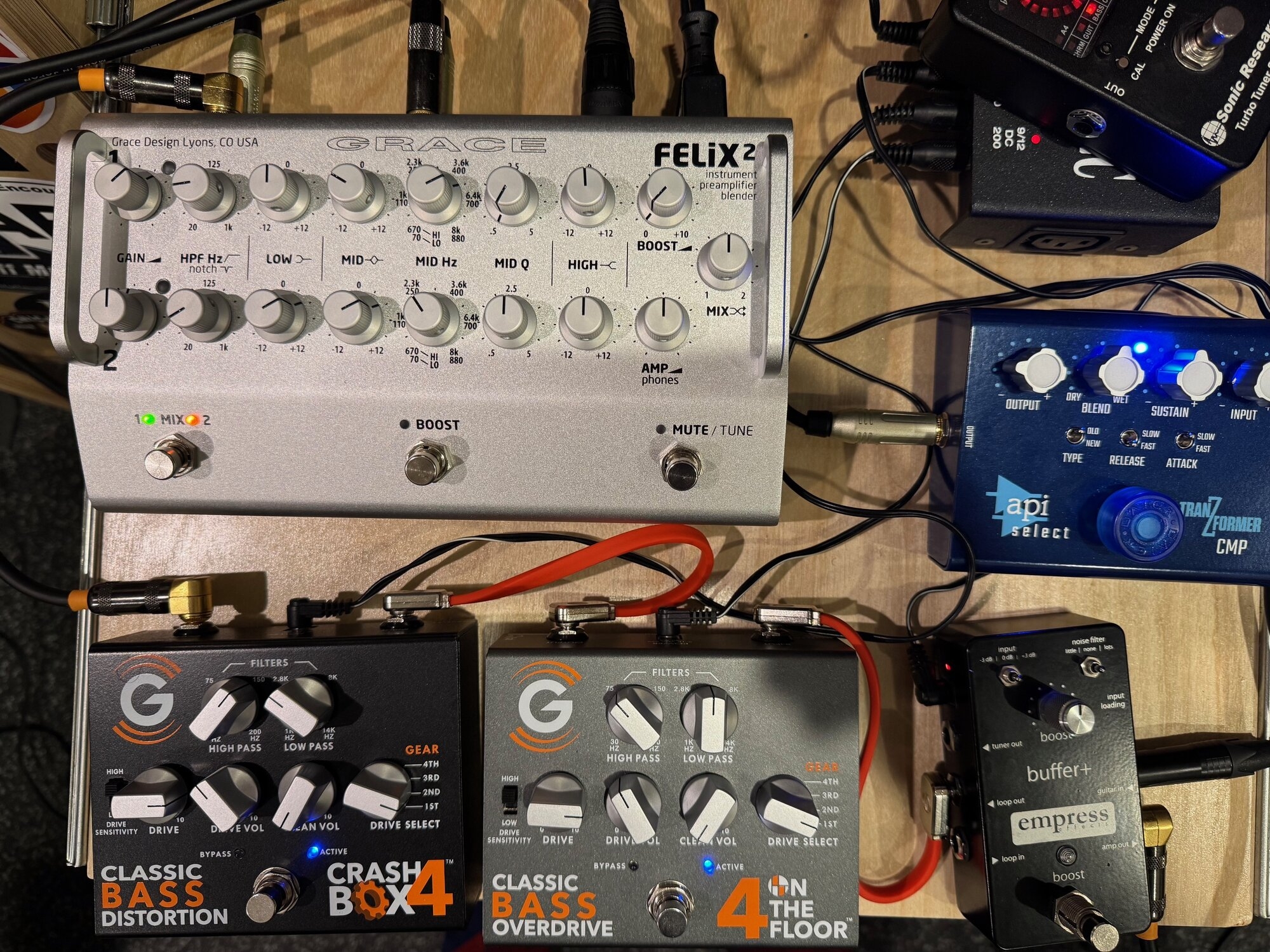
Below is a clip of how I have been using the pedals so far - this is recorded direct. You can see settings in the pictures below. It also translates very well to speaker cabs which filter off more of the top top end, while also adding additional dirt from driver breakup modes. I tend to run things a little dirtier direct than into my NV412 or Bag End S15Ds which add a fair bit of their own color.
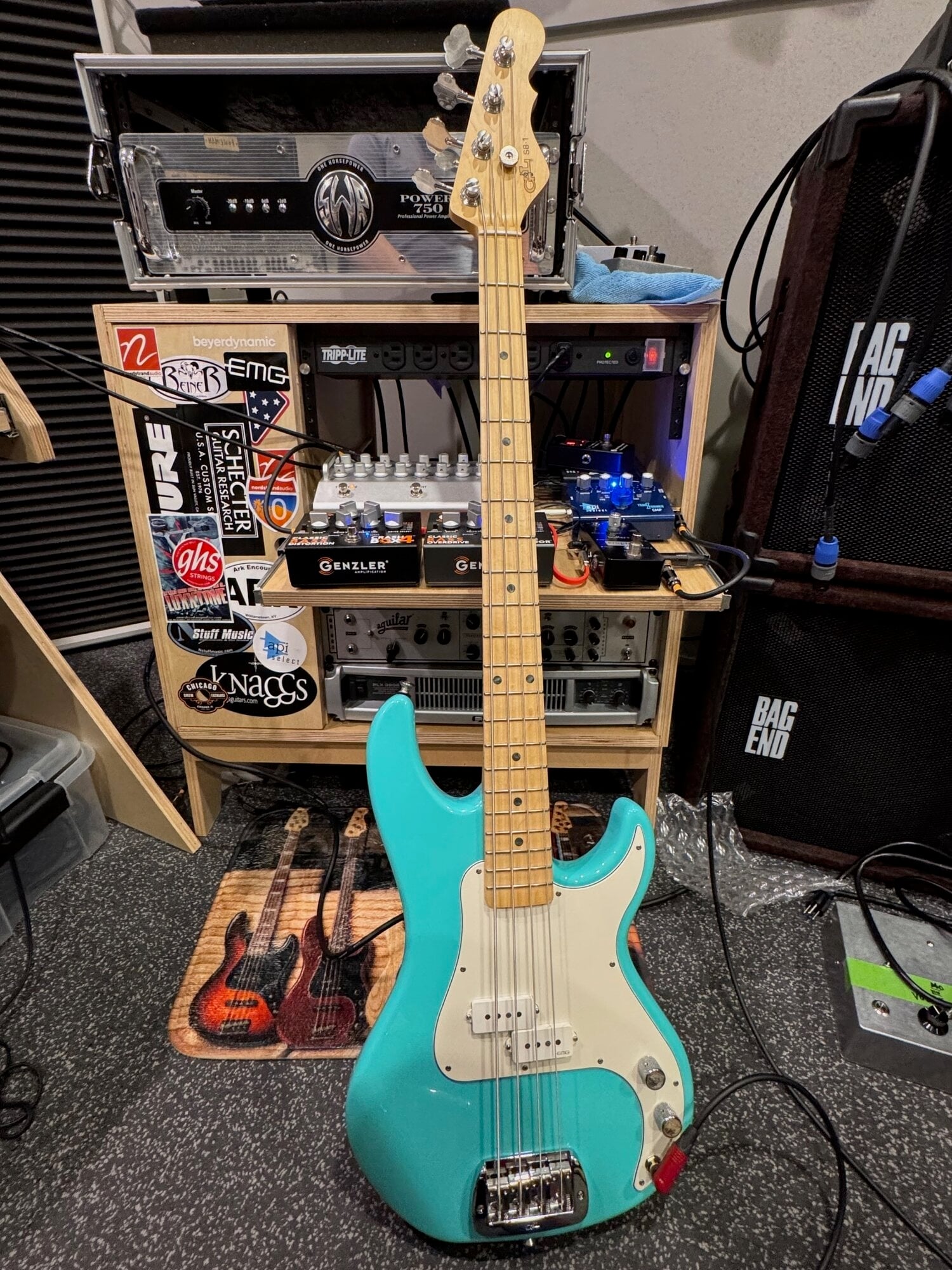
I am running them stacked into one side of a Grace Felix which lets me mix clean and dirty channels - this isn't necessary as the clean/drive blend on the pedals work very well, but it allows me to tweak the EQ on each channel separately and also put a compressor on the front end of the clean channel. I have a bit of 500Hz notched out on the dirty channel but it's flat otherwise. G&L USA SB-1 with an EMG Geezer and GHS Bassics. The 4OTF is set for a wider bandwidth and is always on, and it feeds the CB4 which is set with more gain but in a narrower band, so you have a more dense, chewy center that shades to lighter drive and then back to clean lows and highs. Mix is 50/50 clean/dirty on the Grace.
I was doing a random search a few weeks back and stumbled across the Genzler 4OTF and CB4 pedals - when I saw the way the pedals were designed with pre-distortion high pass and post-distortion low pass, plus dual volumes to mix clean and dirty, my initial thought was that the design was brilliant, why didn't someone do it sooner? I've designed a lot of tube circuits and a few SS and have a pretty good understanding of how the manipulation of these parameters shape the overdrive and distortion characteristics, and the ability to manipulate them without a soldering iron sucked me right in. I ordered a 4OTF and it worked exactly the way I imagined it would, and I ended up ordering the CB4 a couple of days later.
I really like the distortion circuits in both pedals, but IMO the genius is the circuitry surrounding it. I would love to see them make a pedal having this architecture but no gain, and instead with a loop so you could use other pedals to apply the filtering and clean/dirty mix; I think it would make a lot of other dirt pedals way more useable for bass. And I am sure myself and five other people would buy it..
. It would also be a cool addition to the Re/Q pedal as well. Anyway, the amount of low end entering a circuit has a big effect on how and when the circuit clips, so there is a nice range of character that can be manipulated with the high pass control along with the level of gain. I find that too much low end can make things sound splatty, and like to run the high pass at higher settings the higher I set the gain; and even on cleaner settings I don't go lower that the first harmonic - you can and it will give you some cool, compressed, vintage sounds, but that isn't what I am going for. The clean volume makes it very easy to dial low end back in. Having the low pass at the end of the circuit is essential for taming any fizz, especially if you are running direct or into a full range cab. I can get some really cool Audioslave Gasoline tones with it all the way down to 1KHz on the CB4 because you can restore top end on the clean side to balance the tone.The high and low pass filters and the clean and dirty volumes are extremely well integrated in terms of range and levels, and no matter where I set things, there are never any strange phase issues - everything just works. A big thing that jumped out at me is how quiet these are. The low noise floor led me to try cascading them which is something I typically don't do, and they do that extremely well - with still very low noise. Also very good dynamic range to both of the distortion circuits- not overly compressed (unless you want it to be, even when stacking) so you can get more or less dirt based on how hard you play. I am finding great uses setting either as an always-on depending on what I am going for, and then kicking the other one in for heavier stuff.
Another option I like is the ability to run from 9-18 volts - there are a lot of subtleties to explore at different voltages, and when cascading them each running at different voltages. I got some cool results running the 4OTF at 12V feeding the CB4 running at 18V. Running at low voltages give a bit more warmth, midrange, and dirt while higher voltages are a bit cleaner with more attack and aggression at the top end. I look at these boxes as individual gain stages where the designer has allowed me manipulate all the parameters without a soldering iron (or scrolling through menus, or having to hook up to a computer). Shaping the low and high pass, clean/dirty mix, clipping type with the four drive selects, and voltage levels are the majority of key parameters one will tweak when designing something. All that said, I find them very intuitive to dial in based on how well the circuitry surrounding the dirt circuits is designed and integrated.
Below is a clip of how I have been using the pedals so far - this is recorded direct. You can see settings in the pictures below. It also translates very well to speaker cabs which filter off more of the top top end, while also adding additional dirt from driver breakup modes. I tend to run things a little dirtier direct than into my NV412 or Bag End S15Ds which add a fair bit of their own color.
I am running them stacked into one side of a Grace Felix which lets me mix clean and dirty channels - this isn't necessary as the clean/drive blend on the pedals work very well, but it allows me to tweak the EQ on each channel separately and also put a compressor on the front end of the clean channel. I have a bit of 500Hz notched out on the dirty channel but it's flat otherwise. G&L USA SB-1 with an EMG Geezer and GHS Bassics. The 4OTF is set for a wider bandwidth and is always on, and it feeds the CB4 which is set with more gain but in a narrower band, so you have a more dense, chewy center that shades to lighter drive and then back to clean lows and highs. Mix is 50/50 clean/dirty on the Grace.
Last edited: