• TalkBass has been independent since 1998. Add your voice.
    Create a free account to reply to discussions, view embedded media, and browse with fewer display ads.
    Join freeLog in
    Want zero display ads or expanded classifieds tools? Compare plans.

Getting a Fat, deep, live bass tone

I'm wondering how to get a fat, deep, clean bass tone for a practice setup for $150 or less?

I'm about to start playing Bass Guitar for a worship band (praise band? They tend to sound like Bethel Music or similar). For the bass guitar pedals they have a Sansamp DI pedal, a volume pedal, and a tuner.

To prepare for the band I have a Squier Bass (I got it from my brother, it's nothing fancy but works), with flatwound strings. The Bass->pedal->soundboard sequence is:
Bass Guitar->Tuner Pedal->Compression Pedal->Looping Pedal->Soundboard->headphones and/or small practice amp.

I'm aiming to mimic the sound that'll be at the church so I can practice with similar settings to help in practice. Typically the resulting sound from other bassists is a fat, deep, clean sound. I'm guessing* that sound comes from the sansamp DI mostly but occasionally other bass players hookup their own pedals (I'm not sure if it's in addition to the Sansamp or in replacement or something).

I live in an apartment so being able to output to an amp or headphones depending on the time of day and if I think it'll bug neighbors is a big plus.

I'll be chatting with the other bass guitar players in the rotation but was wondering what would be suggested here?
 

Attachments

  • Bass Pedal Sketch.jpg
    Bass Pedal Sketch.jpg
    617.3 KB · Views: 91
The first couple videos of Bethel Music music I pulled up the bass player was standing at a keyboard playing synth bass lines.
A couple of their other songs I know and watched the bass guitar was solid with some mid range, not just deep rumble.

Do they have a worthy sound system and sound operator?
Keep in mind what worked for the music recordings may not exactly translate
well into a live mix.
Maybe to recreate the deep synth parts some are using an octave pedal.
 
Excellent point! I didn't realize the bass was mostly synth (having only heard the audio only and I've never watched the video of the song, that makes sense)

I'd say their sound system and operator are pretty good (The board is a Behringer M32 for the live space. The main operator works as a consultant for church sound)

The below link shows a recording with the sound that's wanted. I don't know if it's on a synth or guitar.
Link to the bass sound that I'm trying to mimic (This is Jesus Culture):
I'm liking that the bass sounds fat, deep.
What would an octave pedal do for the sound? It seems redundant on a bass but I'm definitely new to this.
 
I'm wondering how to get a fat, deep, clean bass tone for a practice setup for $150 or less?

I'm about to start playing Bass Guitar for a worship band (praise band? They tend to sound like Bethel Music or similar). For the bass guitar pedals they have a Sansamp DI pedal, a volume pedal, and a tuner.

To prepare for the band I have a Squier Bass (I got it from my brother, it's nothing fancy but works), with flatwound strings. The Bass->pedal->soundboard sequence is:
Bass Guitar->Tuner Pedal->Compression Pedal->Looping Pedal->Soundboard->headphones and/or small practice amp.

I'm aiming to mimic the sound that'll be at the church so I can practice with similar settings to help in practice. Typically the resulting sound from other bassists is a fat, deep, clean sound. I'm guessing* that sound comes from the sansamp DI mostly but occasionally other bass players hookup their own pedals (I'm not sure if it's in addition to the Sansamp or in replacement or something).

I live in an apartment so being able to output to an amp or headphones depending on the time of day and if I think it'll bug neighbors is a big plus.

I'll be chatting with the other bass guitar players in the rotation but was wondering what would be suggested here?

$150 is a low budget. Doable, but you'll be looking at multi-effects pedals (Line 6 Bass POD) and small practice amps (Fender Rumble 25). If you can go to several music shops and plug into as many amps as possible...

Also be aware that your headphones will affect the amount of "fat deep" sound you hear when you practice.
 
  • Like
Reactions: Cristo
Good points all round! That the audio in the link may be processed. That earbuds/speakers would affect what's heard in practice. I tend to unconsciously think that what I'm hearing is what the congregation/audience will hear (I'd guess that comes from playing brass instruments for a couple years. But that's a guess) I was concerned that the thin sound I was hearing as I practice was the sound that would be produced in the space. But what's heard in practice is not necessarily an accurate representation of what'll be heard in a live space.

$150 is a low budget, I was just looking for suggestions. At the end of the day, the better option might be to save up for something(s) and practice with the current setup. I'm wondering what somethings would help (IE, what to save up for?)
 
$150 is a low budget, I was just looking for suggestions...

Whether or not $150 is too low depends on what you end up doing...

I think it's good that you have willingness to use headphones. IMO, headphone practice offers the greatest configurability and best sound relative to budget. You can do way more with an MFX pedal or software through headphones than any practice amp through the speaker. I haven't used an amp for practice in at least 10 years. My personal preference is an iRig and GarageBand. I used to use a Zoom B3 and I also have a basic plug-in headphone amp. If you're on a Mac, you can get an iRig for somewhere under $50 or a knock-off for about $10 as your total outlay and you're set with enough amp modeling possibilities to keep you busy for hours or possibly days if you really wanted to dig in and try every option that's built in instead of settling in on something and getting down to actually practicing. You can also use an iRig on the Apple side with an iPad or iPhone, but I don't know if the amp modeling options are the same. I'm not up to speed on what good/cheap/free on the PC/Android side of things but there are similar possibilities. I use Denon over-ear headphone and more often, IEMs. I think that relatively low-end over-ear headphones and IEMs can offer a decent and full sound...in my experience, run-of-the-mill "earbuds" for music listening, not so much; they can work but not what I would call well and the overall nod would go to over-ears.

That said, something that you seem to be coming to already from other comments is that your sound for practice, the sound you hear on stage (whether IEMs or wedges) and the sound out front are not the same and chasing one in place of another is likely to be pretty pointless. Reproducing the sound that you hear when playing live for practice (which probably borders on impossible) wouldn't really benefit your practice in any meaningful way.

And nothing to do with practice but just in terms of the sound out front, what you hear live when someone else in the rotation is playing is the end result of that person, their bass and then most importantly, what the sound engineer does with that and the makeup of the house sound (which having to assume could be anything from basic portable PA components to a high-end installed system) each as a factor. Either way, the largest part of any signature sound you hear in the sanctuary comes after the signal has left whatever rig you're using. And that result isn't really on you or the other bass players.

Your job is to show up with your instrument and play. In that regard and to the degree that it matters, you say you have a Squier with flatwounds (P or J?)...while any bass should conceivably work, as far as I'm aware, the most common bass in the overall CCM sound is a 5-string active bass with roundwound strings. If you happen to have a P-bass with flatwounds, you're at the opposite end of the spectrum in some regards. But again, the details of the ultimate sound out front are much bigger than that...a passive bass with flats should work but just may not be the ideal starting point. But that's probably a matter best left to what you find in watching and talking to the other bass players there.

Good luck
 
I don't know that I explicitly said it, but yes In Ear Monitors (IEMs) will be what's used on stage. I can borrow a pair of headphones to use from the church if needed. The headphones are meant as a "just in case" and "works for everybody" option (Typically I run lighting from a PC that is next to the soundboard. I'm often asked for batteries, handheld mics, headphones, etc etc. so I have an inkling of what the church has.) I only have run-of-the-mill earbuds (a slight step up from a a pair that comes free with a phone).

Could/should I get a better pair of headphones? Or would that best be left until later? (IE, it'll be great/nice but not absolutely essential)

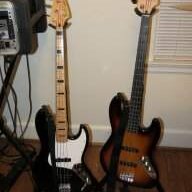
The bass I have is a 4-string Squier with flatwounds. I believe its considered a P-bass and not a J-bass (Precision Bass as opposed to a Jazz bass? The distinction between the two is based on the type of pickups used?) A photo of the bass I'm planning on using is attached. The bass was from someone and hadn't had a string change in about 15 years. A bass player recommended I go with flatwound strings. I figured that since he's played bass, he knows better than me and so I got and installed those strings. To save money, I adjusted the truss rod, action, and intonation myself (I'm anticipating buying a different bass down the line. So if I break something, it's more ok).

I'm now getting that the sound in a bedroom for practice is not necessarily going to be the sound in the sanctuary. And trying to get practice to sound like the sanctuary is extremely difficult and won't really benefit practice much. Have I got that?
 

Attachments

  • 20230315_091916.jpg
    20230315_091916.jpg
    595 KB · Views: 55
You get what you describe when you hook up a Cali76 comp to a Noble preamp and take the output into a headphone amp of your choice (Behringer Powerplay P2 is good enough and not expensive) into a good pair of headphones (Sennheiser HD6XXX, Beyerdynamic 990 Pro, among others).
The problem is that this stuff is expensive.

If it was easy to replicate an "expensive" sound on the cheap, Noble amps would not have a 42 week lead time on his preamp. The two ways around this are either education or trial and error. Both will lead to a point where you can identify what is dear to you and what is not when it comes to bass tones - and ultimately, where you will have to focus your money.

$150 for a decent headphone setup that includes the headphones is not that easy. You can get a decent pair of cans for around $100. Or you go chinese IEM - crinacle.com is a good source to start - you'll find something between 20 and 50 bucks there that will do a halfway decent job.
You still need something to play into that will make your bass audible on the headphones. Most bass preamps will have a problem fitting into that kind of budget.
There is the Behringer BDI21, which does a fair job at impersonating the BDDI. It's plastic - but it's 40 bucks new. In combo with a Behringer Powerplay P2 headphone amp and a set of KZ Audio ZS10pro IEMs you'd land right at $150.
 
In Ear Monitors (IEMs) will be what's used on stage

Does the church provide those or do you have to get your own?

I only have run-of-the-mill earbuds (a slight step up from a a pair that comes free with a phone).

Could/should I get a better pair of headphones?

If we are still talking about practice and versus run-of-the-mill earbuds for that purpose, my opinion would be that headphones would be of benefit, and if you are not buying IEMs (which you could use for practice), then some fairly random budget over-ear headphones should be adequate.

Even something in the $20 range like this would get the job done if you trying to keep costs down...

https://www.amazon.com/Sony-MDR-ZX110-Headphones-Neodymium-Magnets/dp/B01L9VQHJG/ref=sr_1_10?crid=2C7WI08TQT2F0&keywords=sony+headphones&qid=1678896047&sprefix=sony+,aps,92&sr=8-10

A bass player recommended I go with flatwound strings...

Yes. "P" and "J" (for Precision and Jazz) that hear about refer largely to the pickup configuration. That bass is a combination referred to as a P/J configuration and I presume passive, meaning it doesn't have an on-board pre-amp that can boost frequencies selectively. As I said, any bass should work...any strings should work. You have the ability to observe and talk to the other bass players in the rotation about gear, we don't...that's what I would do.

Flatwound strings generally have a more tonally muted sound with less brightness than roundwound strings. They feel different to the touch and can have some affect on certain techniques when playing.

But in terms of middle-of-the-road playing (i.e., basic finger-style), flat and round wound strings can sound pretty much indistinguishable, especially when flats are newer. Played with slapping or a pick, they sound more different. With all of the various types of playing, flats have less brightness and "zing" and the sound engineer can't boost something that's not there to boost. At the end of the day though it may not matter in your situation.

Here's an example of flats and rounds on a P bass. I recorded the same song snippet with flats and rounds on the same bass and played back switching back and forth between them. One the first pass, you can't see when the changes happen. I did another pass where you can see when the changes occur. Blind, I can't really tell that it's not just one clip. With visual cues, I believe I can catch differences, but I can't tell which is which.


I'm now getting that the sound in a bedroom for practice is not necessarily going to be the sound in the sanctuary. And trying to get practice to sound like the sanctuary is extremely difficult and won't really benefit practice much. Have I got that?

That's how I would put it.
 
As an Amazon Associate, TalkBass may receive commissions from qualifying purchases made via links on this site.
  • Like
Reactions: Ithilome
Does the church provide those or do you have to get your own?
You can bring your own headphones or the church has a few that can be used (whether or not they are available will depend on who's playing that day)

Even something in the $20 range like this would get the job done if you trying to keep costs down...
Yep, I'm trying to keep costs down :)

As I said, any bass should work...any strings should work.
Good to know! For at least the first time playing with folks, my approach will be to use the bass I have with the strings I put on it.

Here's an example of flats and rounds on a P bass. I recorded the same song snippet with flats and rounds on the same bass and played back switching back and forth between them. One the first pass, you can't see when the changes happen. I did another pass where you can see when the changes occur. Blind, I can't really tell that it's not just one clip. With visual cues, I believe I can catch differences, but I can't tell which is which.
That was a good example. Thanks for putting it up without visually noting the string change at first. And then showing the visual change later. I couldn't tell the difference

Thanks for all the thoughts and steering me straight! This thread was mostly in regards to equipment but thank you for giving me thoughts, tips, and ideas! In the end, I'll be helping to lead people into worshipping and that's a more important point than to make the best sound. (Granted it's important to make a good, nondistracting sound, but if you're not worshipping...it's pointless...)