
Soldering the pole pieces could degauss the magnets.
A good point.

TalkBass has been independent since 1998. Add your voice.
Create a free account to reply to discussions, view embedded media, and browse with fewer display ads.
Join free Log in
Want zero display ads or expanded classifieds tools? Compare plans.
Soldering the pole pieces could degauss the magnets.
Insure you do not have the ground and signal reversed to the output jackI should add that I touched every other component and no additional noise was added or reduced, fwiw...not sure what the extra noise indicates

Creating a new thread since this one is getting bloated with different questions.
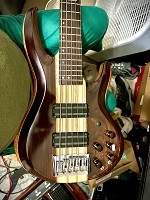
I just changed my bass from active to passive, replaced all the switches and pots, and made it have a parallel/single Coil/series switch for each pickup, a three-way pickup selector switch, a master tone, and a master volume. Got everything functional and shielded but noise isn't completely gone, and it's unbearable in single coil mode, which I know is normal to some extent but it's a lot. And in humbucking mode it's not dead silent like I hoped.
Anything glaringly obvious with my grounding scheme that I should correct before going out and getting a multimeter?
View attachment 1724717

Great Advice. While I'm not a personal fan of star grounding and I do use a proprietary paint and process instead of foil, I support every other point you make and would not particularly exclude these. I adhere to most of your views as well and our instruments are dead silent. Ref Jonathan Herera's review in the June 2017 Bass Player for anyone that might feel a need to validate my claim. As for my view on star grounding: if shielding reads less that 50 ohm within cavity and no more than 150 ohm from the farthest points in the entire cavity system, your noise is going to ground. No doubt this opinion can raise a scream from the star ground advocates (my youngest brother included) but the proof is in the performance of the shielding within our instruments.When I get into shielding a passive bass, there are a few things I try to do every time.
First, I use copper foil with a conductive adhesive backing, so that overlaps are more forgiving, and don't require a lot of fussy foil-to-foil soldering. I don't use shielding paint unless I'm into some really complex cavity shapes or tiny, twisty drill-throughs. Just me; YMMV.
Second, I make sure that pickup wire pairs are twisted on their way to wherever they are going; this helps with common noise rejection (CMR) on each pair, whereby we hope that induced noise on one wire is 180 degrees out of phase with induced noise on the other wire.
Third, I do follow a (relaxed) star-grounding scheme. I try to terminate all ground leads at a single pot shell, physically nearest to the output jack, but I don't get too obsessive about it. Sometimes, it's not practical. In many cases, it also makes no difference that I can measure.
Fourth, I make sure that holes passing from one cavity to another (say, from pickup cavity to control cavity) are shielded. This can take several forms, depending on how the cavities are laid out. Sometimes, I'll use a short segment of plastic soda straw with copper foil wrapped around it. Sometimes, a segment of shielding braid around the (twisted) wire pairs, if there is room. Sometimes, conductive paint in the passage (gravity dripped, pushed through with a Q-Tip, or swirled in with a very fine paintbrush). In all cases, this shielding does need to be grounded; I usually make sure it has a good connection to the shielding foil in both cavities, or to the foil on the underside of the pickguard (if present).
Fifth, as several folks on this thread have suggested, I make sure there's a robust ground connection to the bridge(s). I've seen some pretty sketchy stuff in this arena, even on high-end production basses. Of course, that bridge connection is not going to get you additional shielding from the strings (nor capacitative coupling to your body) if you use coated or tapewound strings. Personally, I think the bridge-ground connection is overrated. But it's still worth doing, IMO. Belt and suspenders.
Finally, I shield the pickup covers if they are not already shielded. Pickups that are internally shielded usually have a ground wire or terminal that needs to be connected to the central ground point. Pickups that are not shielded, I line with copper foil (with careful cutouts for the pole pieces, if they stick up through the cover, like on stock J pickups). I connect the cover shielding to the foil in the cavity with a length of insulated stranded wire, soldered at each end, making it long enough so that I can pull the pickup (or its cover) partway out of the cavity for later maintenance. I try to avoid letting the cover shielding touch the pole pieces, as this can be problematic -- in rare cases, pole pieces are part of a pickup's active circuit (!), or some grounding scheme.
I have yet to encounter a situation where I thought I had to ground the pole pieces. In most magnetic pickup designs, they are coupled to the rest of the circuit inductively, not conductively, and therefore grounding them won't serve much purpose (and may actually introduce noise).
In all of this, an ohmmeter, or at least a conductivity buzzer, is your friend.
Hope this helps some folks.
Star grounding is unrelated to the test you describe here for shielding conductivity. Conducted noise in the ground circuit is not usually a problem in guitars because there isn't any electrical current flowing through the guitar's ground circuit, like there would be in a vehicle where the chassis or airframe is used as an electrical return path for powered devices like lights, motors, and computers. I use star grounding wherever possible because it's very easy to do, and proper as a general practice, although most often not necessary on guitars. "Being a fan of it" doesn't really enter into it at all.As for my view on star grounding: if shielding reads less that 50 ohm within cavity and no more than 150 ohm from the farthest points in the entire cavity system, your noise is going to ground. No doubt this opinion can raise a scream from the star ground advocates (my youngest brother included) but the proof is in the performance of the shielding within our instruments.

Exactly my point. ThanksAny properly assembled guitar/bass guitar is already 'star grounded' if you think about it, because all grounds ultimately connect to the jack sleeve. That's your 'star.' Wire/path lengths are irrelevant.
You're right that the wire lengths don't matter in a star ground, so the only reason that lugs are soldered to shells and shells strung together is for production cost or convenience. But, the circuit we are (should be) talking is the guitar itself, so the fact that grounds ultimately connect to the jack sleeve gives no information about star grounding, or not. Signing off this thread . . .Any properly assembled guitar/bass guitar is already 'star grounded' if you think about it, because all grounds ultimately connect to the jack sleeve. That's your 'star.' Wire/path lengths are irrelevant.
Hi there !!
I have a few questions regarding shielding/grounding, since i decided to shield + rewire my rick-style bass from scratch (it is basically a rick 4001 clone, so two volumes, two tones, two single coils and a switch).
I have gone through most of the main suggestions found here on TB and elsewhere, the result is :
- The global noise/buzz is drastically diminished BUT
- still i have some noise at high volumes (the noise disappear when i touch the strings)
- at the same amp volume, the rick noise is comparable to the one produced by my fender p-bass (though im not sure the latter is totally shielded)
- i have tested continuity for all the all the ground links between each ground element, and the test is right for each of them
So the questions are :
- Does a good grounding usually completely delete the buzz/noise even at higher volumes ?
- Does the continuity test ensure that the circuit should work as expected ?
- Could the residual noise be the result of some ground-loop in the circuit or do a ground-loop manifest itself via some other kind of noises ?
Thank you
I wish to add that when dealing with single coil pups your going to have some 60 cycle hum ,noise etc. Depending on the quality of pups is also a factor so no matter how much you shield or ground you will always have some noise beaware that fans lights and other electrical devices tools or appliances will also effect your amp. Good luck.Sometimes thats as good as it gets I have p bass that I shielded to the max p.u. and control cavities pickguard. etc. And still not completely silent and others like a j bass that have only pickguard shielding and it pretty quiet it"s the nature of the beast I quess.

Yes and no. It depends. If the noise goes away when you touch the strings then you definitely have a grounding issue from what I understand. Others who are more knowledgeable than I can chime in.Hi there !!
I have a few questions regarding shielding/grounding, since i decided to shield + rewire my rick-style bass from scratch (it is basically a rick 4001 clone, so two volumes, two tones, two single coils and a switch).
I have gone through most of the main suggestions found here on TB and elsewhere, the result is :
- The global noise/buzz is drastically diminished BUT
- still i have some noise at high volumes (the noise disappear when i touch the strings)
- at the same amp volume, the rick noise is comparable to the one produced by my fender p-bass (though im not sure the latter is totally shielded)
- i have tested continuity for all the all the ground links between each ground element, and the test is right for each of them
So the questions are :
- Does a good grounding usually completely delete the buzz/noise even at higher volumes ?
- Does the continuity test ensure that the circuit should work as expected ?
- Could the residual noise be the result of some ground-loop in the circuit or do a ground-loop manifest itself via some other kind of noises ?
Thank you
Does it have a factory, or retrofit 3 prong power cord?^^^
My setup is very simple, bass straight into the amp (old Ampeg V4B).
Anyway i'll try to dissect the circuit to catch what is the noise source.
M
That would not ruin the conductive paint. You WOULD have to scrape away the non conducting finish paint at points to connect it, but it would otherwise still functional perfectly.Why waste the paint if you're just going to cover it with copper tape?
Recently I saw a guy posting photos on FB of how he painted a guitar body.
He ruined the shielding by painting right over the conductive paint that was in the cavities


