• TalkBass has been independent since 1998. Add your voice.
    Create a free account to reply to discussions, view embedded media, and browse with fewer display ads.
    Join freeLog in
    Want zero display ads or expanded classifieds tools? Compare plans.

Double Bass Help needed with AKG C-411 and battery pack

I just received one of these from a seller off Reverb but it appears to be DOA. I wanted to check and see if there’s maybe something I’m missing. I believe it’s the C-411 L with the B-29 battery pack (not the B-29L). There’s no on/off switch on the battery pack or LEDs or anything to tell me if it’s on or not. I plugged everything in and am not getting any signal to my interface.

Here’s the battery pack, at first I thought maybe there’d be a detent on the volume control to turn the unit on/off but there’s not. Assumed maybe it powers off when the output jack is unplugged, but like I said I’m getting no signal. At first it looked like there might be LEDs on the side but there’s not.

All Google results are for the B-29L, does anyone here have this older unit and might know if there’s something I’m missing?
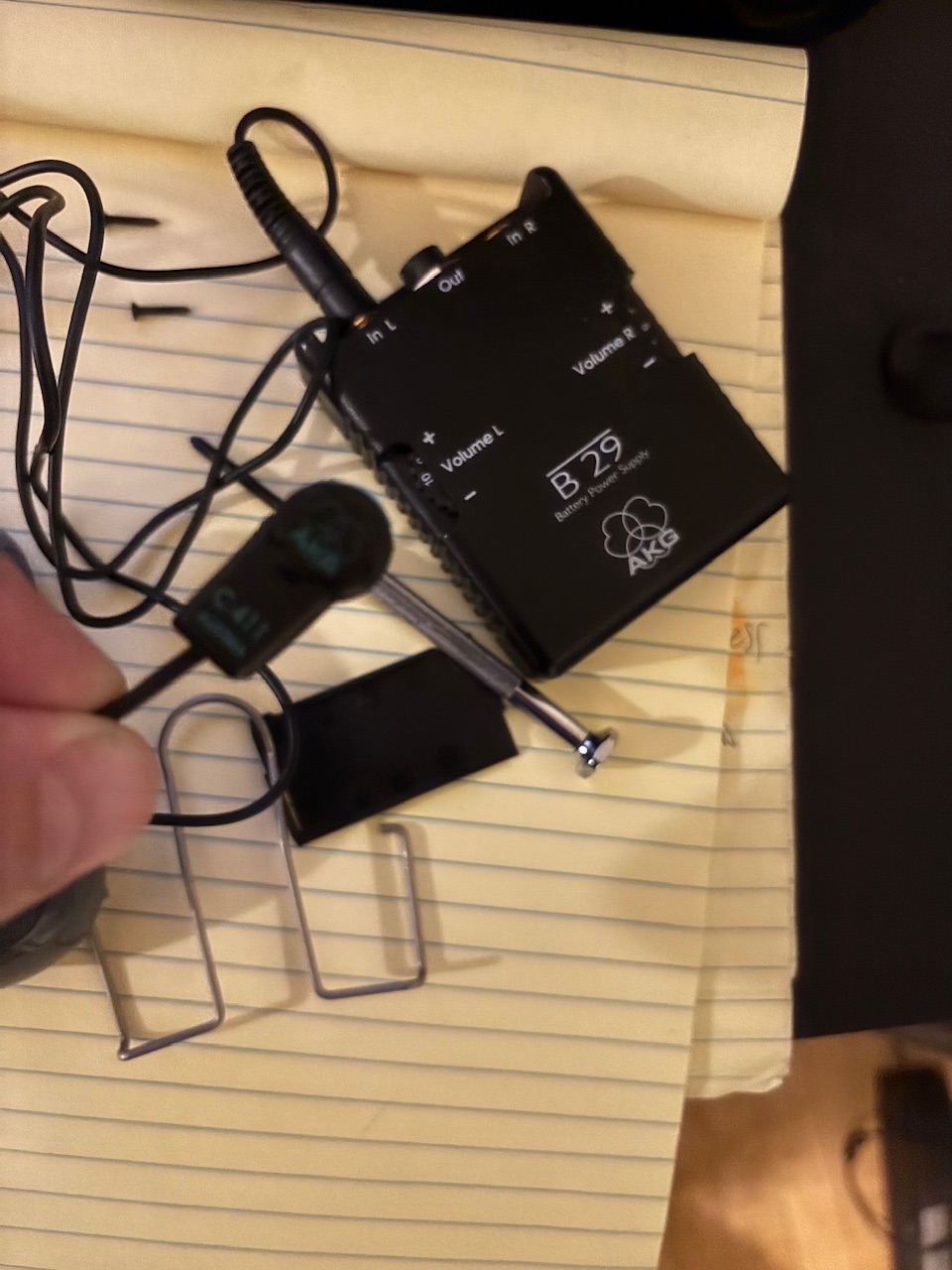
IMG_1873.jpeg
 

Attachments

No manual, but I bought a used C411/B29 a few years ago and had no problem with it.

Did you put in a 9V battery?
Did you screw the mic connector or not the B29? If not the tip might not get in contact.
Did you set the volume control for the input connector used up (10)?

Left and right probably doesn‘t matter, but I have used the left channel and turned down the right one.
 
No manual, but I bought a used C411/B29 a few years ago and had no problem with it.

Did you put in a 9V battery?
Did you screw the mic connector or not the B29? If not the tip might not get in contact.
Did you set the volume control for the input connector used up (10)?

Left and right probably doesn't matter, but I have used the left channel and turned down the right one.


Yes, fresh battery, screwed the mini jack in as far as it would go, tried both channels at all volume settings. So there’s no LED indicators or any kind or on/off on yours? Seems an odd design for a battery powered device. But I at least want to know if I’m doing something wrong
 
No LED as the LED would consume more power than the mic does (but less or as much as the power adapter).
The B29L would typically be powered via phantom power, so the LED would not drain the battery in this case.

After checking the schematic, the B29L cannot be powered via phantom power, so more similar to the B29 as I thought.

You can try to insert a normal 3.5 mm TRS cable and touch the tip to check if the B29 works (output connected to an amp). If you don't get any hum, the B29 is defect. (Check the battery connector cable. It might be broken or disconnected at the soldering.)

What about the cable to the mic?
It might be broken (mine doesn't look very promising, but it works).

The C411 and C411L just have a different connector, so making an adapter cable or changing the connector should work with a B29L.

The B29L needs a switch as the XLR connector cannot switch as a 1/4" connector can. There are more changes in the B29L as the phantom power needs to get reduced. The output is still unbalanced as the inverted output has a fixed level. So similar to the B29.
The B29L-schematic that could be found in the B29L service-PDF (Google search for "6000h0462 AKG") might have most of the information fir the B29.
Mic power is "Tonaderspeisung", the 9V passes a 10 KOhms resistor to the hot signal (R201), the audio signal is decoupled from DC by a 4,7 uF capacitor in the hot signal (C201).
The (mini-)XLR contact 2 is the tip, contact 1 is the sleeve. Contact 3 is open (tied to contact 2 on the C411L).

Good luck!
 
Last edited:
No LED as the LED would consume more power than the mic does (but less or as much as the power adapter).
The B29L would typically be powered via phantom power, so the LED would not drain the battery in this case.

After checking the schematic, the B29L cannot be powered via phantom power, so more similar to the B29 as I thought.

You can try to insert a normal 3.5 mm TRS cable and touch the tip to check if the B29 works (output connected to an amp). If you don't get any hum, the B29 is defect. (Check the battery connector cable. It might be broken or disconnected at the soldering.)

What about the cable to the mic?
It might be broken (mine doesn't look very promising, but it works).

The C411 and C411L just have a different connector, so making an adapter cable or changing the connector should work with a B29L.

The B29L needs a switch as the XLR connector cannot switch as a 1/4" connector can. There are more changes in the B29L as the phantom power needs to get reduced. The output is still unbalanced as the inverted output has a fixed level. So similar to the B29.
The B29L-schematic that could be found in the B29L service-PDF (Google search for "6000h0462 AKG") might have most of the information fir the B29.
Mic power is "Tonaderspeisung", the 9V passes a 10 KOhms resistor to the hot signal (R201), the audio signal is decoupled from DC by a 4,7 uF capacitor in the hot signal (C201).
The (mini-)XLR contact 2 is the tip, contact 1 is the sleeve. Contact 3 is open (tied to contact 2 on the C411L).

Good luck!


Thanks for the reply. I did try another 1/8” into the B-29 to see if I got any signal, still nothing. I do have a multimeter and tested the battery but that’s about as much as I can do without guided instructions.
 
Seems like the B29 is dead. If the mic still works, you can get a 3-pole mini-XLR connector and replace the 1/8” plug or make an adapter for it and buy a B29L or AKG phantom adapter to use the mic.

Maybe you can find someone in your country who can check the mic for you, I would do it, but I’m located in Germany.
 
  • Like
Reactions: Wasnex
I have had one of these for a long time (I think over 20 years) that I use with classical guitar. What I found to be peculiar is that although it has a 1/4" output the signal is actually low impedance. And it's not a tip-ring-sleeve setup (I tested for that), so I made a special cable with male 1/4" at one end and male XLR at the other (you can look up how to wire that), and it works fine. Let me know if this works for you. Also, I believe that plugging into the 1/4" jack is what turns the unit on.
 
Last edited:
1/4“ mono connectors were at least standard in consumer electronics during the 80s. But also some studio mics had them.

I have the C411 with the B29 too.
Got some B29Ls and plan to make an adapter or replace the connector for them, perhaps later than soon. But maybe I just connect a (hopefully better) electret mic with built-in or external JFET to them.

But I think even the B29L needs the battery, due to the schematic it cannot use phantom power.
 
@DoubleMIDI - In my experience, 1/4" generally implies high impedance, which is why I found this flummoxing. But the solution I arrived at (described above) has worked for me. I'd add that I think the C411 is an excellent sounding unit.
 
Our experiences may differ. I have two better consumer electret mics from the 80s with 1 KOhms output impedance and a 1/4” plug (to be used with a bit better cassette tape decks and consumer 1/4” tape recorders).
It’s not 200 to 600 Ohms low impedance but not very far from it.

My old 1/8” and 1/4” C411 sounds really great with my DB, better (in my ears) than the Ehrlund EAP with its preamp.
None of my other pickups and contact mics, including Shadow NFX, Yamahiko, Shadow SH-950, Full Circle, MSP and Ehrlund are so natural sounding.
 
Our experiences may differ. I have two better consumer electret mics from the 80s with 1 KOhms output impedance and a 1/4” plug (to be used with a bit better cassette tape decks and consumer 1/4” tape recorders).
It’s not 200 to 600 Ohms low impedance but not very far from it.

My old 1/8” and 1/4” C411 sounds really great with my DB, better (in my ears) than the Ehrlund EAP with its preamp.
None of my other pickups and contact mics, including Shadow NFX, Yamahiko, Shadow SH-950, Full Circle, MSP and Ehrlund are so natural sounding.
It sounds as if you have broader experience than I, but I think I've seen that, too, some lower-impedance mics with 1/4" plugs on the cables. I was thinking more of electric guitars (and basses), which are decidedly high impedance. Does DB mean direct box?

Another thing I've found that may not be directly relevant to bass is that I get far and away the best sound with the C411 mounted directly on the tie block of a classical guitar's bridge, straddling the treble strings.
 
Last edited:

Latest posts