• TalkBass has been independent since 1998. Add your voice.
    Create a free account to reply to discussions, view embedded media, and browse with fewer display ads.
    Join freeLog in
    Want zero display ads or expanded classifieds tools? Compare plans.

High Mass Bridges vs. Vintage Bridges

Where high mass brides make a difference is in percussive attack slapping/heavy handend ghost notes exc...
I prefer it but to each their own.
 
I think the Fender bridge represents some pretty solid engineering. It's an inexpensive design that functions quite well. Sure, there are some potential issues with side-to-side motion of saddles...
that's the '70s downgrade with one groove per saddle; the original design with the threaded-rod saddles didn't have this problem.
 
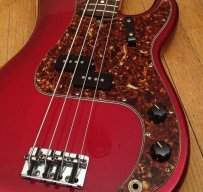
I was always a high mass bridge guy until last year when I bought a road worn P bass (the red one). Wow. That bass has so much more tone (woody, brassy, growly etc) than my other Basses. In fact, I stopped playing my American Standard P, and ended up selling it. There are a lot of possible reasons for the road worn to have a great tone... it has a really wide and thick neck for one, and it has vintage fretwire, and a thin nitro finish. The road worn also has a vintage bridge with threaded barrel saddles. I suppose all of these factors could contribute to a different and subjectively better tone. I have a couple of other high mass bridge basses, that also happen to have thick poly finishes (which no doubt could contribute to the difference in sound). When I play these basses unplugged, the road worn is quite obviously acoustically alive compared to the others. If you pluck a string and put your ear to the bass body, you can hear the harmonics and overtones being produced from the body, especially near the bridge. You can hear the primary note, and many other notes above and below at a lower volume (harmonics). The high mass bridge thick finish basses produce these tones too, but much less so to my ears. Their tones are simpler and the fundamental note dominates. (And I have done quite a bit of audio engineering in the last few years, so I am familiar with harmonics and how they thicken and enhance a sound). Have you ever gone into a studio and seen an old piece of crap bass there that all the engineers seem to love for some reason? They always tell you to give it a try... that the tone records really well, and sits nicely in the mix. Well, now I seem to own one of those basses, and it does record very well. The problem is now I am completely unsatisfied with my other instruments, so I have started to try and figure out how to make them more lively. I'm going to start with a low mass bridge here and there, and see if that wakes them up. I'll probably find that the answer is not that simple. Hopefully I will stop before I strip all the poly off of my basses and spray them with nitro.
 
  • Like
Reactions: BeyondFiredUp
Just remember: any sounds you 'percieve' IN the body are for all intents and values, GONE and are not capable of re-energizing or causing the string to be re-animated so they can help produce any positive effect that the p'ups can use.

Once vibrations/sounds get into the body, it's like a roach motel --- THEY CHECK IN but don't check OUT.

Wood (as in: the body) is a black hole for sound propagation and/or resonance for a solid body instrument. If you WANT something removed, then use something that sends a particular range of frequencies into the body via different mass at the bridge.

This is my experience in building and repairing the instruments I make.

:p
 
I don't see how a body that's as massive as, say a Jazz or Precision, could shake violently enough to make the strings vibrate without giving the player some vibrating thrill just strapping the instrument on.

The whole idea seems incongruent to the flow of energy and the fact that no matter how much a body 'hums' --- it isn't gonna do the magnetic p'ups any good especially if they are humming at the same freq as the strings - if that could ever be the case here.

I see all sorts of phasing and sine wave overlays causing death to the purpose for which the string was plucked in the first place.

If the body were able to (cough, cough) 'hum' in parasitic harmony to the strings, then we'd likely now have arrived at perpetual motion or gotten really REALLY close to it.
 
"especially if they are humming at the same freq as the strings -"
Isn't that sort of how a sustainer works? As also, in face the cabs and let the waves from the cabs keep the strings oscillating, thereby keeping the pickups producing?
 
High mass bridges,Power conditioners,its all Hype,a ploy to get you to spend more money on something that doesnt make a difference at all on your equipment...:rolleyes:

I played a large venue with somewhat of a 'questionable' electrical supply and I was the only rig to not have any 60 cycle him going on. I use a Furman and it has been a decent expense for me as it shuts off the power below a decent Low voltage threshold and unlike those cheap-o power strips, it takes repeated line voltage spikes and clamps them out.

A power strip comes out of the store pretty much all consumed already especially if you shuffle your feet across the carpet when you carry it home.

So, yeah: I can't see any real auditory value in an HM bridge, but keeping electricity clean and spikeless is a good Idea as I see it.
 
Boy howdy, this was a good read. I didn't think it was possible for so many people to get bent out of shape (pun intended) because other posters hear differences in their basses when changing out a 50s design bridge for something different. Why not just play what you brung and be happy knowing the "Fender" name will keep you ahead in the resale value game for the rest of your lives?
 
The zinc bridges sound scooped to me and more compressed. Very clean. The aluminum ones sound louder and middier with stronger attack. Tin bridges are too squirmy for me, and adjustments drift. I like the aluminum Hipshot B best. It sounds close to tin, and the slots allow string changes without dragging the strings through holes. Second best, Gotoh 201. Totally different, both good. Yeah there are way more massive aluminum and zinc and brass bridges, but too much is too much.

The Gotoh 203 is an option for those who don't like the larger saddles and higher mass of the 201. It does have grooves and 2 extra mounting holes on the plate.

Link Removed
 
The reason I prefer a high-mass (please...) bridge has to do with those thin OEM bridges, the upright part of the bridge that the strings go through has a slight, but noticeable lean toward the neck from the pull of the medium gauge (.050, .070, .085, .105, and now, .135) strings I use.

That's enough to turn me off of the thin bridge. I could care less about whatever the hell other reasons are out there. Well, that, and I doubt that anyone makes one of those thin bridges to fit an Alembic Series 1.
 
The reason I prefer a high-mass (please...) bridge has to do with those thin OEM bridges, the upright part of the bridge that the strings go through has a slight, but noticeable lean toward the neck from the pull of the medium gauge (.050, .070, .085, .105, and now, .135) strings I use.

That's enough to turn me off of the thin bridge.

that's one reason my favorite is the first-generation american standard bridges; along with the adjustable string spacing, you get the low-mass tone and vibe, but the string-through setup makes for rock-solid anchoring with no lean:

jazzspacing001_zpsea6341ee.jpg
 
  • Like
Reactions: props