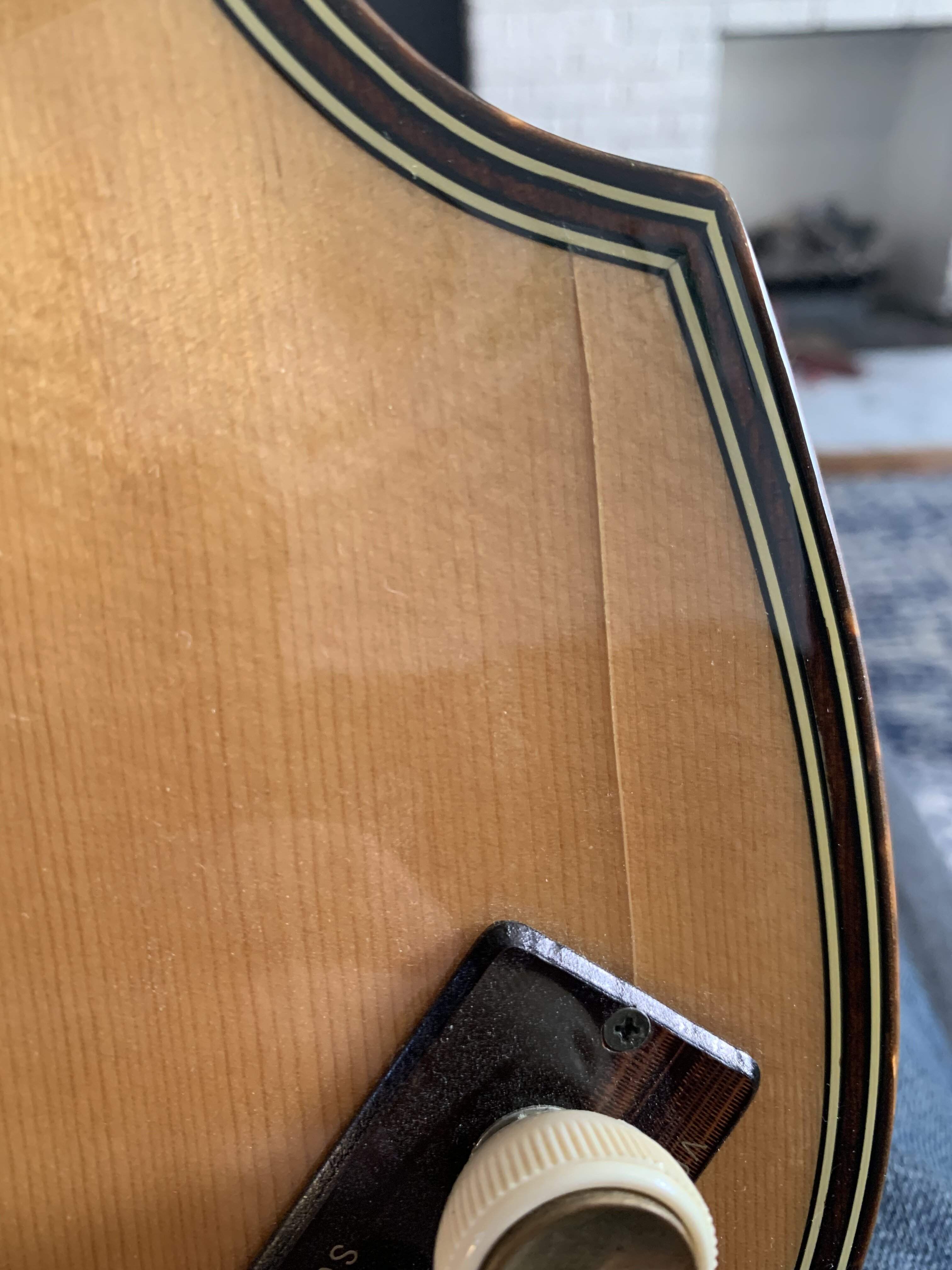
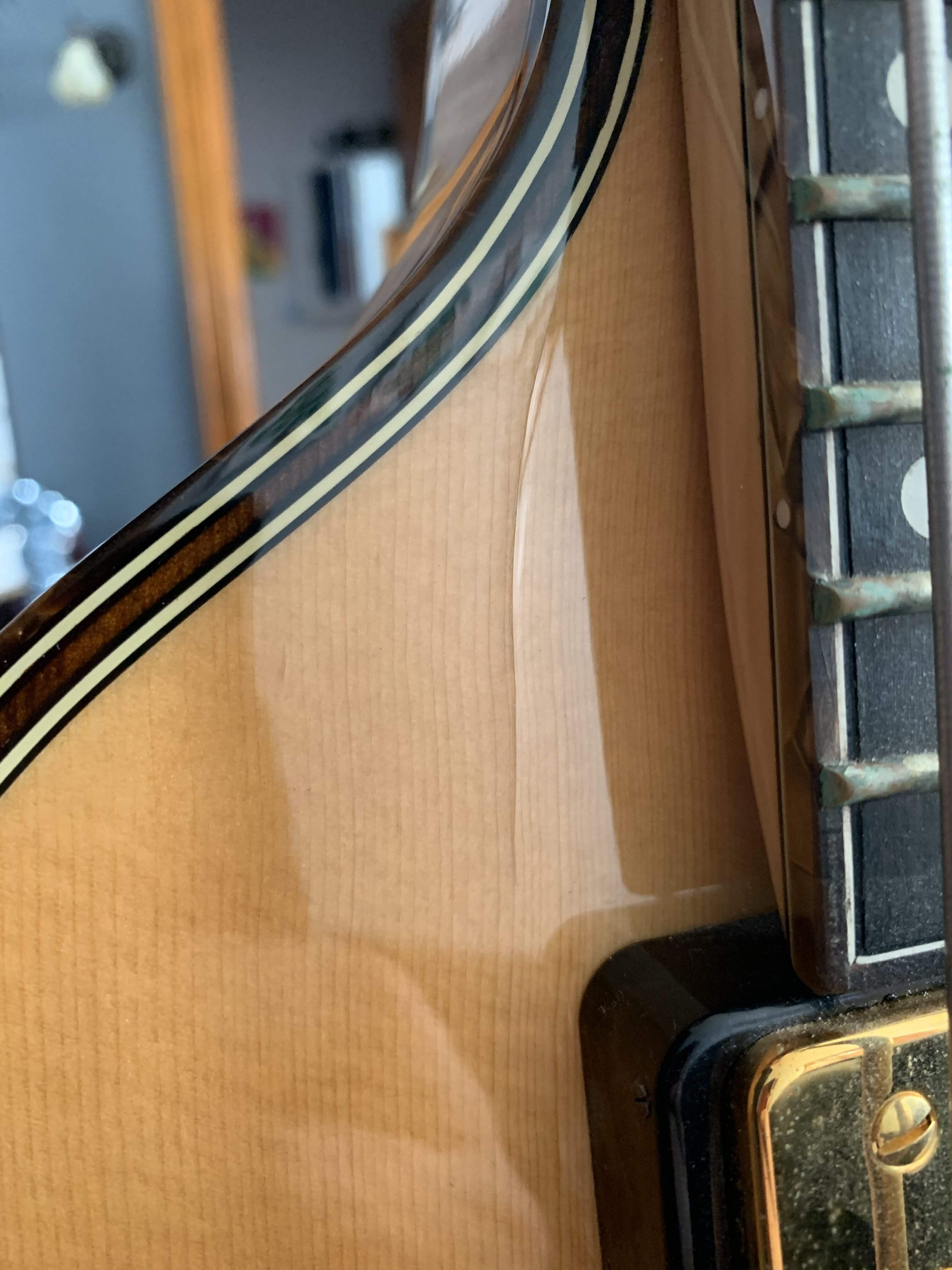
With all possible respect, I personally do not believe these to be cracks in the grain.
The cracks continue right into the binding, a material laid in an entirely different direction altogether.
I have long-standing “interests” in manufacturing companies and over 25 years of professional experience in finishes.
When I began in the music business, a single French Polisher would be allowed an entire week of hourly work, to apply the final gloss on a blacked Steinway Grand Piano.
Today, I deprecate that these instruments instead receive a sprayed polyester finish, which like that on many guitars, is thick, glass like, hard but brittlely susceptible to catastrophic damage, if knocked hard.
They can be repaired, but require specialist expert techniques that are not cheap to hire. If you engage in some research regarding grand piano, polyester finish specialist’s, there may be a chance that someone in your region might be willing to fix your instrument.
But they normally only work on Pianos. If their workload is light they might be persuaded.
A Steinway Concert Grand costs £250, 000 so people engaged in this type of work, can normally charge a premium to address it.
This might make your instrument an uneconomical repair in their eyes, but you might be lucky and find someone willing to do it. The point is, it can be fixed, but at a price.
Now I would like to helpfully address WHY the cracks appear.
There are a number of culprits, and I for one believe that all instrumentalists should be aware of them.
By analogy, it is typical for owners of a Stradivarius violin, to have two slightly different bridges for their delicate instruments.
This is because of annual seasonal changes in temperature and humidity which cause the wood to slightly expand or contract, flexing in sympathy with those changes. The finish flexes too.
By having two slightly different bridges, the required alteration in the configuration of the instruments playing action, induced by seasonal influences, can be successfully accommodated without recourse to a Luthier.
This is despite the fact that major orchestras these days have articulated lorries to transport their instruments. Lorries that are fitted with temperature and humidity controlling equipment, that stabilise the environment in which they are kept. Such is the importance of these issues.
Therefore, it is likely that seasonal changes in temperature and humidity have caused the instruments wood to expand and contract.
To flex, as violin family instruments do, whilst the thick, glass like, extremely hard polyester finish, naturally resists the degree of flex, the wood underneath is experiencing.
Something needs to give and cracks in the finish thus appear.
But there is more.
I trust you will forgive a personal comment.
Although it is not possible to do this with acoustic instruments.
Whenever I pick up any electric instrument of mine from its case or even from a stand.
I never pick it up by its neck. I always only ever pick it up by its body, around a horn or elsewhere, substantial.
This is because I believe that picking up an instrument whose body weight, relative to its neck’s weight, is very substantially higher, can only cause an undue degree of pressure, to be placed upon the area surrounding the neck to body joint.
Usually, the effect of such pressure is not detectable by problems in the wood, but rather, will reveal themselves in finish cracks in the general area surrounding the neck to body join. In my opinion, viewing the second picture posted, it is clear by the cracks larger size at the top, that the crack was induced, initiated from the neck joint region.
The grain on violin family instruments, always run from top to bottom, longitudinally on the front and back of the instrument and at ninety degrees around the sides.
I had a friend call me from Washington a while back as his family heirloom a violin over a hundred years old, completely fell apart after being left in the rear window of his car on a hot day.
I contacted a relative who is a violin maker (who specialises in Stradivarius and other top violin work) to ask his advice. He explained that these instruments, by design, fall apart easily by virtue of the differing grain directions of the top, back and side.
Furthermore, he explained that whilst the owner (a top recording engineer) believed that the heat in the car’s rear window caused the problem (and in a sense it of course did).
In actual fact, the instrument which had been made in Germany well over a hundred years ago, had probably been gradually coming apart, for a great many years indeed.
Precipitated by its journey from Germanys climate, to that in America, which was rather different altogether. That its animal glues had been gradually loosening over time, by virtue of temperature and humidity differences in its new environment.
That in fact, the episode in the rear window of the car was simply the final nail in its coffin so to speak, that sealed its fate.
The salient point here is, these cracks in what I presume to be a German made Hofner, now residing in Ohio, probably didn’t simply just happen in one moment.
Rather, in spite of modern glues, they may be the result of extreme temperature and humidity transitions that naturally occur; but exacerbated and accelerated, by storing the instrument without due care and attention to it requirements in regard to temperature and humidity.
As well as poor handling (as explained earlier) to boot.
There are two other matters in relations to this instrument’s problems, that come to mind.
One is that polyester cracks can often be the result of a hard knock. Usually, the clear indications of this, is a crazed impact point, from which several long hard cracks, spider outwardly.
Though this doesn’t appear to be the case in this instance, it’s worth knowing what a hard knock can do to a thick polyester finish and take care to avoid them. Because polyester is hard, its very hardness makes it brittle and susceptible to hard knocks.
Small knocks, it will shrug off.
The other matter is really more to do with processes of the manufacturer.
If the wood has not been properly seasoned for sufficient time. If its water content is too high.
If the manufacturer has taken on trust their wood suppliers guarantees regarding moisture content and not tested or provided their own validation of the suitability of the material prior to manufacturing.
Then, it is more likely that temperature and humidity variations that might otherwise not be problematic, could suddenly have a far more dramatic effect, than would otherwise be the case. Good woods are in short supply, alternatives more susceptible.
Lastly, my observations of your instruments general appearance would definitely lead me to conclude that you are storing or keeping your instruments at times in what is far, far less than ideal conditions.
Possibly you fail to wipe the fingerboard clean after playing?
Perhaps leave it somewhere that is damp at times?
These may be major contributory factors.
As a general rule of thumb, never leave or store your instrument, anywhere that you yourself would find it uncomfortable to remain.
If a position within the environment would prove a problem for you to remain in, it is likely to do so for your instrument too, and result in an undesirable, adverse effect upon it.
Some people’s fingers and hands actively perspire badly. In any event the fingertips exude acids and even enzymes which when you handle food, helpfully inform your stomach you are about to eat, generating gastric juices, to aid digestion.
You need to clean your finger board and strings of these indecorous ingredients.
There are many simple things that instrument owners can do to preserve their instruments in pristine condition, but these require a degree of discipline and protocols to assiduously follow.
Laziness in such disciplines usually results in unnecessary and unwanted issues, that can be entirely avoided.
By the way, another danger area is that of being distracted whilst replacing an instrument into its case, being talked to by people, following a concert.
With the case lid open and lots going on all around, its very easy for a slight movement of the case to cause the lid to fall with its catches point down, vampire teeth like, while the instrument is halfway into its case.
Someone that really wants to speak to you should be told, “give me a moment while I just put this instrument away”, and fully focus and concentrate on what you are doing. Always take care removing and replacing your instrument. I have seen an innumerable number of instruments badly damaged, simply by inattentiveness and distractions whilst performing this simple task.