• TalkBass has been independent since 1998. Add your voice.
    Create a free account to reply to discussions, view embedded media, and browse with fewer display ads.
    Join freeLog in
    Want zero display ads or expanded classifieds tools? Compare plans.

Home studio advices needed!

Hi Everyone,

We want to set up something like a home studio, that we will be able to record a bass guitar and a drum set, and receieve all the output while we are playing through headphones.

In the drawing attached you will see what we are trying to achive. For now we have;

-An electronic drum set,
-A bass guitar
-A bass amp
-A PC

So the rest is yet to be determined!

I guess our list should like something like this:
-A sound card (or something to do its' job)
-A headphone preamp(we don't want to be noisy at home and receive all the output through earphones)
-A preamp or a processor for the bass guitar (I have a rickenbacker 4003 with rotosound swing bass 66 installed, I'm trying to replicate Chris Squire's sound as much as I can)
-A software to control, record and receive the sound without any delay.
-and whatever is remaining or I missed in this list!

I'd very glad to hear your advices on this, your preference about the software and the equipments, considering that we want to maximize the quality of the sound with minumum amount of money. Plus I have no experience about these stuff, please feel free to correct any mistake I did in the flow of the drawing and in the question.

Thanks a lot in advance!
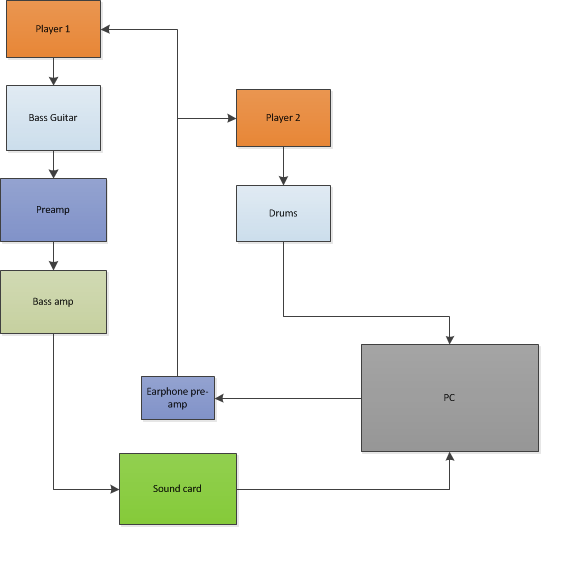
rick.png
 
I recommend a sound card with two inputs and a midi input. This is pretty standard. Audio input one is for the direct bass. The other is the output from the preamp or bass amp or mic. If you really like the sound coming from the speaker, you should get a good mic. That can get costly depending on what you get. The Sure SM7, Heil PR40, or Electro-Voice RE-20 are good choices. In many cases you can get the sound you like by running the dry bass track through an amp simulator plugin. If you find one you like, you may decide to skip the second input channel all together. Of course this setup requires that you split the signal from your bass. If you still want to use two simultaneous inputs, you will need a DI with a thru output. (You should have one anyway for the dry signal.) Since you have a nice bass and you want lots of Chris Squire type highs, I suggest you invest in a really good DI. There are two basic types, active and passive. The Radial JDI is about the best passive DI on the market. You may experience some small loss of highs with long mic cable runs, say over 50'. This should not be a problem in a home studio. I sounds superb and is as reliable as a stone. There are a wide number of good active DIs on the market. I would not bother with anything under $200 myself. I personally have no love for the sansamp or its cousins. But you may like it. If you have the scratch, I suggest planning on spending $400 or more on a good studio DI. A-Designs REDDI gets lots of love around here, but I imagine it is not really the sound you are looking for because it emulates the tone of an Ampeg B-15. The Radial JDV, the Avalon U5, and the Millennia TD-1 are excellent clean sounding D.I.s

I would not bother recording the audio from the electronic drums. You are better off recording the midi events. Then use a software synthesizer to create the drum track. It is much easier to edit midi than it is audio. Plus you get to set up the kit with any software drum sounds you like.
 
@BFunk makes some good suggestions. Bass via DI and a mic if needed, with the drums going in as MIDI through something like Toontrack's Superior Drummer 2.0 will be your best bet for this.

After that it's just down to picking a DAW that you like. I'm a Logic guy, but there's always ProTools, Reaper, Cubase, StudioOne, etc.
 
Yeah, don't underestimate the DAW. There is usually a huge learning curve with these very complex pieces of software. So expect to invest a lot of personal time here. That means that once you learn a DAW to the point where you can work comfortably and efficiently, you are very unlikely to change. So make sure it really suites your working style and musical goals.
 
You already got very good advice from the posters above. The only thing I'll add is try going without mic'ing the cabinet first. The reason is that as soon as you add a microphone, you have now added your room acoustics into the mix and that can complicate things very quickly (and "fixing" room acoustics can be expensive). If you can get a direct sound you like, and that includes using any DI's and/or amp simulator software, you can greatly simplify your life. That's been my experience at least. Fortunately, getting a really good tone direct with bass is a lot easier (and cheaper) than it is for electric guitar.

Oh yeah, added bonus is that with everything direct, you don't have to use headphones. You can record while using your monitor speakers.
 
Agreed. Mic'ing is a pretty complex subject full of subtleties. You should learn how to do it some time, but I would start with a really good DI and sound card. BTW, don't skimp on the sound card either. Apogee and RME are tops in the project studio arena, followed by Presonus and Focusrite. RME writes excellent software drivers that are very efficient and feature packed. (They have a fully routable mixer built into the driver.) I am waiting for the RME Babyface Pro to come out. That should be killer.