• TalkBass has been independent since 1998. Add your voice.
    Create a free account to reply to discussions, view embedded media, and browse with fewer display ads.
    Join freeLog in
    Want zero display ads or expanded classifieds tools? Compare plans.

How do you bias your vintage V-4B?

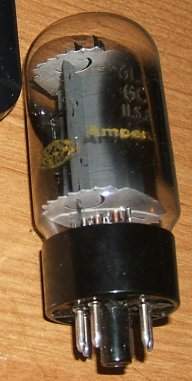
There are different ways of setting the bias. The bias of the power tubes needs to be set so that they operate in a safe region and the amp sounds good. I find that the V4B sounds best when the bias is set for around 60% of the maximum plate dissipation for the 7027A. Setting the bias involves measuring the plate voltage, using a bias problem to measure the cathode current, looking at the output with a scope, and listening for optimal performance.

There was some discussion here.
 
Last edited:
Ive checked the bias today. I set up bias meter on the 1st and 3rd positions (because afaik, tubes are paired inner/outer). the readings were 36mA on one side and 42 on the other. I swapped the 1st and 3rd to see if the mismatch is gone. It helped a bit. Now I have 33ma on one and 36ma on the other. The tubes are Magnavox from 70s.

Is that a big deal with 3-4ma mismatch? btw, The amp is super clean and has absolutely no buzz hum or hiss. dead quiet!
 
Not a big deal. 3mA on 36mA is 8.3%. Some tube sellers will sell matched sets with wider tolerances. Ideally you want them as close as possible (within 1% or 2%), but as you said, the amp sounds good, is quiet, and that's all that is important. If you want to know what is gong on, measure each tube. It is important that they reach a steady state before you take your readings. Let the amp warm up in playing mode, standby off, for at least 20 minutes.

Good to see that you got the power transformer input voltage rewiring successfully done.
 
That V-4B is so underrated power wise and if your straight back has the original speakers you have no headroom when the amp is at distortion. A V-4 is 100 watts clean and goes up from there as the amp distorts. Also, lower gain pre-amp tubes will help. And with the power tubes more closely matched you will get less harmonic distortion from the power stage. I used to use a V-4B all the time with my late 70's tilt back Ampeg 8x10 and the volume was unmanageable at gigs and practice even with a Master Volume mod done to the amp.
 
Today, another problem occured.. The amp has gone down 1/2 on volume and lost high end. I've tried to swap preamp/driver tubes with no effect. Power tubes are fine. Maybe it's time to change the caps? Is it possible that they are doing it? The amp got back to its condition after several on-offs and some time.
 
At this point I would swap back in all the pre-amp tubes you originally had in the amp. If that has no effect, I would then swap the two power tubes back. If that doesn't help then you definitely might need a recap, retube or some service. I had my V-4 recapped recently and gained some clean power, but I swapped my JJ 7027As for JAN Philips ECG 7027As and lost a bit a of power... Go figure.
 
Today, another problem occurred. The amp has gone down 1/2 on volume and lost high end. I've tried to swap preamp/driver tubes with no effect. Power tubes are fine. Maybe it's time to change the caps? Is it possible that they are doing it? The amp got back to its condition after several on-offs and some time.

Chances are, the power supply caps are not the cause of you loosing high end and half the volume. More than likely, it is a preamp tube. If they are old, it is possible that they need changing but that is another issue. If the power supply caps are bad, the amp will loose low end, run out of headroom easily, and you may hear a 50Hz hum.

On the back of the amp are two ext amp jacks. These are both pre-amp out and power amp in. Use an instrument cable. Take the pre-out and feed that into another power amp if you have one. This will test just your preamp. If you don't have another power amp, plug it into the input of another amp. Be VERY CAREFUL with the volume level, otherwise it will distort. Likewise you can take the pre-amp out from another amp and plug it into the ext amp. This will test just the power amp. You can also plug your bass into the ext amp to drive the power amp to test it, bypassing the preamp.