• TalkBass has been independent since 1998. Add your voice.
    Create a free account to reply to discussions, view embedded media, and browse with fewer display ads.
    Join freeLog in
    Want zero display ads or expanded classifieds tools? Compare plans.

How long does it take you to load in/load out? Tips for making it more efficient?

I have a few variables in terms of load in and load out:

a) Venue location and parking

b) Gear I bring. For our larger shows I'll run two parallel rigs, for our smaller shows I'll play through one. Double the amps means double the heads, cabinets, and connections between the two.

c) Getting the gear onto the stage. If we're opening it's a lot easier to load directly into the correct spot v. if we're headlining or midway up the roster and staging. Smaller stages involve working around the other musicians' needs, larger stages aren't as cramped and I can work independently of where my drummer needs his kit arranged.

I'd say we're able to pull off a 15 minute load in and 10 minute load out -- load out not being completely packed and disassembled, but being clear of the stage and out of public walkways. No PA.
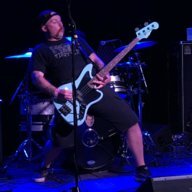
 
The key to a quick breakdown (including cord wrapping) is get all of your gear off the stage and out of the way so the next band can start setting up. Do your cables and all that somewhere else. When bands take forever and break down ON stage it drives me nuts, I hate it. My drummer has been known to hop on stage and start carting off other peoples gear when they stand around chatting it up instead of loading out.
 
Unrepresented said:
I have a few variables in terms of load in and load out:

a) Venue location and parking

b) Gear I bring. For our larger shows I'll run two parallel rigs, for our smaller shows I'll play through one. Double the amps means double the heads, cabinets, and connections between the two.

c) Getting the gear onto the stage. If we're opening it's a lot easier to load directly into the correct spot v. if we're headlining or midway up the roster and staging. Smaller stages involve working around the other musicians' needs, larger stages aren't as cramped and I can work independently of where my drummer needs his kit arranged.

I'd say we're able to pull off a 15 minute load in and 10 minute load out -- load out not being completely packed and disassembled, but being clear of the stage and out of public walkways. No PA.


I agree 100% with this fella
 
ducatiman said:
...drummer with Neal Peart wannabe kit.....crap and cases
clog every conceivable square foot of floorspace. Looks sloppy, real sloppy and creates an obstacle course
for the others.

Why must they lug so much crap around? I'm downsizing, ready to go in 10 minutes LITERALLY.

He's the last one ready on load in...and the last one out.
I've ceased helping him in the hopes doing it alone will force him to pare it down a bit. But....nope.

Terrible.....all this for a simple cover band. I won't even discuss driving up the volume. Terribly unprofessional....

but the gigs keep a' comin.

I must play with his twin brother. Feels like dozens of toms, symbols, doodads and doohickeys of all types for him to bang on until is heart's content. The worst part is it is just a pile of stuff on the floor when it is time to load up. If he had it packed neatly in cases it would be a lot easier. I've always helped him load out his gear but last time I just loaded my own stuff up and said I had to get home early. I think he took the hint. Last practice he said from now on he was only bringing a small kit to the gigs - we'll see.
 
We've got set up time down to about 40 minutes. (Once the drummer gets there.)

After the drummer puts down his rug we're off to the races.

PA head, two mains on stands, four mini monitors, small snake, four vocal, and a bass drum mic.

Two guitars with combo amps, bass with 1x15 and GK200RCB head, 4-piece drum kit.

Two small "automatic" light boxes.

No sound check required as we play at the same volume as reheasal.

Break down runs about 30 minutes! One milk crate for audio cords, one for AC/light cords.
 
Agree with pretty much everything that's been posted here. Our "rules" are:

- Anything bigger than one guy can safely handle alone gets put on wheels (casters or a 2-wheeled cart). "Team lifting" gear that could be put on wheels wastes manpower and can cause too much injury if something goes wrong. We literally have about 2 pieces of gear in our entire setup that cannot be transported by one person.

- Consolidate as much as possible into bigger cases to minimize the number of person-trips (i.e., instead of 3 or 4 plastic tote boxes for cables and cords, put it all in one bigger Anvil case with partitions); ride smaller items on top of the big wheeled cases to further reduce trips

- Each band member has a role. If anyone gets done with their job early, they lend a hand someplace else. Nobody grabs a pre-gig beer or runs off to eat until everything has been set-up, hooked up, tested and we've done a full band soundcheck (or line check at minimum).

- Personal gear / backline is kept to the minimum necessary for the gig. Drummer rolls a 4-piece kit w/3 cymbals and hat. I use a 150w 1x12 combo DI'd to the P.A. and on a few very small stages I've gone ampless (SansAmp to P.A.). Utility guy goes direct for fiddle and a small combo for his guitar. Etc. If a band member is spending 45 minutes unpacking and tuning all his guitars, dealing with a dozen effects pedals, etc., that's too long cause that's time he could be contributing to the common cause. Anything over 20 minutes spent on personal setup (including drums) is too much and they need to downsize and/or figure out a more efficient way to get it all up and running. Our BL has invested a lot into our P.A. and IEMs so we are expected to get by with the minimum backline necessary on stage. It also eliminates wedge monitors from the stage which means less stuff to haul and hook-up.

- If during the course of set-up we discover a bad cord, blown-out light or whatever, that piece of gear is immediately tagged and loaded out separately so we know it needs repair and we don't keep setting up faulty gear night after night.

- Standardize how things are packed in the van/trailer so everything goes in the same way every time (I've been playing for over 30 years and have yet to be in a band that got this right -- including my present one)

- Everyone tears down ASAP after the last note and that includes the BL UNLESS he is scoring future gigs.

- With very few exceptions we all ride in one vehicle to the gigs so that solves the problem of people arriving late for set-up (or leaving before load-out is done).

As for how long it takes, the biggest variable is the venue itself. Our full "show" consists of (3) 2x18 subs and 2 tops per side, 24K watts of power amps, an onstage digital board with wireless IEMs for everyone, a pretty hefty light show (par64s and movers on trussing) and personal / backline. We've put all that up in an hour at some venues, whereas other places we've cut our amount of gear down by half and it's still taken us twice as long.
 
  • Like
Reactions: SpruceApple
The key to a quick breakdown (including cord wrapping) is get all of your gear off the stage and out of the way so the next band can start setting up. Do your cables and all that somewhere else. When bands take forever and break down ON stage it drives me nuts, I hate it. My drummer has been known to hop on stage and start carting off other peoples gear when they stand around chatting it up instead of loading out.

So I should just take my long cables, unwound, and pull them off the stage? I dont mind spending an extra 10 seconds winding up my one or two cables before taking them off stage.
But to your point, yes, take everything off stage before breaking it down. Especially the drums (who seem to be the worst offenders).
 
So I should just take my long cables, unwound, and pull them off the stage? I dont mind spending an extra 10 seconds winding up my one or two cables before taking them off stage.
But to your point, yes, take everything off stage before breaking it down. Especially the drums (who seem to be the worst offenders).

I suppose I'm guilty of doing my main cable on stage from time to time, but when people unhook everything and pack up while still on stage it really grinds my gears. And yes drummers are the worst.
 
Tagging on to the last couple of posts...

My rule of thumb is that my bass is the last piece of gear to be put on the stage before we start, and the first to come off when the show is done. I have seen too many instruments damaged or destroyed because they were sitting on a stage before all the production was set-up and somebody knocked over a guitar or dropped a par light on a drum kit. If the drummer wants to throw down his rug right away to mark his turf, fine, but then the P.A. and lights go up first, followed by drum kit, keyboards and backline amps. Guitars, fiddle, horns, etc are the last things to go onstage and the closer that can be to showtime, the better. This isn't so much an efficiency thing as it is a "protect your personal gear" thing.
 
One thing that I've found to set up process is to mark the adjustment settings of everything can. Our drummer started marking (with a red sharpie) all of the adjustable items on his drums. His set up was like 5 minutes, if that, and the rest of the time he could help with other things.

I once knew a guitarist who has a who host of different colored patch cables. He labelled his pedal board where everything went and put some colored paint on the side of the pedals. All he had to do at gig time was to make sure the pedals were in place then just match the colored patch cable to the paint on the side. He never had an issue with his pedals.

I'm also of the opinion that any member of the band should be able to set up everything with 90% accuracy. There's is no reason that I shouldn't be be able to set up the drums or the guitarist's amp and not have it more or less correct and they should be able to do the same.

The audience didn't pay to watch a band set up.
 
- Anything bigger than one guy can safely handle alone gets put on wheels (casters or a 2-wheeled cart). "Team lifting" gear that could be put on wheels wastes manpower and can cause too much injury if something goes wrong. We literally have about 2 pieces of gear in our entire setup that cannot be transported by one person.

My old guitar player has a gigantic blue rack case (It has wheels and must be 16 or 20 rack spaces). I have no idea what it weighs, but it's full of amplifiers.

According to the guitar player, since the 1970s that big blue rack case has been responsible for several hernia surgeries, and a couple of lower back injuries.

If you can't handle it, for the love of God, get HELP!
 
Our drummer started marking (with a red sharpie) all of the adjustable items on his drums. His set up was like 5 minutes, if that, and the rest of the time he could help with other things.

In my perfect world, the drum set would never be taken apart and the mics would stay mounted on them all the time. But that's not practical so unless you're willing to roll with triggers (or electronic drums), then drum kit set-up and mic'ing is just part of the package.

Now, what you can do (and what the drummer in my current band does as did the guy before him did), is hard-mount the kick drum mic inside the shell. I am a huge fan of this approach as it ensures consistency of mic placement for every gig and more importantly, it gets a mic stand off the stage which inevitably someone runs into during the gig.
 
  • Like
Reactions: SpruceApple