

Enjoy the benefits of a premium membership!
Upgrade Account
-
TalkBass has been independent since 1998. Add your voice.
Create a free account to reply to discussions, view embedded media, and browse with fewer display ads.
Join free Log in
Want zero display ads or expanded classifieds tools? Compare plans.
You are using an out of date browser. It may not display this or other websites correctly.
You should upgrade or use an alternative browser.
You should upgrade or use an alternative browser.
How Many Basses at the Live Gig?
- Thread starter bmusic
- Start date
More options
Who Replied?The last time I performed live, I was a guitarist -- and that was ages ago. But I have watched Lance Hoppen (ex-Orleans, now primarily a Nashville studio pro) back multiple performers at oldies shows several times. Lance brings two basses. His primary is a P which he uses with every act he backs; his backup is a J, which I have never seen him need. Playing rock/pop oldies ranging from the 1950s through the early 1980s over a two-set, three-hour show, he always "sounds like the record" to the audience, as closely as humanly possible. This tells me it isn't what you play as much as how (and how well) you play that really matters.
Things might be different with other styles of music. Oldies shows generally recreate music that was originally recorded/performed with the P, occasionally the J. And oldies audiences generally pay more attention to the frontman/frontwoman than the backing band/singers, no matter how good they are.
Things might be different with other styles of music. Oldies shows generally recreate music that was originally recorded/performed with the P, occasionally the J. And oldies audiences generally pay more attention to the frontman/frontwoman than the backing band/singers, no matter how good they are.
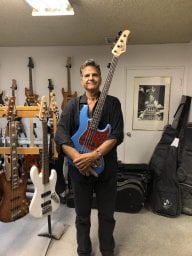
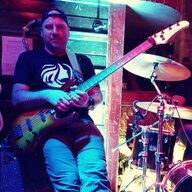
I bring 2, only because we have songs in the sets that have alternate tunings. I swap basses 2-3 times a night.

You’re not crazy. I’ve been doing at least 2 basses for years, because drop D and half step down tunings.
I can foresee 4 basses for 2 hour sets in my near future, between different tunings, fretless, acoustic etc.
I can foresee 4 basses for 2 hour sets in my near future, between different tunings, fretless, acoustic etc.
Well I fell foul of Murphy’s Law this weekend at a gig!
I always take 2 basses my main Stingray and a 5 string which I sometimes use on one song in the set as a backup.
Unusually we had a support act, we’d set up on stage and sound checked and left out gear ready to go and they set up in front.
We finalised the set and we’re not playing the song I need the 5 string for so I just leave it in it’s case for now.
Anyway support act run over by a few minutes so change over is a bit rushed and I just go out with the Stingray.
Typically about 4 songs in I break a string and blind panic sets in.
I jump off stage while the other guys cover me and head for my cases, which have now been blocked in by the support acts gear they have just taken off stage! D’oh!
Fortunately I also carry some spare strings (which should have been on top of my amp!) so I grabbed those and headed back out on stage.
Theatrically ripped off the old string and proceeded to put the new one on.
It seemed to take forever but it was actually pretty quick and not too painful when I watched the footage back!
….However now in my panic I have grabbed the wrong set of strings and have a .110 gauge E string instead of a .100
Never really settled for the rest of the gig and it felt really weird to play.
I’d say I’ll learn, it’s got to be 10 years since I last broke a string, and I probably will for a while until I forget again or get lazy.
The moral of the story is always have a backup and don’t cut corners!
I always take 2 basses my main Stingray and a 5 string which I sometimes use on one song in the set as a backup.
Unusually we had a support act, we’d set up on stage and sound checked and left out gear ready to go and they set up in front.
We finalised the set and we’re not playing the song I need the 5 string for so I just leave it in it’s case for now.
Anyway support act run over by a few minutes so change over is a bit rushed and I just go out with the Stingray.
Typically about 4 songs in I break a string and blind panic sets in.
I jump off stage while the other guys cover me and head for my cases, which have now been blocked in by the support acts gear they have just taken off stage! D’oh!
Fortunately I also carry some spare strings (which should have been on top of my amp!) so I grabbed those and headed back out on stage.
Theatrically ripped off the old string and proceeded to put the new one on.
It seemed to take forever but it was actually pretty quick and not too painful when I watched the footage back!
….However now in my panic I have grabbed the wrong set of strings and have a .110 gauge E string instead of a .100
Never really settled for the rest of the gig and it felt really weird to play.
I’d say I’ll learn, it’s got to be 10 years since I last broke a string, and I probably will for a while until I forget again or get lazy.
The moral of the story is always have a backup and don’t cut corners!

I play p bass in a rock band that has me using a pick exclusively, and I play fairly hard. For that reason only I bring a spare p bass in case I break a string. I’d much rather leave the 2nd at home but I’m paranoid about not having a back up waiting in the wings.

no backup required
That's not up to you to decide.
Sh*t happens.
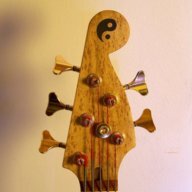
1 bass (my "Stradivarius" =meaning the he best bass I could have)
+ 1 exact copy of that bass, in case something happens in the middle of a song.
Myself I have a EBMM Stingray Short Scale (my "Stradivarius)
-with a Sterling Stingray Short Scale as a spare.
I always keep the spare tuned and on the Hercules stand, next to me on stage.
In the middle of a song there is no time to
"check out the volume and EQ of the spare"
=> it has to be the same level and tone as the main bass.
And the best is if they both have the same sound of the strings,
-or I have to know how to change the tone-knob
if the spare has brand new strings with to much brightness
for the main-bass-settings in the mix.
BUT if some song requires a different tuning
I could have the spare tuned in that tuning.
(Drop-D I ususally do directly on the main bass...)
What about all the advantages of
changing to the perfect bass type & for the different songs
-as I do in studio...?
SORRY...on most BIG concerts I have seen
the only ones to really hear - and appreciate- those different characters of bass sounds
are the people listening in the monitor systems...
On BIG concerts that doesn't happen... I am sad to say.
The latest BIG concert I attended was Rolling Stones in July 2022
(Stockholm Sweden, arena-roof closed)
-and I really tried to hear what BASS-NOTES Darryl Jones played,
BUT except from hiss bass solo
I COULD NOT HEAR WHAT NOTES HE PLAYED!
= and of course not hear any nuances in his bass sound,
expert from the overdriven bass-solo.
It was the usual arena sound:
BOOM BOOM BOOMY bass (kick...)
-like the sound You hear from a bling-bling-car passing by:
You hear there IS bass, but You don't hear the NOTES
(and not any trace of character in the bass sound).
And that is not unique.
But it is a little sad for us bass players,
-as we hope that the audience will hear- and appreciate
the nice sound & funky touch we deliver
(the things we hear in our speakers on stage...)
HOPELESS...?
No.
I hope the Motown type of mixing returns:
-having the bass in the bottom (not SUB...) frequencies
making the groove rolling, and the legs starting to dance.
That is our mission
+ 1 exact copy of that bass, in case something happens in the middle of a song.
Myself I have a EBMM Stingray Short Scale (my "Stradivarius)
-with a Sterling Stingray Short Scale as a spare.
I always keep the spare tuned and on the Hercules stand, next to me on stage.
In the middle of a song there is no time to
"check out the volume and EQ of the spare"
=> it has to be the same level and tone as the main bass.
And the best is if they both have the same sound of the strings,
-or I have to know how to change the tone-knob
if the spare has brand new strings with to much brightness
for the main-bass-settings in the mix.
BUT if some song requires a different tuning
I could have the spare tuned in that tuning.
(Drop-D I ususally do directly on the main bass...)
What about all the advantages of
changing to the perfect bass type & for the different songs
-as I do in studio...?
SORRY...on most BIG concerts I have seen
the only ones to really hear - and appreciate- those different characters of bass sounds
are the people listening in the monitor systems...
On BIG concerts that doesn't happen... I am sad to say.
The latest BIG concert I attended was Rolling Stones in July 2022
(Stockholm Sweden, arena-roof closed)
-and I really tried to hear what BASS-NOTES Darryl Jones played,
BUT except from hiss bass solo
I COULD NOT HEAR WHAT NOTES HE PLAYED!
= and of course not hear any nuances in his bass sound,
expert from the overdriven bass-solo.
It was the usual arena sound:
BOOM BOOM BOOMY bass (kick...)
-like the sound You hear from a bling-bling-car passing by:
You hear there IS bass, but You don't hear the NOTES
(and not any trace of character in the bass sound).
And that is not unique.
But it is a little sad for us bass players,
-as we hope that the audience will hear- and appreciate
the nice sound & funky touch we deliver
(the things we hear in our speakers on stage...)
HOPELESS...?
No.
I hope the Motown type of mixing returns:
-having the bass in the bottom (not SUB...) frequencies
making the groove rolling, and the legs starting to dance.
That is our mission
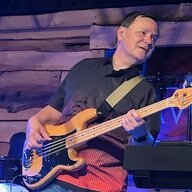
I take two only because of what we’re playing. My band mates love the sound of my ‘74 P bass so that’s the main player. In a 20-some song, two-set gig, about six songs require a fiver (mostly modern country pop crossover stuff for my five-string active jazz). So both are ready to go on stage and we’ve got the sets organized so I’m only swapping once a set. I’m using my Radial Bigshot for a quick swap. It’s also nice to know that if disaster strikes one bass, I’ve got the second right there.
2 basses at a gig. P for the soul set and J for the funk set but both back each other up in case one fails. I’ve never had a bass fail so have often thought about just taking 1 bass for convenience but that would be tempting fate!
I also use 2 cabs incase one fails but only 1 head. If that fails I have a DI box ready to go so I can move the DI cable from the head to the DI box to a get PA connection. The cabs are just used as stage monitors so I can survive with just PA if necessary.
I also use 2 cabs incase one fails but only 1 head. If that fails I have a DI box ready to go so I can move the DI cable from the head to the DI box to a get PA connection. The cabs are just used as stage monitors so I can survive with just PA if necessary.
Last edited:
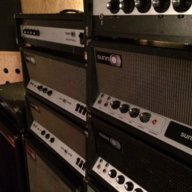
2 basses for a gig - the P is my main bass and I use a PJ or a J for songs with the E string droped to D. I think of the setlist before so I do as less changes as possible. I have to mention that I like to use basses with diffenent neck profiles at gigs - keeps my hands releaxed. I used to take 3 with me but I do thin that's faar too much. Oherwise you could take two amps with you in case of a breakdown.
For small accousic gigs I take one bass with me.
Check out Triggerfinger, the bassplayer uses up to 5+ basses in one gig! His sound is suberb as he is a great bassist!
For small accousic gigs I take one bass with me.
Check out Triggerfinger, the bassplayer uses up to 5+ basses in one gig! His sound is suberb as he is a great bassist!
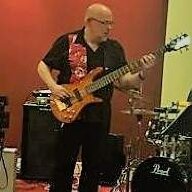
Three basses. One fretted, one fretless (same make/model, so no faffing around with tone change) into one channel of the pre-amp; plus an EUB, which goes into a separate channel of said pre-amp. Again, no faffing. And since I'm the guy up front doing the talking....I have learned to blend my bass changes into my conversation with the audience. So I try to make it not a distraction, but an opportunity for a talking point.
However, I'm also house bassist at a local jazz jam - one P-bass, flats, no fx, small amp, single speaker cab. One trip to and from the car.
Sometimes I might think "do I really need to take all that stuff?", but that should be treated in the same way as every drummer's "I should have learned the piccolo" comments!! We all know that it's strictly for the sake of form, and let's be honest......if anyone were offered that choice, who the heck would really pick a piccolo rather than bringing the noise with drums?
However, I'm also house bassist at a local jazz jam - one P-bass, flats, no fx, small amp, single speaker cab. One trip to and from the car.
Sometimes I might think "do I really need to take all that stuff?", but that should be treated in the same way as every drummer's "I should have learned the piccolo" comments!! We all know that it's strictly for the sake of form, and let's be honest......if anyone were offered that choice, who the heck would really pick a piccolo rather than bringing the noise with drums?
Last edited:

Salud!
I use just 1 bass. Once, playing very far from home, where it wasn't feasible to run back for a second one in case of problems, I brought 2.
For me, bass is a function, not a sound. In a live setting, tone isn't really that important (terms and conditions apply). I would want to hear the sound guy about "that guy that brought 4 basses to a gig". I can get the fretted/fretless thing. If you really need a fiver, use the 5-strings and the fretless.
I use just 1 bass. Once, playing very far from home, where it wasn't feasible to run back for a second one in case of problems, I brought 2.
For me, bass is a function, not a sound. In a live setting, tone isn't really that important (terms and conditions apply). I would want to hear the sound guy about "that guy that brought 4 basses to a gig". I can get the fretted/fretless thing. If you really need a fiver, use the 5-strings and the fretless.

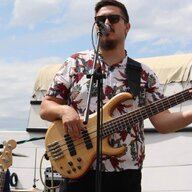
I only ever take 2 basses, 1 to play and then 1 as a spare in case anything goes wrong. If I'm doing 2 sets I do occasionally switch the basses up in between. Nothing to do with tone, purely because I feel like playing a different bass. As others have said, the subtle differences you're talking about are great for recordings, but live will cause you a lot of unnecessary hassle and nobody other than you will notice anything other than you adding to time between songs. I have only once needed to use a spare on stage but i'm quite paranoid and usually take 2 of most things to gigs, microphones, tuners, basses... I even have spare egg shakers for some reason!
All the basses you have described have completely different characteristics tonally, the pickup outputs are likely to be inconsistent across the board, the scale length of the basses will change how each string sounds between basses. You would need to spend a bit of time between each track getting the tone right for the different basses which obviously live is very impractical. Probably best sticking with a single bass and having a second ready as spare.
All the basses you have described have completely different characteristics tonally, the pickup outputs are likely to be inconsistent across the board, the scale length of the basses will change how each string sounds between basses. You would need to spend a bit of time between each track getting the tone right for the different basses which obviously live is very impractical. Probably best sticking with a single bass and having a second ready as spare.
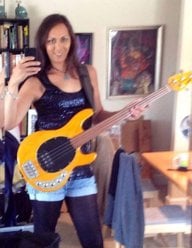
Is 4 basses over 18 songs a ridiculous look?
Yes. You don't need more than two. One fretted, one fretless, max, or if you play one type exclusively, one and a backup, max. 99% of the time, you'll never use the backup.
Last edited:
i Have 60 plus basses in my swamped collection but choose to ALWAYS take a single Santa Barbara Kubicki EX-Factor and this covers it all...
Latest posts
-
-
Software drums recommendation for practice Latin, Cumbia styles preferred
- Latest: bass player 53
-

-

