• TalkBass has been independent since 1998. Add your voice.
    Create a free account to reply to discussions, view embedded media, and browse with fewer display ads.
    Join freeLog in
    Want zero display ads or expanded classifieds tools? Compare plans.

How many frets do you really need?

How many frets do you need to do what you want to do?

  • Just the first five. Anything past that is a waste of space.

    Votes: 3 1.3%
  • Nine. That's a two-octave reach (on a 4-stringer).

    Votes: 7 3.1%
  • Twelve. The full octave.

    Votes: 9 4.0%
  • Fifteen is plenty. I never venture that far down (up) the neck.

    Votes: 34 15.0%
  • Twenty. A P-Bass has twenty. That's all I need.

    Votes: 103 45.6%
  • 24. I actually use all 24 frets regularly.

    Votes: 70 31.0%

  • Total voters
    226
After playing a bass with 24, good intonation, and decent high fret access (Ibanez SR1345b), I'd always want 24 frets unless a pickup placement absolutely prevents it. It feels very natural to use all 24. I am pretty sure it would work on my HH ray34 and Mercalli 4, and if not, I could lose the neck pickup in the Ray for it, I would not want to lose the neck pickup in the Mercalli.

The only good reason not to have 24 on a single humbucker ray is because the originals didn't - and that doesn't seem like a good enough reason to me.

Of course, the availability of 24 fret basses is pretty low, which is why I have two that don't have 24.

 
I think if I'd want a challenge, I could get through a gig on the first nine frets. The highest note of any part in my originals band is an A on the 14th fret of the G string, so I'd need at least that if I wouldn't want to make any compromises. For improvisations, writing or other creative moments I'd like all the frets I can get, thank you very much.

I'd say it is not so much if you need those frets but how often. As your run of the mill pop, rock, blues, country player you'll be happy with your first octave 95% of the time. But when (and that is a when, not an if) you need those extra notes, you need them.
 
Well, they say when you take away one sense the others become more attuned. Probably has extremely good feedback from fine motor control muscles in his arms and fingers, plus perfect pitch?

Also, I wonder if he had markings he could feel on the neck, raised dots somewhere he could feel with his fingers or hand?

I, on the other hand.........well, I can tell when I hit the nut, or go off the end of the fretboard. Gotta at least have some dots on the side at the major intervals, ones I can see.
Having excellent pitch is an aptitude; you get what you get from Nature in that respect. But, the shift memory thing is 99.9% mechanical with possibly some room for adjustment in sufficiently slow passages.

I did my early upright student dues with Bob Gladstone, then Principle for the Detroit Symphony Orchestra. He used to drive all of his students INSANE with shift drills. There is literally no substitute; just something that must be done. Pitch discrimination is just a starting point. Bob didn't even take students without sufficient pitch discrimination. This is NOT a matter of a Johnson measuring contest for pitch discrimination. FWIW
 
  • Like
Reactions: BassicJazzy
Having excellent pitch is an aptitude; you get what you get from Nature in that respect. But, the shift memory thing is 99.9% mechanical with possibly some room for adjustment in sufficiently slow passages.

I did my early upright student dues with Bob Gladstone, then Principle for the Detroit Symphony Orchestra. He used to drive all of his students INSANE with shift drills. There is literally no substitute; just something that must be done. Pitch discrimination is just a starting point. Bob didn't even take students without sufficient pitch discrimination. This is NOT a matter of a Johnson measuring contest for pitch discrimination. FWIW
Yes, I get it. I drill all the time on shifts. Last 8 months I've pretty much only been playing the fretless. I try to practice broken scales and try to constantly vary my shifts, so I'm never in a fixed pattern. The only thing I've ever learned is not to get locked into patterns.

Maybe I was scared as a baby by patterns, because my first and only in-person bass teacher gave me a blues scale he drew in tab on a sheet in E, and I played only in that key using that scale pattern for my first few years?

All that said, back to the OG point, I do find myself drifting out of tune if I don't realign myself to dots, lines, whatever, at least every 30 seconds or so. I do not have perfect pitch. Muscle memory is good enough to go 30 seconds but that's about it unless I am locked into a section of the board, and as I said, I do not like to stay in patterns very long.

So I need my dots. "Dots for tots," but I'm 71 now, started at 18.

Some people just never learn.
 
  • Like
Reactions: bucephylus
Yes, I get it. I drill all the time on shifts. Last 8 months I've pretty much only been playing the fretless. I try to practice broken scales and try to constantly vary my shifts, so I'm never in a fixed pattern. The only thing I've ever learned is not to get locked into patterns.

Maybe I was scared as a baby by patterns, because my first and only in-person bass teacher gave me a blues scale he drew in tab on a sheet in E, and I played only in that key using that scale pattern for my first few years?

All that said, back to the OG point, I do find myself drifting out of tune if I don't realign myself to dots, lines, whatever, at least every 30 seconds or so. I do not have perfect pitch. Muscle memory is good enough to go 30 seconds but that's about it unless I am locked into a section of the board, and as I said, I do not like to stay in patterns very long.

So I need my dots. "Dots for tots," but I'm 71 now, started at 18.

Some people just never learn.
Same. I started with Bob Gladstone 50 years ago. On fretless bass guitar, I not only have dots; I've got training wheel lines. With 6 grandchildren, I'm not too concerned about my manhood.
 
  • Haha
Reactions: BassicJazzy
I think if I'd want a challenge, I could get through a gig on the first nine frets. The highest note of any part in my originals band is an A on the 14th fret of the G string, so I'd need at least that if I wouldn't want to make any compromises. For improvisations, writing or other creative moments I'd like all the frets I can get, thank you very much.

I'd say it is not so much if you need those frets but how often. As your run of the mill pop, rock, blues, country player you'll be happy with your first octave 95% of the time. But when (and that is a when, not an if) you need those extra notes, you need them.
For me it's about getting a different sound. Also, I can play some things in the higher register that are not easy in lower. Just short passages, some fast riffs. Never good to stay up there for more than a short bit, sound is thin, and guitar player may pull your power cord plug out.
 
OK, I'm going to go a different direction on this. Some of the upright teachers, including Ron Carter, advocate learning to play within the 1/2 position. That's 16 available notes. First three frets on an EB plus the open position. Obviously that limits your choice of keys but I have found you can play most jazz major and minor blues, including bebop, successfully in that range, and many other things too. Ron Carter used to force his students to "express the chords using incomplete note availability" and I have found it a useful exercise, part of my daily routine.
 
How many frets do you need to do what you want to do?

Play 5 string basses and mainly live below the 7th fret but I'm a fan of having more than you need. . . . just in case. So far I've never needed more than the standard 21, but a couple of my basses go to 24. It's my job to play what the song requires and if that's a line that hits notes in the 20's then that's what I'll use. I'm not going to tell someone I can't play their song or arrangement because the bass can't do it.

I've used the open B string on a few songs and I once had to play Stevie Wonder's Sir Duke and used every fret on the bass.
 
Interesting. That would challenge my skill set. What maker was that, OOC?

B.C. Rich

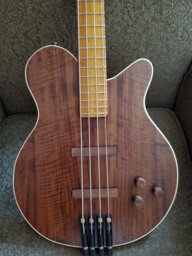
Not mine, but it was an Eagle like this one

b419286d-bbfb-560b-be4c-f20a55d1004c__40674.jpeg


I had my repair guy put in side dots.
 
All my basses have 24 (well except my fretless which has an extended finger board length but no idea how many "frets" that would translate to). I use the upper range, but I didn't realize how often I use it until I was playing a friend's bass that didn't have the full 24 (I don't recall exactly how many it had - 21 probably). Too many times during that jam I ended up running out of frets. It was fun to rethink lines and play the same notes lower on the fly, but I did miss my extra room on the neck.