I currently own an HD500 Hartke combo. Only 250 watts RMS. The amp doesn't sound good at all above 4 or 5 in volume and isn't loud enough for playing with a drummer. I am going to join a band soon. Last 12 years I've been the drummer of the band,, so I am changing it up and playing bass this time and playing bass. I'm buying a new amp and want to buy once. QUESTION for you gigging bassists... How many watts do I need to play with a drummer in a hard rock/classic rock band assuming no PA in a room seating 100 to 200 people? THANK YOU FRIENDS FOR YOUR VALUABLE TIME.

Enjoy the benefits of a premium membership!
Upgrade Account
-
TalkBass has been independent since 1998. Add your voice.
Create a free account to reply to discussions, view embedded media, and browse with fewer display ads.
Join free Log in
Want zero display ads or expanded classifieds tools? Compare plans.
You are using an out of date browser. It may not display this or other websites correctly.
You should upgrade or use an alternative browser.
You should upgrade or use an alternative browser.
Double Bass How much power?
- Thread starter Mike Ikona
- Start date
More options
Who Replied?
Mike, if you're wanting answers from a lot of double bassists and from double bassists who also play electric bass, you're in the right place, because you're currently in the TalkBass/Double Bass (TB/DB) section. If you are really wanting answers from a lot of electric bassists, you may want to have a moderator move this thread to the TalkBass/Bass Guitar (TB/BG) section.

The Hartke might get some more juice with a second cab to get 500 Watts total. Watch the impedance and sensitivity. There are good explanations just a few days ago about the meaning of sensitivity.
But for louder too stuff you might get in feedback land with a DB. I’m pretty sure you need at least 600 watts, probably closer to 1000 watts. But it might alle sense to distribute it to the other musicians by monitors or PA boxes and raise your own speaker loser to your ear and away from the DB body.
So a bigger amp might not be the ultimate solution.
But for louder too stuff you might get in feedback land with a DB. I’m pretty sure you need at least 600 watts, probably closer to 1000 watts. But it might alle sense to distribute it to the other musicians by monitors or PA boxes and raise your own speaker loser to your ear and away from the DB body.
So a bigger amp might not be the ultimate solution.

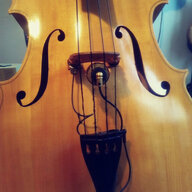
I was thinking raise the cab higher or get an extension cab. Should have enough watts for the real world.
I run 800 watts through three 12” speakers and usually keep up okayish.
If you haven’t already, get your cab off the floor on a milk crate or a chair or something, or tilt it backward. It’ll help get the sound to your ears instead of your knees.
If you haven’t already, get your cab off the floor on a milk crate or a chair or something, or tilt it backward. It’ll help get the sound to your ears instead of your knees.
Also, generally speaking - more speakers will get you more volume better than more watts will. Add an extension to your combo and see if that helps.
Agree. A wall of sound helps reproduce the fundamentals better than a single cab.
I use an 800 watt head with a 410 cab and a Krivo pickup when I know there will be a heavy handed drummer anywhere nearby; 'much better to have a bit extra headroom than too little.
I was thinking of going with fender rumble stage 800 with 2x10 extension cab. that would give me 4x10 total

Also, generally speaking - more speakers will get you more volume better than more watts will. Add an extension to your combo and see if that helps.
Double the power gets you +3dB. This assumes the cab can handle the extra power.
Double the cabs (both identical) and keep the power constant and you also get +3dB
Double the cabs and hold the voltage constant (which results in doubling the power) and you get +6dB.
So with a tube amp, as long as the amp sees the expected loud you will get +3dB from doubling the cabs. This is because the power is held constant.
With solid state amp you will get anywhere from +3dB to +6dB from doubling the cabs.
For example the Mesa Subway amps are rated for
-400W at 8 ohms
-800W at 4 and 2 ohms
So if doubling the cabs changes the impedance from 8 to 4 ohms, you get +6dB. But if doubling the cabs changes the impedances from 4 to 2 ohms, you only get +3dB. -800W at 4 and 2 ohms
Many solid state amps increase power when the impedance is cut in half, but only by about 150%. So you get something like +4dB or +5dB.
Agree. A wall of sound helps reproduce the fundamentals better than a single cab.
While this is true, I would say it's more of an advantage with bass guitar than upright. Putting a bunch of cabs, or even a really big cab like an 810, next to an amplified upright can make it very difficult to get good gain before feedback.
Ultimately the wrong question has been asked.
250W may be plenty with an efficient cab, but nowhere near enough if the cab's efficiency is too low.
SPL results from two things, the amp's power and the speaker's efficiency.
Speaker efficiency is expressed with a sensitivity rating. For example you might see something like 97dB 1W/1m. This means the speaker will produce 97dB measured at a distance of 1 meter with 1 watt applied.
A potential problem here is sensitivity is often given for 1kHz where the driver is most efficient. So, the rating may not be valid at 100hz. Some companies use a nominal sensitivity rating, which means it is sort of an average across a certain frequency band. Sensitivity ratings tend to be most useful if you are comparing cabs in the same product line. This is because them same rating process is used. If you compare product between two companies that use a different process, the ratings can be misleading.
There is a rule that says SPL will change 3dB if the power is doubled. So our cab rated for 97dB 1W/1m will make 97dB with 1W, 100dB with 2W, 103dB with 4W, 106dB with 8W, etc. This makes it fairly easy to figure out how many watts you need for a certain SPL if you know the cab's sensitivity rating; just keep doubling the power until you get the desired SPL.
Of course you will want to keep track of how much power your cab can actually handle and avoid feeding it too much. The point is sometimes you can get the desired SPL by feeding the cab more power, and sometimes you need more cabs to get the job done. See post #11 for more on the benefits of adding cabs. Essentially when you add an identical cab, the sensitivity goes up by 3dB and the power handling doubles so you get another 3dB if you can drive the cabs to their limit.
Sensitivity ratings are sometimes referenced to 2.83V/1m instead of 1W. In other words the rating tells you how loud the cab will be with 2.83V applied. My belief is this is done because when you have a driver that is available in both 4 ohms and 8 ohms, the 4 ohm driver is often less efficient. So using a 2.83V sensitivity rating is a way to hide the difference.
2.83V at 8 ohms is 1W. So an 8 ohm 2.83V/1m rating is the same as the 1W/1m rating.
2.83V at 4 ohms is 2W. To convert this to the 1W/1m rating simply drop off 3dB. For example, if a 4 ohm cab is rated 98dB 2.83V/1m, it is the same as a 95dB 1W/1m sensitivity rating.
250W may be plenty with an efficient cab, but nowhere near enough if the cab's efficiency is too low.
SPL results from two things, the amp's power and the speaker's efficiency.
Speaker efficiency is expressed with a sensitivity rating. For example you might see something like 97dB 1W/1m. This means the speaker will produce 97dB measured at a distance of 1 meter with 1 watt applied.
A potential problem here is sensitivity is often given for 1kHz where the driver is most efficient. So, the rating may not be valid at 100hz. Some companies use a nominal sensitivity rating, which means it is sort of an average across a certain frequency band. Sensitivity ratings tend to be most useful if you are comparing cabs in the same product line. This is because them same rating process is used. If you compare product between two companies that use a different process, the ratings can be misleading.
There is a rule that says SPL will change 3dB if the power is doubled. So our cab rated for 97dB 1W/1m will make 97dB with 1W, 100dB with 2W, 103dB with 4W, 106dB with 8W, etc. This makes it fairly easy to figure out how many watts you need for a certain SPL if you know the cab's sensitivity rating; just keep doubling the power until you get the desired SPL.
Of course you will want to keep track of how much power your cab can actually handle and avoid feeding it too much. The point is sometimes you can get the desired SPL by feeding the cab more power, and sometimes you need more cabs to get the job done. See post #11 for more on the benefits of adding cabs. Essentially when you add an identical cab, the sensitivity goes up by 3dB and the power handling doubles so you get another 3dB if you can drive the cabs to their limit.
Sensitivity ratings are sometimes referenced to 2.83V/1m instead of 1W. In other words the rating tells you how loud the cab will be with 2.83V applied. My belief is this is done because when you have a driver that is available in both 4 ohms and 8 ohms, the 4 ohm driver is often less efficient. So using a 2.83V sensitivity rating is a way to hide the difference.
2.83V at 8 ohms is 1W. So an 8 ohm 2.83V/1m rating is the same as the 1W/1m rating.
2.83V at 4 ohms is 2W. To convert this to the 1W/1m rating simply drop off 3dB. For example, if a 4 ohm cab is rated 98dB 2.83V/1m, it is the same as a 95dB 1W/1m sensitivity rating.
I use this with the Krivo for certain situations. If you get it. I can help you with getting usable settings.I was thinking of going with fender rumble stage 800 with 2x10 extension cab. that would give me 4x10 total


