
Wow. Crazy. My extension (in my avatar) cost me less than £1000 Sterling just over 2 years ago. You guys over there sure pay some money for stuffKieran O'hara recently quoted me at $2800 for a fully gated extension. that's about the going rate.

TalkBass has been independent since 1998. Add your voice.
Create a free account to reply to discussions, view embedded media, and browse with fewer display ads.
Join free Log in
Want zero display ads or expanded classifieds tools? Compare plans.
Wow. Crazy. My extension (in my avatar) cost me less than £1000 Sterling just over 2 years ago. You guys over there sure pay some money for stuffKieran O'hara recently quoted me at $2800 for a fully gated extension. that's about the going rate.

But then again, the quality of the best US extensions is far higher.Wow. Crazy. My extension (in my avatar) cost me less than £1000 Sterling just over 2 years ago. You guys over there sure pay some money for stuff
That is a good suggestion. Also, as I've said, they turn up on all sorts of basses, and they seem to affect the end price far less when it is not a pro orchestra level bass. You see jazz players with them all the time. There is a great younger bassist on the NYC jazz/free jazz scene, Brandon Lopez. He just paid (IIRC) around 3k for a beautiful old carved flat back with one that used to belong to Teddy Kotick (again, IIRC).In the meantime, see if you could convince your orchestra director to install one on the best school bass. It would stay on it permanently and allow the section to learn how to play on one. I just put new E closers on 4 that belong to a local high school. (Originals done in the 80's-90's)
BG

Personally, I've played a bass with an Extension or a 5 string since 1997. I can't imagine being an orchestral bassist without one. (In fact, I've played a few gigs on a borrowed bass without one- and I couldn't process trying to play those notes transposed up an octave anymore...)
As a luthier that makes C extensions, I would recommend holding off until you have a bass that is going to last through college. In the meantime, see if you could convince your orchestra director to install one on the best school bass. It would stay on it permanently and allow the section to learn how to play on one. I just put new E closers on 4 that belong to a local high school. (Originals done in the 80's-90's)
Also- Keiran O'Hara's extensions are about the best in the business! They are worth every penny, however- if you shop around you can find a lower price alternative. If you want the Mercedes of extensions, you will pay for it.
Hope that helps,
BG

The quality of the extension is as good as any I've ever seen, and one would think that the cost of a mechanical extension would be far higher than the simple extended fingerboard with capos. Fitting was done by Martyn Bailey, whose work I find to be at least the equal of anyone else in the UK. When was the last time £1 bought you $2????But then again, the quality of the best US extensions is far higher.
There are recently two exceptions to this in the UK. FYI, the best one I have tried was well over 2800. Also consider that not that long ago £1k was +- $2k. Comparing across borders in such different markets is difficult.
A little over a decade ago.When was the last time £1 bought you $2????
Could not agree more.@Phil Rowan makes a good point, though: If it’s a choice between an extension or a good bow, I’d prioritize investing in the bow.


Why doesn't anyone just make the extension a permanently attached part of the neck/pegbox/fingerboard? (Or maybe, someone already does, but I only read about adding it to an existing bass)

Would capoing the Eb be an option?I always tell myself that the 4th movement of the Eroica symphony would be much easier if I had an Eb gate.
Would capoing the Eb be an option?
Or does it go lower than Eb in places - don't have the score at hand.
Sure. With a good extension, I open the eb with a firm shift if I need to go lower. I hit it with my first finger side up to the knuckle ish. If well made, you can clear E, Eb,D,Db in one quick swipe without much noise. The trickiest thing in Eroica is mastering either shutting them progressively in the skippy arpeggios, or just doing it old school. The latter takes some skill to do truly well, as does shutting each halfstep if that is the plan.Would capoing the Eb be an option?
Or does it go lower than Eb in places - don't have the score at hand.
I have a love-hate relationship with my extension. It makes the scroll-end of the bass heavier, which is more weight on my hand if I stand. It also messes with the balance of the bass when it rests on its side. Playing notes up there can be challenging, too. That's made worse in my case because I've only got a gate on the E. I always tell myself that the 4th movement of the Eroica symphony would be much easier if I had an Eb gate.
On the other hand, there are times when only those low notes will do and most of my section (amateur orchestra) can't reach them. I feel somewhat obligated to be able to play them. I could just tune down, but that can be confusing. I wouldn't want my only bass to be a five-stringer - they're a compromise in themselves. The extra string puts more tension on the top. Also the string spacing is affected or the neck is wider, or maybe both.
I guess in a perfect world, I'd have a fully gated extension that was trivial to remove when I wasn't going to use it. I don't currently have a spare nut; to remove the extension now I'd need to unwind the E string, replace the nut, and rewind the E. Maybe an extension could be made so you didn't have to completely remove the E and just drop in a small partial nut in its place, then wind down the extra E length.
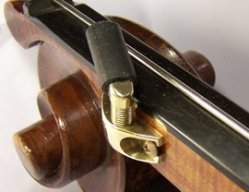
On my bass, I think the interface between the extension and the bass is too tight for a capo to fit on there. I've tinkered with using a banjo capo; it works okay but it takes a long time to put on properly and the fit isn't perfect.


