

I thought I'd post a couple of pictures just for general interest. Since about 1984 this old German bass has been my favorite gig and orchestra bass. It has a very nicely carved round back, but it seemed obvious that it had been cut down, as the endpin was not even close to being centered. There were also missing linings, and bits of linings left elsewhere.
One day, after all this time, the lower back seam popped, and revealed at least a 1/2 inch gap!
Apparently, it was originally a flatback, and all was well with the conversion until half way down the lower bouts, where the width was not the same, and even somewhat asymmetrical. It appears whoever did this solved the issue, by just gluing up the bottom seam good and tight. Sloppy, but it probably worked for over 50 years.
So now, we are finally fixing the errors. The back actually fits beautifully as if it were made for the bass.

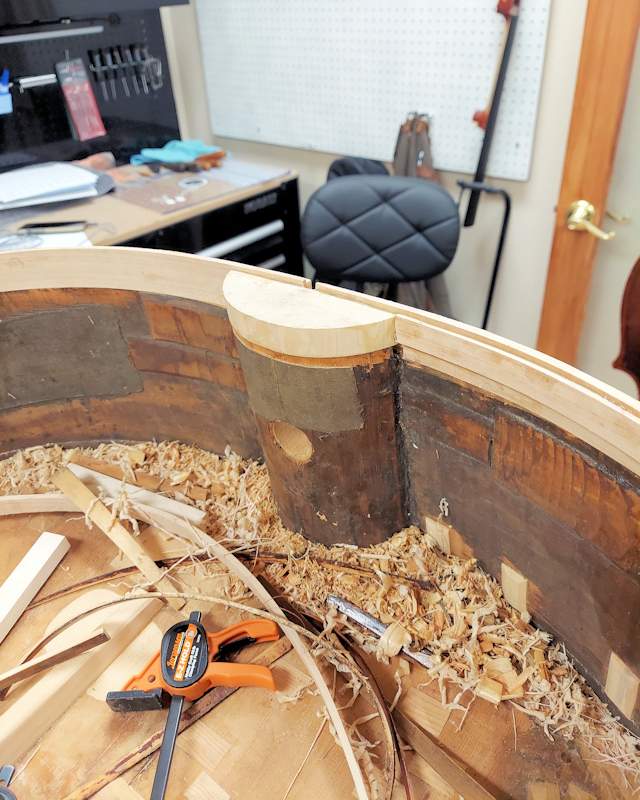
One day, after all this time, the lower back seam popped, and revealed at least a 1/2 inch gap!
Apparently, it was originally a flatback, and all was well with the conversion until half way down the lower bouts, where the width was not the same, and even somewhat asymmetrical. It appears whoever did this solved the issue, by just gluing up the bottom seam good and tight. Sloppy, but it probably worked for over 50 years.
So now, we are finally fixing the errors. The back actually fits beautifully as if it were made for the bass.


