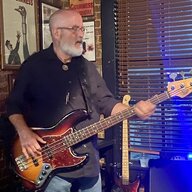
That bassist actually shared a bit in a couple of blog post
[This invalid link has been removed]
Fender American Elite Jazz Bass V + Boss Compress + Sansamp + Ampeg TubeHead + Tone Hammer
I'd say mostly the Jazz, the Ampeg and the Tone Hammer
View attachment 7349211
View attachment 7349210
Cool tone, work well finger style and slap
Hard to translate from an image file - I had to find the blog. TLDR:
He uses an Aguilar Tone Hammer pedal to help color his Sansamp.
The actual translation:
So, changing the subject, I'd like to introduce the gear I use again this time.
Continuing from last time, we started with preamp ①, so this time I'll introduce preamp ②.
The effect pedal I'm introducing this time is the Coachella!! (in the style of a certain major TV shopping channel)
It's the Aguilar Tone Hammer!
I bought this Aguilar Tone Hammer for a low price from a senior at my local high school when I was in high school.
Like the SANSAMP from last time, I had been wanting one, and my senior had one, so I think it was a "if you have it, why not buy it?" situation.
Thank you, S-senpai...
I'll skip the "What is a preamp???" part, as I explained it in the last article. If you'd like to start from there, please take a look at the article on (p.1).
In the last article, I said that the SANSAMP I introduced was too overbearing, but the Aguilar Tone Hammer is different.
Its unique feature is that it makes the original sound natural and refined.
To use an example, it's like that legendary episode of a certain TV shopping show where what looks like just hydrogen water at first glance becomes special just by opening the cap and saying, "Ah, the sound of hydrogen!" The person introducing it has incredible technique.
Since it's a preamp, some of you might be thinking, "Another tone creation?", but its purpose is to add something missing from the sound created with the SANSAMP. Essentially, it's a substitute for an EQ (equalizer). Of course, it also has a D.I (direct box).
This is purely my personal opinion, but I felt like something was missing with just one SANSAMP. It felt like it had a lone wolf-like character but didn't really belong anywhere, so it didn't really suit me. Maybe it's because I'm not very good at creating sounds, though...
I was wondering what to do, so I did some research and found that a lot of professional bassists actually layer preamps, and my own preconceived notion that "if you're going to use a preamp, you should only use one" was completely shattered.
I really felt that the presence of professional bassists who had come before me was invaluable.
By the way, I used bass magazines a lot as a reference when I was researching.
It was a magazine called Effect Board File, released in 2015.
After I realized this, I tried out various preamps I had, and the Aguilar Tone Hammer was the perfect fit. It felt like my lone wolf SANSAMP had found a friend who was there for me; its sharp edges were mellowed out, the sound became warmer, and the SANSAMP sound came to the forefront in a nice way, as if it was being given a push from behind.
The Aguilar Tone Hammer now acts as a secretary.
There's just one downside: most effects pedals are powered by a voltage of 9V, but the Aguilar Tone Hammer is 18V...
This can be surprisingly inconvenient, as you have to get a special adapter and batteries just for this pedal, which can be a bit of a hassle.
To address this issue, I've built my effects board with a built-in power supply (something that provides power) to keep things as consistent as possible.
However, one benefit of doubling the voltage is that it significantly increases the volume and definition, so it might be an even deal.
If you're thinking of buying one, please be sure to consider the power consumption before making your purchase.
To be honest, while the SANSAMP series now has a built-in mid EQ, the earlier models didn't have it.
The model I have doesn't have a mid EQ, so I may not have realised how important it was at the time because I wasn't well-versed in the subject matter...
I believe that the mid EQ is something that is determined by your discretion, so I now believe that the balance of the mid is very important for bassists.
It's a difficult point that needs to be considered depending on the band's genre and song, the vocals, and the sounds of the other instruments. Having too much bass EQ can actually be a distraction and make things worse, while not having enough EQ can make the bass sound unnatural.
I still struggle with this quite a bit, so it's something that will continue to be a challenge for me.
This is great. "Mids are important," I'd like to spread the word...
Bass is so hard.
Also, I'll go into more detail about the power supply and EQ I mentioned earlier in another article.
So, this time I introduced preamp #2. What did you think? ?
I say this every time, but do you get it? ? (cries)
I'm not good at Japanese, so I get anxious every time I post...
I feel like crying.