• TalkBass has been independent since 1998. Add your voice.
    Create a free account to reply to discussions, view embedded media, and browse with fewer display ads.
    Join freeLog in
    Want zero display ads or expanded classifieds tools? Compare plans.

How to play fretless bass

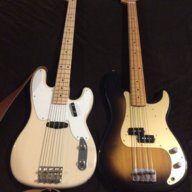
I'm thinking your transition would be easiest with a fretless P bass because the overall feel would be identical to what you're used to and your already present muscle memory would already be very close.
Another consideration is that unless you want to chew your board up, or are playing on a hard synthetic board, you're going to be playing with flatwound strings.
 
It ain't for sissies!

Love it.

It isn't all that hard but you really need good enough ears to confirm your intonation. Go with lines. Especially first bass. I've been playing FL for 45 yrs and believe me it helps. I play particularly complex jazz/fusion stuff and appreciate the lines.

I'm not trying to impress any eyes, only ears.
 
Another consideration is that unless you want to chew your board up, or are playing on a hard synthetic board, you're going to be playing with flatwound strings.

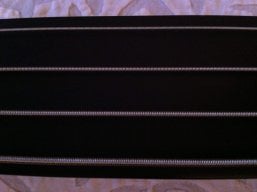
Nah, it's much less of a big deal than people think. I seem to post this photo on a lot of fretless threads, so I'll post it again. My fretboard after 15 years of roundwound strings. There's some wear, but it doesn't affect sound, tone, playability, etc.

 
I play nothing else and most of my bandmates simply don't notice. You MUST play in tune. If you take away nothing else from this thread, take that.

How to do that? My violin teacher used to make me play in the dark. It worked for me. It probably won't for everyone. But that's all I know! I don't know if, since you play fretted, if getting one with fretlines would help or not. The violin guys frown on it but if you already know the fretted it might help.

Good luck!
 
There are a lot of different ways to tackle it; here's what worked for me...

Get a fretted and fretless that are similar (like a fretted and fretless Jazz). Learn a song on fretted, then switch over to playing it on the fretless. You will have the 'feel' of what to do, and it will be suprisingly easy (IMO).

Start with lines, then to go unlined later (that's what I did) OR go right to unlined if that feels right...

OR just stick with lines forever. Don't get hung up on whether you should have lines or not. Both are totally valid approaches. I found it easier to start lined (way easier if you are beginning), but I finally went unlined because the I tended to stare at my left hand so much it made my neck hurt. So I just use the side dots now. (All the lined ones seem to have the dots in between the lines, which is annoying/confusing, while the unlined ones have dots at the fret position.) Aside from that the only real advantage to unlined is that people notice it and think you are cool. At first I would have said that is a stupid reason, but if I am honest, I like it. And it kind of explains why I am not that good :D.

Opinions are like @$$holes, everybody's got one; that's mine. :)
 
  • Like
Reactions: jasonmatthews
My violin teacher used to make me play in the dark. It worked for me. It probably won't for everyone. But that's all I know!

I'm a cellist. This makes sense for classical instruments because there are things we do that let us know where we are on the fingerboard and it's relatively easy to play without ever having to look at your hands. When you're learning, it's difficult to know the neck by "feel" so things like playing in the dark are good training tools. Ultimately, though, it's *much* easier (in my opinion) to play a classical instrument blind than an electric bass. On bass we don't have physical things along the board to let us know where we are (like the neck joint, etc.) so it's incredibly difficult to know exactly where you are all the time.

Additionally, as a classical musician your eyes are almost always busy looking at music, or the conductor, or section leader (or if you're the section leader, you're watching the concertmaster), or whatever else, so it's critical to be able to play without looking. Soloists, though, look at their left hand all the time. Not always, but frequently when there's a tough passage.

All that said, in my personal opinion I do not think it's terribly helpful to try and learn a fretless bass neck by feel (obviously other people might have different opinions). If it were such an important or "normal" thing to do, fretless bass necks wouldn't have markings of any kind. But it's not normal and they all have markings; it's the nature of the instrument. As bassists (and guitarists), we look at our hands; it's normal and expected. As a teacher, I would rather have a student be 95% accurate by watching his hands than have him be 75% accurate never looking and always having to adjust if he missed.

But that's just my opinion. :)
 
I have been playing a P-Bass for most of the 52 years I've been playing. About 25 years ago, I got a fretless P-Bass (obviously with no lines). The 2 most important things I figured out right off the bat were #1-The dot markers on the side of the neck are NOT where they are on a fretted bass, they are where the fret for that note is supposed to be. #2- Intonation set at the octave is actually more critical than on a fretted bass. If your octave isn't perfect, you will never play in tune anywhere else on the fretboard. I have always played on the back side of the fret on a fretted bass instead of right between them, so the transition was fairly easy.
It's not real hard to play. You just have to pay attention to what you're doing all the time. It's not for the guy who mixes sound from the stage or fiddles with gadgets while he's playing. That's my 2 cents worth.
 
I switched fretless 15 years ago and now that's all I play. I bought an unlined Warmoth used for a great price. I had tried fretless many years ago and failed. I think part of the reason for my success this time around was having a bass that suits me. I agree with almost all the comments above. I don't think lined or unlined matters because you have to play with your ear, as many have said. The side dots provide plenty of reference when you need them. Having an instrument that in tune with a good set-up is important. Start very slowly and use a reference pitch. A drone works. iReal Pro works. What really helped me was SightReadingFactory.com. You read standard notation and hear the notes being played. When you're off, it's obvious because you're playing in unison with audio output. The advantage of sight reading is that you can't look at the neck if you're reading the notation. You can read standard notation if you start slowly enough and simple enough. Once I can play the exercise through with few mistakes, I repeat the exercise, but up an octave on my bass. Higher frequencies are much less forgiving. Knowing that you're off is important, but knowing whether you're sharp or flat is even more important. The key is learning how to make micro adjustments on the fly by ear. I don't know any way of learning that, except through lots of practice. I have no doubt that singing helps, but I just hate singing. I like iReal Pro for practicing intonation too. Just arppegiate all the chords, and you'll learn how chord tones sound in the context of the chord. Your first time playing at rehearsal will be stressful, and your first time gigging will be even more stressful. I recommend recording your rehearsals and gigs to identify problem areas. Sometimes different fingering can improve the intonation. Your initial goal should be to play so that you don't sound like you're playing a fretless. All those slides and mwah gets old after a while. A little goes a long way. If you want to make the commitment, I believe it will pay off for you. Your ear will improve as a result. If you get discouraged, go back to slow and simple.
 
  • Like
Reactions: almadillo
...... A drone works. iReal Pro works. What really helped me was SightReadingFactory.com. You read standard notation and hear the notes being played. When you're off, it's obvious because you're playing in unison with audio output. The advantage of sight reading is that you can't look at the neck if you're reading the notation.....

What a great site to learn how to sight read! Thanks! This is awesome!

Also, I love iRealPro but sometimes find it limiting in selection of what instruments are playing. I've been using ChordBot which is similar but lets you get very specific as to what instruments are playing and how loud each are ... and you can have a lot of them playing at the same time. I use a keyboard-drone sound that works well with the guitar playing chords and the drum doing whatever.

Cheers.
 
  • image.jpeg

  • Practice mindfully
  • 1,2 4 fingering (Simandl upright method) below the 12th harmonic
  • Use tools like tuner, drone and metronome
  • Tuners and metronomes do not lie
  • Set aside a few minutes practice time specifically for intonation
  • Record yourself and listen back
Either lined or unlined fretless bass, the Simandl upright fingering was developed for intonation.
Simandl = 1,2 4 fingering below the 12th harmonic. Go to 1,2,3 or 1,2,3,4 when higher up. Thumb on the back of the neck and don't angle fingers.

Get a good tuner. That Korg in the photo is a tuner, metronome, drone and records. Be aware of the 'lazy ear'. Lazy ear develops because of unmindful practice. Can happen over years and you won't notice it. Playing fretless in front of the tv is a waste of time, don't bother. Ok for fretted bass just to flex some fingers.

Like some singers sing kinda in tune, but notes in phrases are out of tune, this can happen on fretless. You hear singers do it all the time on 'The Voice'. Fretless players fall into this. Don't!

Practice bass patterns carefully, stop and check notes with your tuner, open strings and harmonics. You can play with your eyes closed or in the dark. Play a chromatic scale then check it with an open string or harmonic to hear how in tune you really are. A drone can be useful.

Know your board 100%, right to the top. This means every note you can play, know it's name. That goes for fretless unlined, lined, and fretted. Be able to name the notes you play (out loud or in your head) one end of the board to the other.

Don't rely on visual patterns, that's too easy. Minor/major, diminished, half dim etc triads play one end to the other and name the notes. Same for scales in all keys. Every pro, and good amateur can do this. It's not that hard as notes above the half of the 12th harmonic are simply the same as the lower half.

Make your ears do the real work, don't get lazy with the tuner.

Set aside about 20 minutes each practice specifically for intonation. Try to think of intonation practice as putting money in the bank. Then go crazy and play whatever turns you on. Start spending the money.

1,2 4 fingering may be awkward and un natural at first but will pay off with good technique and intonation later. Higher on the board 1,2,3 or 1,2,4 or 1,2,3,4.

This vid of Federico Malaman shows great left hand technique.


Attachments

  • image.jpeg
    image.jpeg
    79.8 KB · Views: 37
Last edited:
I like Lauren's midi file idea. SightReadingFactory.com is a similar concept, but entering the line in Sibelius and playing along to the audio output allows you to practice more useful (and musical) lines. Slow unison lines above the twelfth "fret" have really helped me.
 
Classic TB thread cycle: OP asks a kind of green question, gets a load of really good, detailed replies, then goes "actually nah i'm not going to bother LOL". then everyone just carries on replying with yet more detailed advice.

anyway - this is actually a great thread for new fretless players!
 
  • Like
Reactions: JRA
Classic TB thread cycle: OP asks a kind of green question, gets a load of really good, detailed replies, then goes "actually nah i'm not going to bother LOL". then everyone just carries on replying with yet more detailed advice.
:laugh: :thumbsup:

...this is actually a great thread for new fretless players!
:thumbsup:
 
  • Like
Reactions: knumbskull