Preface:
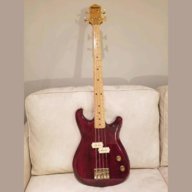
My favorite bass--and my #1--is my Hofner 500/1 Contemporary violin bass. However, that doesn't mean it's perfect; in particular, the arcane control panel wiring is somewhat limiting. I thought I'd share the rewiring scheme I've experimented with, in case any one else wants to make their violin (or Club) bass more flexible. (I've posted about this in other threads, but this gathers it all in one place and brings the circuit up to date.)
Stock Wiring:
The stock switch functions are as follows: Rhythm puts two resistors in series with the output signal, reducing the volume to 70% of full; Bass On puts a .1 uF treble cut capacitor in series with an 8.2K Ohm resistor parallel to the neck pickup (the resistor in series prevents the tone from being 'turned down all the way,' which reduces or eliminates the resonant peak and leaves a little more treble intact) and also switches the bridge pickup out of the circuit; Treble On puts a .01 uF capacitor in series with the bridge pickup (a capacitor wired in series cuts bass) and also switches the neck pickup out of the circuit. Everything up ('off') is bypass (no capacitors affecting the pickups). Because of the 'equal and opposite reaction' switch wiring, pickup blending is only possible with the pickups bypassing the capacitors, which is one of the biggest limitations. And the volume reducing Rhythm setting doesn't seem particularly useful.
The Solution:
So last year I set about keeping the existing control panel but rewiring it for more flexibility. In particular, I wanted to be able to use treble cut capacitors to affect both pickups, and I wanted to use the bridge pickup's bass cut cap to improve pickup blending.
I went through several iterations and a quite a few capacitor values before settling on a simple yet versatile circuit (thanks to several folks on Talk Bass and Hofner Hounds for their help along the way):

What we have here is basically a Volume-Volume-Tone-Tone circuit; each pickup has its own volume and tone controls. (The diagram is missing the resistors I've wired in series with the two caps on the Bass On switch; more on that below.)
Variations on the Theme:
For a while, I had it wired more like a Jazz bass (red wire connected to to yellow and green on the Volume 2 pot and no treble cut cap on the Treble On switch), so the Bass On treble cut caps affected both pickups. Sounded good, but the pickups blend much better with the tone controls connected to the volume pot wipers. (In particular, the bridge pickup tone got pretty strangled with both a bass cut cap and a treble cut affecting it at the same time, making its volume pot act more like an on-off switch.)
And for about a year, I had three tone caps (plus bypass) on the Bass On switch (run another jumper from the Solo switch to the unused side of the Bass On switch and add a cap). In the end, all that switching was too fiddly, as I didn't need three caps plus bypass in the real world. I also tried a slew of treble cut cap values along the way: .0068 uF imparted a woody, somewhat P-bass-ish tone; .01 uF, .015 uF, and .022 uF created rather harsh and honky resonant peaks, .033 uF sounded really good--fairly dark but with strong mids, .047 uF was dark and punchy, .068 uF and .1 uF were dark and dubby. The original .1 uF cap with the 8.2K Ohm resistor sounded good, too. Here's what I settled on in my final iteration of the circuit (the diagram above):
How It Works:
The Solo/Rhythm switch bypasses or engages the neck pickup's treble cut capacitors.
From there, Bass On lets me choose between two treble cut caps: .015 uF with an 8.2K Ohm resistor in series for a moderate treble cut (without the honky sound the cap had on its own); .047 uF with an 8.2K Ohm resistor for a deeper cut and a really smooth tone (by comparison, I found the stock .1 uF/8.2K Ohm combo a little dull sounding).
On the bridge pickup side of things, Treble On lets me switch the stock .01 uF bass cut capacitor in and out. This setting doesn't sound particularly great soloed (great for tic-tac tones, though!); where it comes to life is in blending the two pickups. The bass cut cap removes the comb filtering and phase interactions between the pickups, allowing the bridge pickup to be used a treble boost of sorts--switch in a dark sound on the neck pickup and then dial in the bridge pickup to taste for more bite and clarity, while still maintaining a really rich, full tone.
And in the up position, the switch takes out the bass cut cap and puts a .033 uF treble cut cap in parallel with the bridge pickup for a tight, punchy tone that actually sounds good soloed (and also with some neck pickup dialed in); without any treble cut, the soloed bridge pickup is just too bright and nasal sounding for my taste.
Together, these mods offer a lot more tonal flexibility and control than the stock wiring, while still being simple to use (which I find particularly important for playing live). The improvement in pickup blending is dramatic, thanks to the tone controls connected to the pot wipers and the switchable bass cut cap.
Addendum:
Note 1: The pickups blend best when the dominant pickup is dialed back to about 80% and the secondary pickup is dialed in to taste; there's less subtle blending control if one of the pickups is turned up all the way.
Note 2: The capacitor values are very much according to personal taste; I settled on the ones that sounded best to my ear and for my playing situations. And there's a simple way to audition treble cut caps without even opening up the bass: unscrew the end of the instrument cable that plugs into the bass, attach an alligator clip lead to ground and another alligator clip lead to hot, and then put various caps between them (the switches need to be set to bypass [off/no caps] for this to work).
Note 3: When putting a resistor in series with a capacitor to smooth out the resonant peak, the value isn't critical--anything between around 5 and 10K Ohms will smooth out the sound. If you like the resonant peak, skip the resistor, or lower its value. (A trim pot could be an interesting option...)
Note 4: One could also put just one capacitor on the Bass On switch and use the Rhythm/Solo switch to select how deep the treble cut from that cap is, using something like a 150K Ohm resistor on one side of the switch and and a smaller resistor (6 or 8K Ohm) on the other side. The bigger resistor would be like turning down a tone knob part of the way, the smaller resistor would be like turning it down most of the way. (Or no resistor on one side would be like turning the tone down all the way, with the resulting resonant peak.)
Note 5: Alternatively, if one were to have only one treble cut cap on the Bass On switch (so there's still a bypass setting), the Rhythm/Solo switch could be turned into a kill switch.
Note 6: Another option in place of the .01 uF bass cut capacitor is a smaller value, like .0047 uF, a la Rickenbacker. The idea would be to let only highs through the bridge pickup and only lows through the neck pickup; the particular bass cut and treble cut capacitor values will determine the crossover frequency.
Note 7: If one were to leave the stock .1 uF cap/8.2K Ohm resistor as a Bass On setting and if one were to omit the bridge pickup treble cut cap (leave off the cap and the yellow wire running from the Treble On switch to the Volume 1 wiper), the bass would offer all the original stock tones, just with more flexibility. (In fact, one could even leave the stock Rhythm/Solo switch; the Bass On switch would select between cap or no cap [bypass]. In this case, the only change from stock would be eliminating the 'equal and opposite reaction' from the Bass On and Treble On switches for improved pickup blending.)
My favorite bass--and my #1--is my Hofner 500/1 Contemporary violin bass. However, that doesn't mean it's perfect; in particular, the arcane control panel wiring is somewhat limiting. I thought I'd share the rewiring scheme I've experimented with, in case any one else wants to make their violin (or Club) bass more flexible. (I've posted about this in other threads, but this gathers it all in one place and brings the circuit up to date.)
Stock Wiring:
The stock switch functions are as follows: Rhythm puts two resistors in series with the output signal, reducing the volume to 70% of full; Bass On puts a .1 uF treble cut capacitor in series with an 8.2K Ohm resistor parallel to the neck pickup (the resistor in series prevents the tone from being 'turned down all the way,' which reduces or eliminates the resonant peak and leaves a little more treble intact) and also switches the bridge pickup out of the circuit; Treble On puts a .01 uF capacitor in series with the bridge pickup (a capacitor wired in series cuts bass) and also switches the neck pickup out of the circuit. Everything up ('off') is bypass (no capacitors affecting the pickups). Because of the 'equal and opposite reaction' switch wiring, pickup blending is only possible with the pickups bypassing the capacitors, which is one of the biggest limitations. And the volume reducing Rhythm setting doesn't seem particularly useful.
The Solution:
So last year I set about keeping the existing control panel but rewiring it for more flexibility. In particular, I wanted to be able to use treble cut capacitors to affect both pickups, and I wanted to use the bridge pickup's bass cut cap to improve pickup blending.
I went through several iterations and a quite a few capacitor values before settling on a simple yet versatile circuit (thanks to several folks on Talk Bass and Hofner Hounds for their help along the way):
What we have here is basically a Volume-Volume-Tone-Tone circuit; each pickup has its own volume and tone controls. (The diagram is missing the resistors I've wired in series with the two caps on the Bass On switch; more on that below.)
Variations on the Theme:
For a while, I had it wired more like a Jazz bass (red wire connected to to yellow and green on the Volume 2 pot and no treble cut cap on the Treble On switch), so the Bass On treble cut caps affected both pickups. Sounded good, but the pickups blend much better with the tone controls connected to the volume pot wipers. (In particular, the bridge pickup tone got pretty strangled with both a bass cut cap and a treble cut affecting it at the same time, making its volume pot act more like an on-off switch.)
And for about a year, I had three tone caps (plus bypass) on the Bass On switch (run another jumper from the Solo switch to the unused side of the Bass On switch and add a cap). In the end, all that switching was too fiddly, as I didn't need three caps plus bypass in the real world. I also tried a slew of treble cut cap values along the way: .0068 uF imparted a woody, somewhat P-bass-ish tone; .01 uF, .015 uF, and .022 uF created rather harsh and honky resonant peaks, .033 uF sounded really good--fairly dark but with strong mids, .047 uF was dark and punchy, .068 uF and .1 uF were dark and dubby. The original .1 uF cap with the 8.2K Ohm resistor sounded good, too. Here's what I settled on in my final iteration of the circuit (the diagram above):
How It Works:
The Solo/Rhythm switch bypasses or engages the neck pickup's treble cut capacitors.
From there, Bass On lets me choose between two treble cut caps: .015 uF with an 8.2K Ohm resistor in series for a moderate treble cut (without the honky sound the cap had on its own); .047 uF with an 8.2K Ohm resistor for a deeper cut and a really smooth tone (by comparison, I found the stock .1 uF/8.2K Ohm combo a little dull sounding).
On the bridge pickup side of things, Treble On lets me switch the stock .01 uF bass cut capacitor in and out. This setting doesn't sound particularly great soloed (great for tic-tac tones, though!); where it comes to life is in blending the two pickups. The bass cut cap removes the comb filtering and phase interactions between the pickups, allowing the bridge pickup to be used a treble boost of sorts--switch in a dark sound on the neck pickup and then dial in the bridge pickup to taste for more bite and clarity, while still maintaining a really rich, full tone.
And in the up position, the switch takes out the bass cut cap and puts a .033 uF treble cut cap in parallel with the bridge pickup for a tight, punchy tone that actually sounds good soloed (and also with some neck pickup dialed in); without any treble cut, the soloed bridge pickup is just too bright and nasal sounding for my taste.
Together, these mods offer a lot more tonal flexibility and control than the stock wiring, while still being simple to use (which I find particularly important for playing live). The improvement in pickup blending is dramatic, thanks to the tone controls connected to the pot wipers and the switchable bass cut cap.
Addendum:
Note 1: The pickups blend best when the dominant pickup is dialed back to about 80% and the secondary pickup is dialed in to taste; there's less subtle blending control if one of the pickups is turned up all the way.
Note 2: The capacitor values are very much according to personal taste; I settled on the ones that sounded best to my ear and for my playing situations. And there's a simple way to audition treble cut caps without even opening up the bass: unscrew the end of the instrument cable that plugs into the bass, attach an alligator clip lead to ground and another alligator clip lead to hot, and then put various caps between them (the switches need to be set to bypass [off/no caps] for this to work).
Note 3: When putting a resistor in series with a capacitor to smooth out the resonant peak, the value isn't critical--anything between around 5 and 10K Ohms will smooth out the sound. If you like the resonant peak, skip the resistor, or lower its value. (A trim pot could be an interesting option...)
Note 4: One could also put just one capacitor on the Bass On switch and use the Rhythm/Solo switch to select how deep the treble cut from that cap is, using something like a 150K Ohm resistor on one side of the switch and and a smaller resistor (6 or 8K Ohm) on the other side. The bigger resistor would be like turning down a tone knob part of the way, the smaller resistor would be like turning it down most of the way. (Or no resistor on one side would be like turning the tone down all the way, with the resulting resonant peak.)
Note 5: Alternatively, if one were to have only one treble cut cap on the Bass On switch (so there's still a bypass setting), the Rhythm/Solo switch could be turned into a kill switch.
Note 6: Another option in place of the .01 uF bass cut capacitor is a smaller value, like .0047 uF, a la Rickenbacker. The idea would be to let only highs through the bridge pickup and only lows through the neck pickup; the particular bass cut and treble cut capacitor values will determine the crossover frequency.
Note 7: If one were to leave the stock .1 uF cap/8.2K Ohm resistor as a Bass On setting and if one were to omit the bridge pickup treble cut cap (leave off the cap and the yellow wire running from the Treble On switch to the Volume 1 wiper), the bass would offer all the original stock tones, just with more flexibility. (In fact, one could even leave the stock Rhythm/Solo switch; the Bass On switch would select between cap or no cap [bypass]. In this case, the only change from stock would be eliminating the 'equal and opposite reaction' from the Bass On and Treble On switches for improved pickup blending.)
Last edited: