Originally posted by Chris Fitzgerald
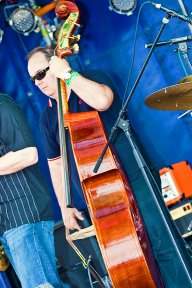
I wouldn't suggest for a minute that you emulate the sound of DB unless that's what you're hearing in your head. What I meant was, on tunes that you WANT to sound "straight ahead", it's often good to take some of the edge off of the BG tone. When you start to get beyond note choices and even (to a certain extent) rhythm, one often overlooked aspect of improvisation is something I think of as "sonic space", for lack of a better word...I firmly believe that this is one part of the music that people react to on a very instinctual level, and in some ways, that fine control of the subtleties of this part of the musical texture are a lot of what seperates the good players from the mediocre, and the great from the good. BG takes up a quite different portion of the sonic spectrum (texturally speaking, not in terms of range) than DB, and this must be accounted for when playing, especially if the tune you are playing requires walking bass.
The BG tone is typically much punchier on the attack than DB, and also sustains longer - which makes it resemble more a solid wall of sound when walking lines. (This is not a value judgement, just an observation) As a result, the "bounce" often found in good DB walking lines is difficult to pull off on BG, even by great players. Again, let me state that this is just the nature of the beast - I've heard Pattitucci (sp?) play with Chick Corea's "Akoustic Band" live twice in my life. Once, he was playing DB, and the second time the airline had temporarily "lost" his DB, so he had to play 6 string BG. Both were great concerts, but they were also very different sonically.
I do try to change the tone/texture depending on what's happening and quite often if it starts as a quiet solo - by piano or guitar for example; I will switch to a palm-muted sound and pluck with my thumb, for a walking line with more space. Then maybe go to a more sustained BG sound if it is a tenor player, say, really trying to raise the energy level.
The thing is though that I tend to feel if all I am going to be doing is emulating DB on walking lines, than I might as well get one; but I like the fact that you can do a lot more on BG and actually make yourself heard on solos!

The question really is about being accepted by other players and bandleaders as a BG player in Jazz groups.
We could ask the same question about Pop and Rock music. Why is it that for the past 50+ years, 99.9% of the music has been played using a snare backbeat on 2 and 4? It absolutely killed me when Rap first came in, and music was reduced to ONLY this rhythm and some angry dude or another talking and shaking his arms like a chicken. I think that walking lines - like the backbeat - have persisted because they are "comfortable", and everybody can already identify with them.
Well, there are a lot of things that can be added to walking lines, a lot of derivations, but I'm not sure that this thread is the best place to discuss them, since it started out as a newbie instructional thread. One thing is for sure - anyone who CAN'T walk a pretty decent "standard" type of line has no business trying to go "beyond that".