• TalkBass has been independent since 1998. Add your voice.
    Create a free account to reply to discussions, view embedded media, and browse with fewer display ads.
    Join freeLog in
    Want zero display ads or expanded classifieds tools? Compare plans.

How would you finger this passage?

Bob_Ross

Gold Supporting Member
Dec 29, 2012
14,358
29,430
One of my bands is doing a cover of Donny Hathaway's version of "What's Going On?" and I've been using a transcription of Willie Weeks' original bassline from that recording as a general guide.

He plays this figure, twice in the introduction:
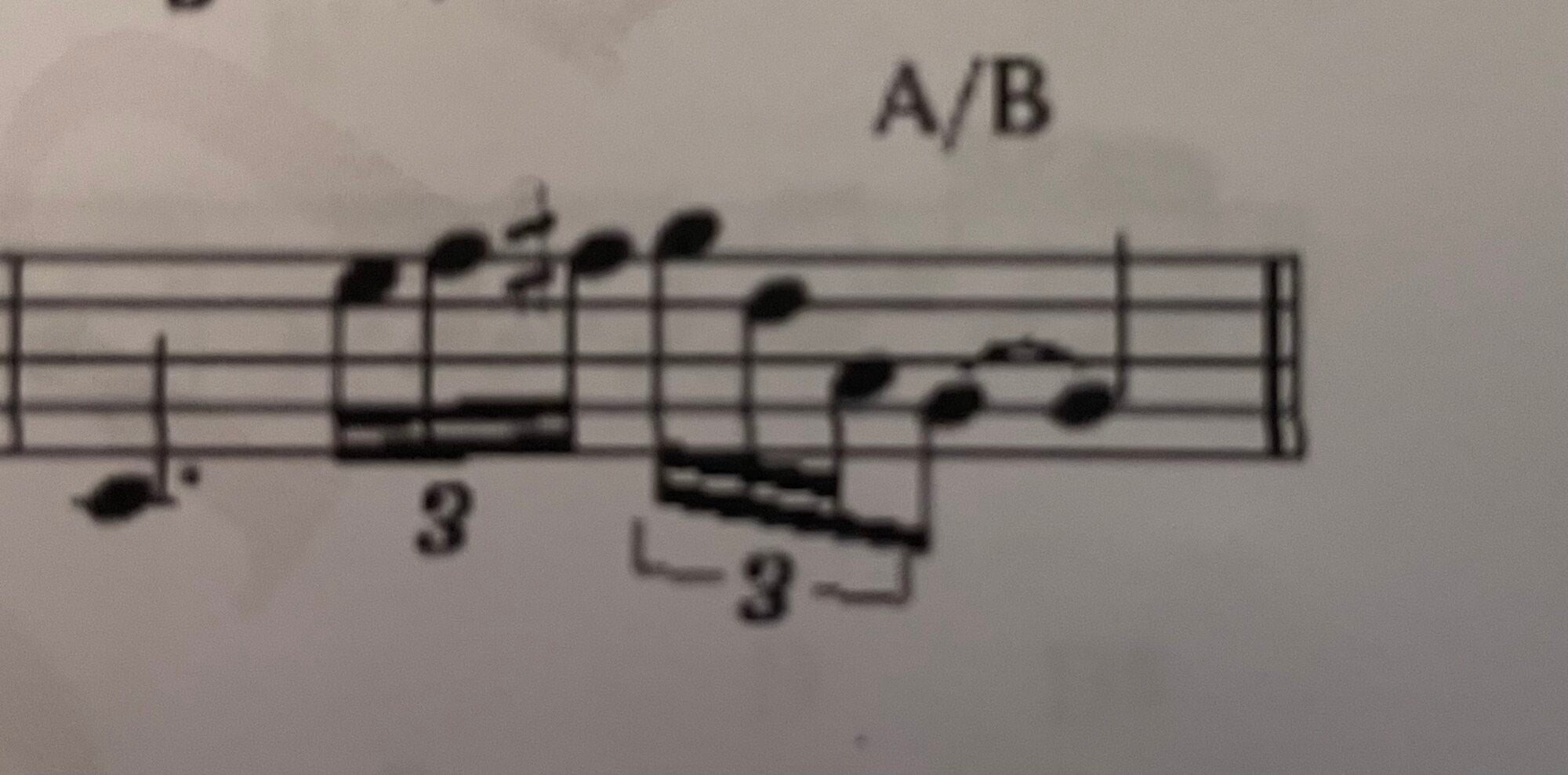
IMG_7147.jpg


(Song is EDIT in C# minor, so four sharps. Tempo is 95bpm, and sixteenth notes are swung. FWIW, if it had been me doing the transcription I'd put the two triplets under a single slur and add an accent over the final B, just to be thorough.)

How would you finger that passage?

I've come up with a way that works...but it is such an odd, atypical way of executing old-school R&B/pop/funk bass lines that I just can't convince myself that's what Weeks did, or even that that's the best way to play this passage.

Just curious if there's something I've overlooked, or if anyone has some insights that might help. Thanks.
 
Last edited:
One of my bands is doing a cover of Donny Hathaway's version of "What's Going On?" and I've been using a transcription of Willie Weeks' original bassline from that recording as a general guide.

He plays this figure, twice in the introduction:

View attachment 7317485

(Song is kinda in E Dorian, so key signature indicates F# and C#. Tempo is 95bpm, and sixteenth notes are swung. FWIW, if it had been me doing the transcription I'd put the two triplets under a single slur and add an accent over the final B, just to be thorough.)

How would you finger that passage?

I've come up with a way that works...but it is such an odd, atypical way of executing old-school R&B/pop/funk bass lines that I just can't convince myself that's what Weeks did, or even that that's the best way to play this passage.

Just curious if there's something I've overlooked, or if anyone has some insights that might help. Thanks.
What is the key?
 
Me, I'd finger it:
G string - Fret 1 finger 1, fret 2 finger 1, fret 3 finger 2, fret 4 finger 4
D string - Fret 4 finger 4
A string - Fret 4 finger 4, fret 2 finger 1

Yeah, that was my first approach, but I think my pinky is too weak to barre the second triplet reliably, while still being able to pull off to hit the low B accent cleanly.
 
Wait, derp, I'm an idiot! I grabbed the wrong chart when I was checking the key signature! :facepalm:

You are correct @MonetBass "What's Going On?" is indeed four sharps, so C# minor or E major.

Mea culpa.
 
  • Like
Reactions: MonetBass
One of my bands is doing a cover of Donny Hathaway's version of "What's Going On?" and I've been using a transcription of Willie Weeks' original bassline from that recording as a general guide.

He plays this figure, twice in the introduction:
Best if you specify the fingering system you use.

I use primarily one finger per fret, so I would probably play the chromatic line 1,2,3,4. The drop back down could be 4,4,1 or 4,4,2.

Years ago I used Simandl 1,2,4, where a shift or pivot would be required. Don't have a bass in my hand at the moment, but I would probably use a pivot with 1,2,2,4,4,4,1
 
What's Going On is most certainly in the Key of E Maj. The tonal center is major. You are referring the Donny Hathaway, Live recording?
Fingering for Electric Bass, 1F1F
G# 1st
A 2nd
A# 3rd
B 4th
F# 4th
C# 3rd or 4th (see what works, some have suggested 2, that seems like too much movement)
B 1

Simandl method for DB would not use the 3rd as Wasnex points out.

Willie Weeks bass line in this rendition is spectacular. This is the definitive version of this tune in my opinion. Jamerson is great too, but Weeks kills this.
 
Last edited:
I just sight read it and played it. I played E open, G string: g#1, a1, a#2, b4, D string: f#3, A string:
C#2, B1.
I generally use what I call closed/open fingering for electric. It is my own terminology. For lower positions I generally stick to a modified * Simandl fingering (closed) and expand to one finger per fret when needed (open). Note that I only do this on fretted electric. On fretless and upright I pretty much use Simandl.

I haven’t listened to the track in many years. If I was trying to really articulate every note in the triplets detache, I would have played it as 1, 2, 3, 4 on the G string.

* by modified I mean that I will use my 3rd finger occasionally when in closed position if it feels natural and musical.
 
Last edited:

So for all you guys who've suggested 4th finger for the B-F#-C# descending triplet figure... you're barring that with your pinky?
iow, when you hit the high B on the first string 4th fret, you're stopping that note with the side of your pinky (so that the parts of your pinky closer to the tip are immediately available to stop the second string 4th fret and third string 4th fret in quick succession)?
 
So for all you guys who've suggested 4th finger for the B-F#-C# descending triplet figure... you're barring that with your pinky?
iow, when you hit the high B on the first string 4th fret, you're stopping that note with the side of your pinky (so that the parts of your pinky closer to the tip are immediately available to stop the second string 4th fret and third string 4th fret in quick succession)?
Yeah, I'd be barring that. I know you said that's not a possibility for you, in which case you could slide your 2nd finger up to the B so you could bar the F# and C#.
 
  • Like
Reactions: Bob_Ross