• TalkBass has been independent since 1998. Add your voice.
    Create a free account to reply to discussions, view embedded media, and browse with fewer display ads.
    Join freeLog in
    Want zero display ads or expanded classifieds tools? Compare plans.

I can’t make up my mind - help me pick a round!

Mar 30, 2023
1,449
2,317
I started caring about strings about five years ago, when I switched to flats and tapes almost exclusively. Last year, I sold all my Fenders and got an oddball - a six-string short-scale string-through headless.

I won't get into details, but this means I can only use hex-core round wounds (scale length doesn't matter).

Edit: I need a hex-core string because I can't cut into the middle of a round-core string without it unwinding and/or going dead, which is also the case for flats. I can cut into a tapewound without it going dead, and I could try using glue to stop it from unwinding, but it seems like too big a risk.

My three favourite strings, tone and feel wise, on the Fenders were the La Bella light black nylons, light white nylons and low-tension flats. I did try rounds briefly and liked DR Sunbeams and TI Jazz Rounds, but those have a round core.

Because my favourite flats and tapes were from La Bella, I bought La Bella's RX-N6A nickels (30-40-60-80-100-118). While I like the gauge and tension, I'm not particularly fond of the tone. It's alright, a bit bright, though I suppose that's expected coming from flats and tapes, but nothing special. The B could also use more definition.

Of course reading forums and watching videos can only get me so far, but six-string sets aren't cheap and as readily available as four-string sets.

Some strings that have piqued my interest are:

Dunlop Super Brights nickels - Tension seems good, heard they weren't too bright despite the name and they're pretty cheap. But the B on the six-string set is 130 and that seems daunting.

DR Nickel Lo-Riders - People have said they were stiff and that the B doesn't sound so good. Also expensive.

GHS Pressure Round - I think I'd like them tone wise, but tension sounds like it could be a bit high. Even more expensive.

SIT Foundation nickels - Seem interesting, but many people on Amazon have said they had QC issues with the six-string set.

I've also never really knowingly tried steel rounds. I don't think I like the idea of something even brighter than nickel, but I realize some bassists I admire, like Janek Gwizdala and Derrick Hodge, use them, although their playing is much more melodic than mine.

For what it's worth, I mainly play pop, R&B, soul, funk and follow along jazz method books. I don't play hard rock or metal. I only play finger style, and I don't have a heavy picking hand.

Thank you!!
 
Last edited:
  • Like
Reactions: GTHintz
Dunlop Super Brights nickels - Tension seems good, heard they weren't too bright despite the name and they're pretty cheap.

I like these strings pretty well. I agree that they're not too bright, maybe somewhere in the Sunbeam neighborhood. But if you are looking for something tighter/stiffer than Sunbeams, you won't find it with the Super Brights. Yes, they have a hex core; but that core is so thin, they are noticeably more flexible than Sunbeams.

EDIT: I just re-read your post, and I think I now understand why you need hex core. Super Brights may be worth a try for you, especially considering they are cheaper than a lot of other options.
 
Last edited:
  • Like
Reactions: Just Wrong
I like these strings pretty well. I agree that they're not too bright, maybe somewhere in the Sunbeam neighborhood. But if you are looking for something tighter/stiffer than Sunbeams, you won't find it with the Super Brights. Yes, they have a hex core; but that core is so thin, they are noticeably more flexible than Sunbeams.

EDIT: I just re-read your post, and I think I now understand why you need hex core. Super Brights may be worth a try for you, especially considering they are cheaper than a lot of other options.
Thank you for your input.

I've elaborated on the hex-core thing in the original post. I would love a round-core string, but:

I need a hex-core string because I can't cut into the middle of a round-core string without it unwinding and/or going dead, which is also the case for flats. I can cut into a tapewound without it going dead, and I could try using glue to stop it from unwinding, but it seems like too big a risk.
 
  • Like
Reactions: Lee Moses
I can't cut into the middle of a round-core string without it unwinding
Not sure if it's possible with your situation but, I use the flat spot on the back end of a pair of wire crimpers before I cut my roundcore strings.


maxresdefault-2236417146.jpg
 
Some companies offer single strings for sale. Since auditioning six-string sets is expensive, maybe try a single string from various sets you're considering, to make weeding out the rejects more affordable?
 
Not sure if it's possible with your situation but, I use the flat spot on the back end of a pair of wire crimpers before I cut my roundcore strings.


View attachment 7185870
I don't know how other brands do it, but DR says:

"Strings made with wrap wire wound upon round core wire need an edge to grip the core wire to prevent the string from going dead and losing intonation.

Round core wire, by definition, has no edges. Hexagonal core has 6. So, at DR Strings we flatten the round core wire to create an anchor for the wrap wire to grip the core wire.

We flatten a small section of the core wire at a spot that should lie past the nut at the top of the fingerboard and between the tuning machines of your instrument. This flat section provides and anchor for the wrap wire to grip the core wire. You should be able to feel this flattened area between your fingers as you touch the end of the string opposite the ball end.

Without the anchor the string is likely to unwind, go "dead", and fail to intonate properly.

If you need to cut or trim your strings between the anchor (the flattened section) and the ball end, carefully and severely bend or crimp your string as illustrated. The severe bend (crimp) will provide an anchor for the round core."

From what I understand, if you have a 34-inch scale headless bass, you'd still be cutting the string in the flat section, preventing it from unwinding.

With a short scale, I'd have to bend it and cut it, but I can't really do that unless I want to look like this:
 

Attachments

  • 1742991586956.png
    1742991586956.png
    1.7 MB · Views: 13
Some companies offer single strings for sale. Since auditioning six-string sets is expensive, maybe try a single string from various sets you're considering, to make weeding out the rejects more affordable?
That could be an option. Thanks!

I actually bought a single tapewound when I first got it, because while some people told me it would unwind if I cut it before the silk, others were adamant - and I mean adamant - that it wouldn't. Spoiler: it did.
 
Who makes the bass? What strings come on it stock?

And sounds cool, let's see some pics 📸

😁
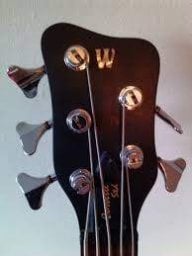
The brand is Swan. It's from a luthier in Argentina. It came with Magma strings, an Argentinian string manufacturer. I did not like them. They sounded lifeless, felt rough and the tension was a bit high.

Essentially, I'd been playing four-string passive Fender Precisions and Jazzes for 15 years, and decided I wanted something new.

So I basically got the complete opposite: six strings, headless, short scale, four-band preamp, soap bar hum buckers, a ramp, sting-through body, semi hollow, 16.5 mm spacing, pau ferro board, single cut, etc.

IMG_0040.jpeg
 
Some companies offer single strings for sale. Since auditioning six-string sets is expensive, maybe try a single string from various sets you're considering, to make weeding out the rejects more affordable?
This reminds me actually that I did talk to Pyramid about making a short scale six string set where I would cut into the silk rather than the middle of the string. They could do it, but then I tried their four-string set and didn't like them. They were hairy? And the gauges were huge. I think the E was 112. Maybe I'll try again see if they can make the gauges smaller…
 
I think the real issue for you is the short scale. I spoke to Jason at Fret Nation and he feels that with my 33" scale headless I can use any hex core flatwound. I'm guessing this could be different for you because of your bass' scale length?

Once again, I have Sunbeams on my headless, and now that they're losing their brightness, they sound amazing. My good friend has been using Sunbeams on his headless basses for years. Also 33" scale basses. You may want to give them a try. After a lot of playing time, they mellow out perfectly, and the low tension is wonderful. I'm actually hesitant to switch them out. I played a gig with this bass two nights ago, and the sound was amazing....although I'm still really curious about the Pressurewounds and also to try and see if flats could indeed work for me.

Good luck!
 
I think the real issue for you is the short scale. I spoke to Jason at Fret Nation and he feels that with my 33" scale headless I can use any hex core flatwound. I'm guessing this could be different for you because of your bass' scale length?

Once again, I have Sunbeams on my headless, and now that they're losing their brightness, they sound amazing. My good friend has been using Sunbeams on his headless basses for years. Also 33" scale basses. You may want to give them a try. After a lot of playing time, they mellow out perfectly, and the low tension is wonderful. I'm actually hesitant to switch them out. I played a gig with this bass two nights ago, and the sound was amazing....although I'm still really curious about the Pressurewounds and also to try and see if flats could indeed work for me.

Good luck!
The round-core should be fine if you're cutting into the "flatten section" as stated above, which is probably the case if it's your working for you.

The problem with flats, as I understand it, is that you need to cut into the silk, which might work with a 33-inch scale, but not a 30.75-inch scale.

I know from experience that tapes need to be cut into the silk - I tried cutting them for this bass and the nylon unwound.
 
The round-core should be fine if you're cutting into the "flatten section" as stated above, which is probably the case if it's your working for you.

The problem with flats, as I understand it, is that you need to cut into the silk, which might work with a 33-inch scale, but not a 30.75-inch scale.

I know from experience that tapes need to be cut into the silk - I tried cutting them for this bass and the nylon unwound.
I wonder if you could put a drop of superglue at the place you wanna cut to keep the tape from unwinding?
 
I wonder if you could put a drop of superglue at the place you wanna cut to keep the tape from unwinding?
People have said they've done it… but it's a gamble I'm not sure I want to take. A six-string set is $85. I have to do it right six times.

But, I've spoken to Pyramid. They can do a six-string set in light gauges for a short scale bass.

I also sent an email to D'Addario. They already make a short scale set, along with a long scale B and C. So it's just a matter of making a short scale B and C.

I'm hoping D'Addario says yes, but if not, I'll probably try Pyramid.
 
  • Like
Reactions: Reedt2000
The round-core should be fine if you're cutting into the "flatten section" as stated above, which is probably the case if it's your working for you.

The problem with flats, as I understand it, is that you need to cut into the silk, which might work with a 33-inch scale, but not a 30.75-inch scale.

I know from experience that tapes need to be cut into the silk - I tried cutting them for this bass and the nylon unwound.
I haven't tried it yet, but I'm wondering about putting heat shrink around a tape wound where you need to cut it…I would think that could keep the tape from unraveling…seems reasonable and I'll definitely try it at some point
 
  • Like
Reactions: Reedt2000
The round-core should be fine if you're cutting into the "flatten section" as stated above, which is probably the case if it's your working for you.

The problem with flats, as I understand it, is that you need to cut into the silk, which might work with a 33-inch scale, but not a 30.75-inch scale.

I know from experience that tapes need to be cut into the silk - I tried cutting them for this bass and the nylon unwound.
Jason told me it's ok to cut into the string itself, as long as it's a hex core flat…but definitely check with him to be sure I understood correctly
 
Jason told me it's ok to cut into the string itself, as long as it's a hex core flat…but definitely check with him to be sure I understood correctly
I would definitely check with the string manufacturer before cutting into a flat string, whether hex or round. I haven't asked any, but IIRC, the conversation around it seemed unanimous that that wasn't going to work.
 
I started caring about strings about five years ago, when I switched to flats and tapes almost exclusively. Last year, I sold all my Fenders and got an oddball - a six-string short-scale string-through headless.

I won't get into details, but this means I can only use hex-core round wounds (scale length doesn't matter).

Edit: I need a hex-core string because I can't cut into the middle of a round-core string without it unwinding and/or going dead, which is also the case for flats. I can cut into a tapewound without it going dead, and I could try using glue to stop it from unwinding, but it seems like too big a risk.

My three favourite strings, tone and feel wise, on the Fenders were the La Bella light black nylons, light white nylons and low-tension flats. I did try rounds briefly and liked DR Sunbeams and TI Jazz Rounds, but those have a round core.

Because my favourite flats and tapes were from La Bella, I bought La Bella's RX-N6A nickels (30-40-60-80-100-118). While I like the gauge and tension, I'm not particularly fond of the tone. It's alright, a bit bright, though I suppose that's expected coming from flats and tapes, but nothing special. The B could also use more definition.

Of course reading forums and watching videos can only get me so far, but six-string sets aren't cheap and as readily available as four-string sets.

Some strings that have piqued my interest are:

Dunlop Super Brights nickels - Tension seems good, heard they weren't too bright despite the name and they're pretty cheap. But the B on the six-string set is 130 and that seems daunting.

DR Nickel Lo-Riders - People have said they were stiff and that the B doesn't sound so good. Also expensive.

GHS Pressure Round - I think I'd like them tone wise, but tension sounds like it could be a bit high. Even more expensive.

SIT Foundation nickels - Seem interesting, but many people on Amazon have said they had QC issues with the six-string set.

I've also never really knowingly tried steel rounds. I don't think I like the idea of something even brighter than nickel, but I realize some bassists I admire, like Janek Gwizdala and Derrick Hodge, use them, although their playing is much more melodic than mine.

For what it's worth, I mainly play pop, R&B, soul, funk and follow along jazz method books. I don't play hard rock or metal. I only play finger style, and I don't have a heavy picking hand.

Thank you!!
Regarding the GHS Pressurewound strings - GHS makes the same strings for Ken Smith, who sells them cheaper than GHS does for their own. They do a tapered core B string and the winding on that is 38", so make sure that will work with your bass. I think I have an old one in my to recycle box that I could measure if you want to know the distance between the ball end and the end of the taper. I never noticed any issue with stiffness playing them. Is tension/pull on the neck your main concern or is it how stiff they feel? Those don't always correlate exactly.

Something I've found helpful in avoiding wrap unwinding is to put a 90 degree bend in the end of the string before I cut it, then trim just enough past the bend (about an inch, I estimate) so that it goes into the hole in the middle of the tuner post.
 

Latest posts