Ditto on all the comments about EQ.
I'd like to suggest that "Timbre" is often what we are talking about though. Timbre is that quality of the musical sound that, for example, separates one instrument from another. If a violin and flute both play an "A", they still sound much different. This is because each instrument has a different timbre.
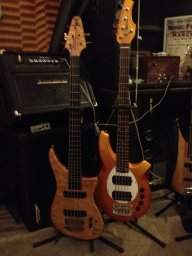
But you can also distinguish timbre between similar instruments. A P-Bass won't get certain Warwick sounds no matter how you EQ it. You can add Mids, but you still won't get that Warwick "sound". Same holds for all kinds of models of basses.
Take this one step further, and we see that strings have a huge impact in timbre as well. Flats just can't be EQd to sound like Rounds, etc.
The reason for this is harmonic overtones. When an instrument plays a 440hz "A", it is also generating lots of harmonics - at 880, 1320, 1760, 2200, 2640, etc. Each harmonic has a different relative amplitude to the fundamental. Different instruments have different relative amplitudes for the harmonics. And this basically is timbre - it's why a violin doesn't sound like a flute. A violin sounds so rich because it has a very complex harmonic spectrum, with (generally speaking) high relative amplitude.
I know what you're thinking: "Hey, I'll get a 31-band (or 63, or N) EQ and I'll fix fiddle with those pesky harmonics, and I'll turn my flute into a violin! Cool!! Ahhh... Not so fast! It turns out that the harmonic spectra is pretty complex. There's a lot of stuff going on "in-between" the whole number harmonics as well, due to the mathematical nature of how those frequencies interact. I'm a former signals engineer, so I'll try to keep that hat OFF, but the point is that the harmonic spectral content of various instruments is very complex.
So, little changes like strings, pickups, finger vs. pick, etc, all do have a very real impact on "cutting through". EQ is a necessary thing for balancing out the large scale sound issues (boomy room, high end treble for slap, etc). It can help you cut - especially the mids as stated - but only so much. As an exercise, play an E on the 7th fret of the A string, and then play the same octave E but on the 2nd fret of the D string. Sounds different, no? Playing higher up the neck chokes off some harmonic content, changing the timbre. And that's on the same exact bass!
Here's a neat mathematical example: Take a fundamental freq, then add only the odd harmonics. Furthermore, make the amplitude for each harmonic equal to 1/N (where N = the # of the harmonic). So that the 3rd harmonic is 1/3 the amplitude of the fundamental, the 5th harmonic is 1/5 the amplitude of the original, etc. What do you get? If we do this out for several harmonics, we get a nice square-wave! And most of you know how buzzy and harsh a square wave sounds - nothing at all like the adding some nice even order harmonics at varying amplitudes.
Sorry for the long ramble - hope somebody finds the geekier aspects of the hobby as interesting as I do!
The bottom line: You can't turn a flute into a violin.
-M
p.s: Yes, you're correct: most people actually mean "timbre" when they say "tone".