• TalkBass has been independent since 1998. Add your voice.
    Create a free account to reply to discussions, view embedded media, and browse with fewer display ads.
    Join freeLog in
    Want zero display ads or expanded classifieds tools? Compare plans.

Ibanez SR400 Radius question for fretless conversion (5ths tuning)

Hey guys I recently received an SR400 bass (dark purple / black hardware) from a friend of mine who no longer plays. The thing is in rough shape but hey I got it for free. Since I already have a BTB 1406e 6 String I figured I could have a little fun with this one.

I pulled the frets using end nippers and a soldering iron ), filled them with birch veneer (rosewood fretboard), and super glued them in and then used a flush cut saw to shape them flat to the board and gradually sanding from 120 to 600 grit until smooth.

My question for you guys is for the next part of this. It already sounds great with the custom GHS Precision flats set on it (.130, .085, .055, .040 for CGDA fifths tuning) but I want to make it even better.

Right now the fretboard is still a little rough and you can see the shimmer of the super glue on the edges of where the frets use to be. So I want to sand more but I would feel more comfortable if I had a sanding radius block to ensure I'm not messing with the board too much.

MY QUESTION: Does anyone know the radius for an Ibanez SR400? from what I can tell on the ibanez site all of their 4 string basses have 12" radius boards, but I want to make sure before I go ahead and buy a block from stew mac.

Thanks in advance guys! I was thinking about even using a cyanoacrylate coating or epoxy for the board if I can't get ride of the shimmer of the super glue. Jaco style haha. I also think I need to shim the neck or something since all the frets above 11 and 12 buzz like a mofo. Any tips on that would be appreciated as well.

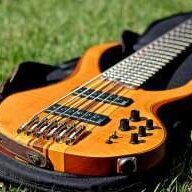
Edit: Not a photo of mine but this is the bass I'm talking about
$_35.jpg
 
I'm not sure of the radius on that bass but you can find out by buying a radius gauge from Stew Mac. If you look carefully on google I think you may even be able to download a printable one (I saw it mentioned somewhere).

Buzzing on higher frets sounds like too much relief, take some out (if necessary) with the truss rod after assessing the current level of relief. Don't shim the neck, its not going to help.
 
Thanks for your help guys. The reason I was going to shim the neck was mostly because my strings are still way too high on the upper parts of the neck even though my saddles are set as low as they could go. In that case I would assume a shim would be beneficial?

Also do you think the ibanez basses would be compound radius (different at the first and last fret)?
 
Here's some of my photos of the fretless conversion:

13138112195_0f322d2f2e_c.jpg

13138396274_c3835f78a4_c.jpg

13138227073_73cdcba541_c.jpg

13138224853_8b813209fa_c.jpg


It's a bit rough but I'm happy with it! The instruments finish needs fixing since the last owner pretty much never cleaned it (gross). After trying to clean it myself with every dunlop product imaginable (i have the kit) I'm not sure what to do, oh well it was free haha.
 
So I'm playing with the idea of finishing the board some how, possibly with epoxy. Right now its just oiled with bore oil.

I'm a bit worried about ruining the board and was wondering if it was worth it since I think I'm only going to use flat wounds on this bass anyway. Opinions? Will a epoxy finish make the board smoother playing?

Edit: Also was hoping someone could help me with my shim question
Thanks for your help guys. The reason I was going to shim the neck was mostly because my strings are still way too high on the upper parts of the neck even though my saddles are set as low as they could go. In that case I would assume a shim would be beneficial?

I also heard good things about Envirotex Lite for finishing the board
 
Hey guys I recently received an SR400 bass (dark purple / black hardware) from a friend of mine who no longer plays. The thing is in rough shape but hey I got it for free. Since I already have a BTB 1406e 6 String I figured I could have a little fun with this one.

I pulled the frets using end nippers and a soldering iron ), filled them with birch veneer (rosewood fretboard), and super glued them in and then used a flush cut saw to shape them flat to the board and gradually sanding from 120 to 600 grit until smooth.

My question for you guys is for the next part of this. It already sounds great with the custom GHS Precision flats set on it (.130, .085, .055, .040 for CGDA fifths tuning) but I want to make it even better.

Right now the fretboard is still a little rough and you can see the shimmer of the super glue on the edges of where the frets use to be. So I want to sand more but I would feel more comfortable if I had a sanding radius block to ensure I'm not messing with the board too much.

MY QUESTION: Does anyone know the radius for an Ibanez SR400? from what I can tell on the ibanez site all of their 4 string basses have 12" radius boards, but I want to make sure before I go ahead and buy a block from stew mac.

Thanks in advance guys! I was thinking about even using a cyanoacrylate coating or epoxy for the board if I can't get ride of the shimmer of the super glue. Jaco style haha. I also think I need to shim the neck or something since all the frets above 11 and 12 buzz like a mofo. Any tips on that would be appreciated as well.

Edit: Not a photo of mine but this is the bass I'm talking about
$_35.jpg
 
I am a former luthier and current bass player, among other things. Your Ibanez SR 400 has a board radius of 12". For a shine, dont apply a finish. Use Micromesh. It STARTS at 600 grit, and goes up to 12000. Use in order. When you're done, your board will have a nice luster, and be smoother than something or other. I never ever ever put finish on a violin or other board. Bad, very bad. Re the string height. Without looking at it, it sounds like your truss rod is WAY too tight. Sight down the neck. The board should have only a very slight downward curve for mediums .Before you start fixing that, put your bridges at about mid-height. Now, with an allen wrench that fits the truss rod nut, loosen 1/8 turn at a time until the problem is corrected. Then set up per factory specs. A fretless (Im doing the same thing to mine, and btw, good choice of birch veneer.) A fretless obviously can have lower action. Also, the nut needs to be lower. It's a file and try operation, or cut grooves deeper. That's all I know to suggest. Now adjust your bridges to match the curve of the fb. Adjust only 1/4 turn at a time until you get a buzz, then back off until it doesn't buzz. Good luck, Jim
 
Without looking at it, it sounds like your truss rod is WAY too tight.
huh?

with too-high action and saddles as low as he can put them, my guess would be a rod that's too loose.

he should indeed have only the slightest amount of curve in the neck, checked by holding down a string at the first and last "fret" and looking at the 8th "fret"; if the gap between board and string is any bigger than a thin business card then that rod needs to be tightened.

Also, the nut needs to be lower. It's a file and try operation, or cut grooves deeper.
+1, very important! those slots should be almost down to the wood, like maybe .010" above the board itself.

get a .010" feeler gauge, lay it in front of the nut, and file down the slots until your nut file just hits the feeler gauge.
 
I want to sand more but I would feel more comfortable if I had a sanding radius block to ensure I'm not messing with the board too much.

MY QUESTION: Does anyone know the radius for an Ibanez SR400?
here's a good answer:

who cares? :)

instead of getting a radius block or whatever, all you need to do is tighten the rod until the neck is totally straight, no relief at all, then sand it with a long perfectly flat bar of some sort, like a 2 foot long carpenter's level from the hardware store, with sticky-back sandpaper on it, say 120 grit.

you sand parallel with the neck, working your way back and forth across from bass side to treble side, until all of the neck is smoothed out.

the issue with the radius block is that it's too short, so you end up sanding "up the hills and down the valleys" and not actually leveling out the bumps and twists in the wood.

this is the idea, only without the big price tag:
Fret_Fingerboard_Levelers.jpg


i use theInvalid Link Removed myself, but for a one-off home repair it might be a bit pricey.

i also only use it in a proper neck-tensioning jig to guarantee my results will be perfect, but again that's beyond the scope of what you're dealing with here.
 
  • Like
Reactions: JLS