• TalkBass has been independent since 1998. Add your voice.
    Create a free account to reply to discussions, view embedded media, and browse with fewer display ads.
    Join freeLog in
    Want zero display ads or expanded classifieds tools? Compare plans.

Idea for a DIY practice amp

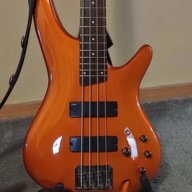
Not long ago I picked up my first bass (A used Ibanez SR300), and I need to get a practice amp. I need something pretty small because the area where I practice is small. For guitar I use my Boss Katana 50, and I'd like to stick to around the same size for the bass amp. Unfortunately, pretty much everything I see this small isn't able to provide any low bass output, so my lower tones are pretty muted and mushy. Right now I'm just using the Katana amp, which has the same issue despite having a 12" driver.

So... since I'm a DIY'er and a hobbyist speaker builder, I thought it would be fun to build my own to suit my specific needs. I don't need it to be loud enough to gig with, just loud enough to practice at home, but I want deep bass extension and a small size. To accomplish this I'm looking at an active 3-way design that utilizes a subwoofer driver designed for small enclosures, a woofer/midwoofer for midrange, and a tweeter for the highs.

To power it, I'm looking at one of the cheap TPA3116 chip based modules. I've used a few of these and I like them. One that I'm looking at has a 2.1 configuration with an active low pass filter with variable filter frequency for the .1 channel, and a 100hz active high pass for the other two channels. I can use one of the stereo channels to power my mid(s) and the other to power the tweeter, with passive filtering applied to both.

So, overall, this should be a really nice sounding fullrange speaker, with more than enough power (200w total) to shake my windows, which is more than I'll ever need for practicing.

However, since I want this to sound like a bass rig and not like a DI into a stereo, I'm planning on incorporating the Behringer BDI21 bass preamp into the system.

My total investment should be under $300, and fits my needs of a small form factor and full range sound with deep bass extension, as well as the benefit of whatever cosmetics I choose. While I have plenty of experience with home & car audio, as well as with guitar amps, I have no experience at all with bass amps. For those of you with more bass experience (specifically associated with practice situations), do you see any major flaws with my plan?

 
Look at Equal-loudness contour - Wikipedia
When you play quieter, you need to turn up the bass and highs make it sound "equal" to how you'd play it louder levels.
Some EQ tweak may be all you need.
I'm aware of the loudness contour, but cranking the bass on the amp isn't going to compensate for the rolloff of the driver, which seems to be pretty high on most of the smaller, undersized practice amps. If anything, it's going to make the upper bass range boom and still have a weak low E note. I was really hot for the Fender Rumble 40, but after learning that it employs a high-pass filter, even if I change the driver to something with better extension, I'm going to be fighting its inability to produce low notes.
 
You could find a used bass combo amp on Craigslist for much less and would better fit your needs. I found an old Fender Rumble 15 cheap. It has a great bass sound, not like other cheap amps. And you can run your phone through the RCA jacks for music to practice to.
 

Attachments

  • rumble.jpg
    rumble.jpg
    111.8 KB · Views: 78
I'm aware of the loudness contour, but cranking the bass on the amp isn't going to compensate for the rolloff of the driver, which seems to be pretty high on most of the smaller, undersized practice amps. If anything, it's going to make the upper bass range boom and still have a weak low E note. I was really hot for the Fender Rumble 40, but after learning that it employs a high-pass filter, even if I change the driver to something with better extension, I'm going to be fighting its inability to produce low notes.

Use some tools to measure what your speaker actually does. i.e.
REW - Room EQ Wizard Room Acoustics Software

And also look at: Missing fundamental - Wikipedia
This is why you can hear fundamentals in speakers that can't actually reproduce the fundamentals.

But, by all means, if you already have all the answers go for it.
Runs some cabinet design software, make the smallest, lowest, that puts out enough volume for you.
Maybe you'll have something revolutionary that just nobody ever thought of.
 
Use some tools to measure what your speaker actually does. i.e.
REW - Room EQ Wizard Room Acoustics Software

And also look at: Missing fundamental - Wikipedia
This is why you can hear fundamentals in speakers that can't actually reproduce the fundamentals.

But, by all means, if you already have all the answers go for it.
Runs some cabinet design software, make the smallest, lowest, that puts out enough volume for you.
Maybe you'll have something revolutionary that just nobody ever thought of.
I doubt any of this will be anything unique... it's just employing techniques that are already well understood in speaker building. I just haven't seen them used for bass guitar amps.

I realize that you can simulate a bass sound with harmonics, but it's not a sound that I ever felt was natural sounding. Bose did a lot of this with their Acoustimass subwoofers by using cheap drivers with huge amounts of 2nd order distortion to fool the listener into thinking that there was deeper bass than what was really there. Once you hear "that" sound, it's hard to unhear it, and it's something that I'm hoping to avoid.
 
I think a 3-way speaker system seems overly complicated for a practice amp, especially if a design goal is a smaller package.

How is the power distributed among the 3 channels of the power amp? Generally speaking, your sub and low/mid driver will need most of the power available; the tweeter will need almost none. And do you really need a tweeter in a bass practice amp? (YMMV :D).

If you're determined to go 3-way, tri-amped, then it seems logical to use active filters in front of the power amps rather than wasting power with passive filters. Otherwise, why not just use a larger, single-channel amp? Oh wait, I see that you're going to employ the on-board active filter for the LF/MF, so would just need a simple HPF for the tweet. Still seem overly complicated for a practice amp to me...do you know about the newer 8" drivers like the Faital or Turbosound ones? They seem like pretty good fit for your application.

Or...just buying something used would be more cost-effective; I've bought a couple of small amps off of Craigslist for $100 or so each. Ampeg BA-112, Fender Rumble 60 (gen 2), Hartke something-or-other with 120-watts into a 12, etc. Obviously, not as much fun, or as challenging, but....
 
I think a 3-way speaker system seems overly complicated for a practice amp, especially if a design goal is a smaller package.

How is the power distributed among the 3 channels of the power amp? Generally speaking, your sub and low/mid driver will need most of the power available; the tweeter will need almost none. And do you really need a tweeter in a bass practice amp? (YMMV :D).

If you're determined to go 3-way, tri-amped, then it seems logical to use active filters in front of the power amps rather than wasting power with passive filters. Otherwise, why not just use a larger, single-channel amp? Oh wait, I see that you're going to employ the on-board active filter for the LF/MF, so would just need a simple HPF for the tweet. Still seem overly complicated for a practice amp to me...do you know about the newer 8" drivers like the Faital or Turbosound ones? They seem like pretty good fit for your application.

Or...just buying something used would be more cost-effective; I've bought a couple of small amps off of Craigslist for $100 or so each. Ampeg BA-112, Fender Rumble 60 (gen 2), Hartke something-or-other with 120-watts into a 12, etc. Obviously, not as much fun, or as challenging, but....
I specifically went with a 3 way because subwoofers that are optimized for small enclosures aren't going to do midrange frequencies well, if at all. A pair of small 4" midrange drivers and a small tweeter can be worked in pretty easily. Active filters would be nice if I wasn't trying to stick with a premade amplifier board that doesn't have provisions for midrange/tweeter filters. I could utilize something like a MiniDSP module, but it pushes the cost way up. A simple single order filter on the tweeter and either a corresponding single order filter on the midrange or using the midrange's natural rolloff should make the passive filtering pretty simple.

The TPA3116 amplifier has 4 amplifier channels rated at 50WPC. The design of the premade board that I'm considering bridges 2 of the 4 channels, which results in a 100wpc subwoofer channel as well as 2 50wpc full range channels (or 100hz high passed as an option on this particular board) that I can use to power the mid(s) and tweeter.

Pro drivers like the Faital generally all have way too high of an FS to reach to the low frequencies that I want this to do, especially in small enclosures. Drivers designed specifically for subwoofer use have a low FS, high driver mass, and high strength motor assemblies. The tradeoff is that they have terrible efficiency compared to pro drivers, but since I'm able to control the level individually thanks to the active sub filter, that's a trade that I can make.
 
It does sound like an interesting concept; I think I get where you're going with it. I also think you might be putting more effort into getting that bottom half-octave than is warranted, but I guess the approach might work. The 'mid' drivers will be providing the biggest part of what you'll hear, so you might consider bridging the other two amps into them, with a passive HPF for the tweeter. And get the most robust mid drivers you can find.

Other random thoughts:

You say you're new to the bass; have you experimented or otherwise gained enough experience to know for sure that you really need that last bit of LF extension? As mentioned above, many players are happy enough not having it. Same with the HF driver--have you played through a number of single-driver cabs and found them all lacking in HF response? Or are you maybe responding to some inner preconceptions? I'm not intending to throw any shade; we're all victims of this sort of internal biasing...at least I am.

200 clams would buy a pretty nice bi-amped desktop monitor with great low-end extension, with a $100 left over to spend on buying or building a groovy preamp. Just spit-ballin' with that concept...not trying to spoil your fun.

I've got a really small practice rig with great low end that uses 2 very small drivers--less than 1" diameter. They benefit from close-coupling, as they are attached to a flexible mounting arrangement that clamps them over the ear-holes on the sides of my noggin. :D
 
Last edited:
For $300, I would just buy something. For another $200, you could pick up something like an Eden WT300 and one of their cheaper 110 cabinets. Just a thought. There are many options out there.

If you make one, make sure that TDA is easily accessible and replaceable.
 
  • Like
Reactions: agedhorse
Since you already plan on using a preamp, have you considered a nice active studio monitor? Sure it takes all of the adventure out of you quest, but you'll be playing it immediately.

No one mentioned it yet, but that Katana doesnt have a bass driver, so there's your huckleberry in lack of low end from that amp.

Your plan does seem a bit over the top for a practice rig, but there also may not be any urgency, and you might be seeking a journey. I wish you good luck.
 
  • Like
Reactions: Pings Bass