• TalkBass has been independent since 1998. Add your voice.
    Create a free account to reply to discussions, view embedded media, and browse with fewer display ads.
    Join freeLog in
    Want zero display ads or expanded classifieds tools? Compare plans.

Double Bass IDENTIFICATION OF A THREE STRING BASS

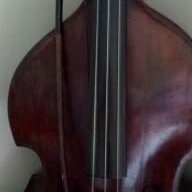
I`m from argentina and i have a three string double bass very old, if you can help me to identificate the bass is rare cause the top form is like the italian style but the sides have (contrafajas).
thank you so much and excuse my poor english :help:
 

Attachments

  • 06-05-07_1313.jpg
    06-05-07_1313.jpg
    15.3 KB · Views: 541
  • 06-05-07_1302.jpg
    06-05-07_1302.jpg
    20.4 KB · Views: 421
  • Like
Reactions: ChaloCBA
Your bass appears to be an old German 3 string, blockless wonder. So called because it was made without a neck block. The ribs are inletted directly into the heel of the neck. Probably made around the turn of the century. I'm no expert on bass identification, so take that with a grain of salt. Hopefully, one of the luthiers on this board will post with better info than I have.
 
I have a three stringed bass and bow that were purchased by my great grand father in the mid-lands of England (probably Leeds) somewhere probably between 1880 and 1890. They were in all probability second hand at the time as he was in impoverished Salvation Army officer. They have been in my family ever since. I was just wondering if anyone could tell me anything about their likely age, origin and possible value
022.jpg
009.jpg
011.jpg
017.jpg
018.jpg
022.jpg
from the attached photos.
 
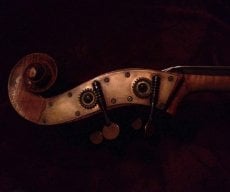
The tuners look French to me as well.

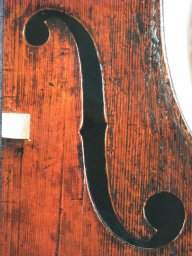
The bass has a number of top cracks, including one that goes under the treble bridge foot (you can see it in the well-lit but out of focus pic above the bass bow pic). The value depends a lot on whether those cracks are repaired and secure or not. Most likely some are and some aren't. Cracks in the ribs and back might also need to be dealt with, so there would likely be a restoration fee that could be substantial. One other consideration, if you're having it restored, would be whether to convert it into a 4 string. I think most would say yes, to make it up to today's standards.

It's impossible to tell the health of the bass from pics, so you'll have to take it to a luthier for appraisal. But if it were French, and 100+ years old, and restored, it could be a good amount.

Cheers,

Paul (eh_train)
 
  • Like
Reactions: eerbrev
The tuners look French to me as well.

The bass has a number of top cracks, including one that goes under the treble bridge foot (you can see it in the well-lit but out of focus pic above the bass bow pic). The value depends a lot on whether those cracks are repaired and secure or not. Most likely some are and some aren't. Cracks in the ribs and back might also need to be dealt with, so there would likely be a restoration fee that could be substantial. One other consideration, if you're having it restored, would be whether to convert it into a 4 string. I think most would say yes, to make it up to today's standards.

It's impossible to tell the health of the bass from pics, so you'll have to take it to a luthier for appraisal. But if it were French, and 100+ years old, and restored, it could be a good amount.

Cheers,

Paul (eh_train)

You might look for an Argentine visit on Edicson Ruiz's calendar.

 
Not French at all. It looks like an inexpensive southern German bass, probably pre-1900. The humped shoulders are the tell, and it's too refined to be Italian but not refined enough to be French. The bow looks older, possibly 1820-ish.

Value in as-found condition isn't likely to be terribly high. The bass needs work, and I can tell you from experience that I got $800 for a similar but slightly younger bow. It went to a player who was looking specifically for a period bow to play early music.
 
  • Like
Reactions: eerbrev
Thanks for your input thus far. Some more photos attached as per request. The cracks have all been repaired some time ago, (yes, at considerable expense) and the bass is in otherwise good condition. It's tone is exceptional compared to others I have owned and played.
001.jpg
 

Attachments

  • 002.jpg
    002.jpg
    533.3 KB · Views: 240
  • 004.jpg
    004.jpg
    525.1 KB · Views: 246
  • 005.jpg
    005.jpg
    449.9 KB · Views: 250
  • 013.jpg
    013.jpg
    449.5 KB · Views: 251
  • 014.jpg
    014.jpg
    654.3 KB · Views: 237
We're looking at two different basses here. It might be a good idea to specify which one you're commenting on. They both look Tyrolean blockless to me, outside linings or not. I've seen several with "French" tuners as well.
 
We're looking at two different basses here. It might be a good idea to specify which one you're commenting on. They both look Tyrolean blockless to me, outside linings or not. I've seen several with "French" tuners as well.
No, it's just the one bass. The lighting is different in some photos but it is only one instrument. The centre of the sides is original, but the upper and lower sides were severely damaged and replaced some years ago.
 
I vote Tyrol-ish? German shop, maybe a blockless wonder? I agree that the shoulder hump is a big tell.

Edit: Also interesting to note is that Boosey and Hawkes was selling 3 string basses in its catalogue up until the early 20th century.
 
Last edited:

Latest posts