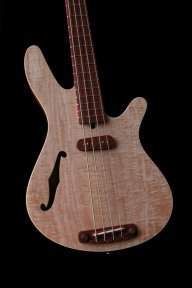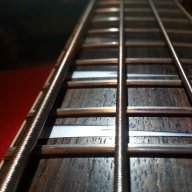
Here's the bass in question, an octave 8-string I got in like-new condition for $185 from a Pawn Shop:

Basswood body with an arched maple top, 6-bolt 24 fret maple neck, rosewood board, brass nut, and Grover machine heads.

For a Rogue it's surprisingly well-built, and it's looks & sound really get me off.
The previous owner had put a set of .105"s on it and I guess they pawned it after finding out that it wouldn't intonate.
I put .095" Boomers on, and while I'm still near the end of adjustment, it plays in-tune now.
Apparently the bridge wasn't put in the right place on all of them, but that's the only design flaw I've found.
I couldn't get the neck straight enough with the .105"s either, so it's obvious this bass is designed for lighter strings.
Which is fine since the added tension of the octave strings brings it right back to the feel of medium+ gauge strings.
After a few gigs, my main issue was the super-high output level.
While it has the same control layout--volume, pickup blend, 3-band EQ--the Rogue's preamp output was more than 10db louder than my Ibanez SR500's. Unfortunately, it was also far enough under a 20db difference that simply engaging my tube preamp's 20db pad wasn't a solution to the annoying knob-twisting I had to do every time I switched basses.
Between songs I barely have enough time to tune and drink beer, so needing to adjust my amps was a huge pain.
A few weeks ago I was unwinding after a gig (= beerbeerbeer, etc) and realized that I had never looked inside the control cavity.
Imagine my confusion when I discovered THIS:
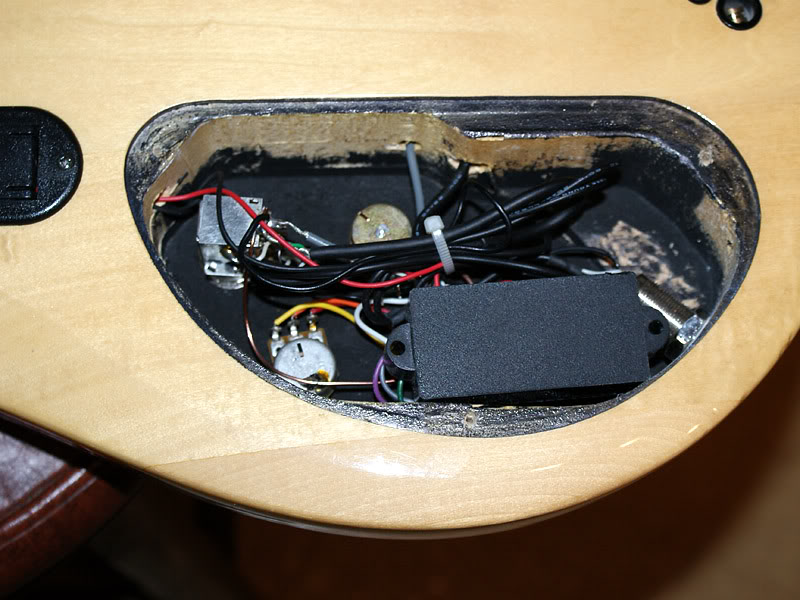
"What the
 is a Pbass pickup doing in there?"
After a few seconds it made sense--why pay to have a custom case made for your preamp module when there's hundreds of little plastic doodads in a carton across the factory that'll do the job just fine?
A smart and convenient solution, but it sure messed with my head at first.
Here's the best part:
Flipping over the preamp, I found a little trim pot sticking out of the wax potting.
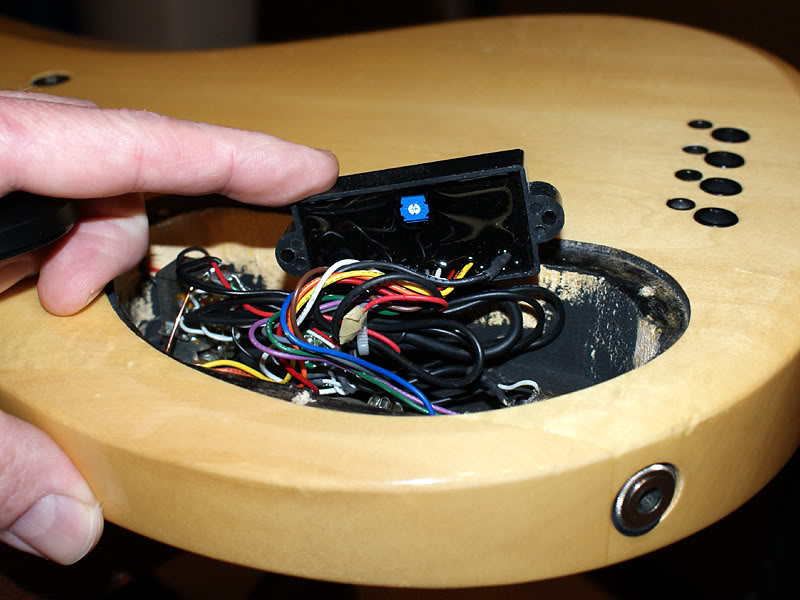
Hmmm...
Sure enough, when I amped the bass and started adjusting the trim pot it was obvious that it's purpose was to set the maximum output of the preamp.
Paradoxically, clockwise turns it down.
It took a few minutes of work, but now my basses have the same output!
Should have opened her up sooner.
Anyone else found something unusual inside a bass?
Basswood body with an arched maple top, 6-bolt 24 fret maple neck, rosewood board, brass nut, and Grover machine heads.
For a Rogue it's surprisingly well-built, and it's looks & sound really get me off.
The previous owner had put a set of .105"s on it and I guess they pawned it after finding out that it wouldn't intonate.
I put .095" Boomers on, and while I'm still near the end of adjustment, it plays in-tune now.
Apparently the bridge wasn't put in the right place on all of them, but that's the only design flaw I've found.
I couldn't get the neck straight enough with the .105"s either, so it's obvious this bass is designed for lighter strings.
Which is fine since the added tension of the octave strings brings it right back to the feel of medium+ gauge strings.
After a few gigs, my main issue was the super-high output level.
While it has the same control layout--volume, pickup blend, 3-band EQ--the Rogue's preamp output was more than 10db louder than my Ibanez SR500's. Unfortunately, it was also far enough under a 20db difference that simply engaging my tube preamp's 20db pad wasn't a solution to the annoying knob-twisting I had to do every time I switched basses.
Between songs I barely have enough time to tune and drink beer, so needing to adjust my amps was a huge pain.
A few weeks ago I was unwinding after a gig (= beerbeerbeer, etc) and realized that I had never looked inside the control cavity.
Imagine my confusion when I discovered THIS:
"What the
is a Pbass pickup doing in there?" After a few seconds it made sense--why pay to have a custom case made for your preamp module when there's hundreds of little plastic doodads in a carton across the factory that'll do the job just fine?
A smart and convenient solution, but it sure messed with my head at first.
Here's the best part:
Flipping over the preamp, I found a little trim pot sticking out of the wax potting.
Hmmm...
Sure enough, when I amped the bass and started adjusting the trim pot it was obvious that it's purpose was to set the maximum output of the preamp.
Paradoxically, clockwise turns it down.
It took a few minutes of work, but now my basses have the same output!
Should have opened her up sooner.
Anyone else found something unusual inside a bass?