• TalkBass has been independent since 1998. Add your voice.
    Create a free account to reply to discussions, view embedded media, and browse with fewer display ads.
    Join freeLog in
    Want zero display ads or expanded classifieds tools? Compare plans.

Double Bass Interesting Extension issue and experiments

There seems to be a touch of relief in the neck... it is strung up with Passione mits and a stark long E/C—not the heaviest set of strings around by a long shot. Around 105cm string length.

Photos below with a straight edge—at first I thought it was shadow, but the straight edge is flush and lighting is from the opposite side.

Seem like a normal amount of relief, or should it be expected to show next to none?

E5936B8C-F386-4443-9A08-B98C0C5478CB.jpeg 00B3327F-FCDA-4514-84AD-1A1C17FFF20C.jpeg B7936BEF-7C19-4B89-A97A-71EEDDD44BEE.jpeg
 
The easiest way I see to check if the neck and fingerboard are not well bond to each other is putting a clamp in the middle of the neck. Maybe also one at the neck heel and one close to the nut.

A luthier would separate the fingerboard from the neck and reglue it. Needs a night to dry the glue but otherwise a quick thing.

If the issue still remains, it might not be the neck from heel to nut but the pegbox vibrating and/or twisting. Keep in mind that the vibration force is not in the middle of the scroll, so twisting is easily possible. If it is the weak pegbox, a carbon fiber reinforcement of the neck would not help.

But maybe only the glueing of the fingerboard is weak, then a simple reglue might solve the issue.
 
The easiest way I see to check if the neck and fingerboard are not well bond to each other is putting a clamp in the middle of the neck. Maybe also one at the neck heel and one close to the nut.

Am I looking for the relief/glue line to be straight in doing this, or making sure the E/C string can vibrate and checking for the response?

...If the issue still remains, it might not be the neck from heel to nut but the pegbox vibrating and/or twisting. Keep in mind that the vibration force is not in the middle of the scroll, so twisting is easily possible. If it is the weak pegbox, a carbon fiber reinforcement of the neck would not help.

The 'heavy' vibration starts from about 8 cm south of the nut and is present all the way up, through the pegbox/extension/scroll. As far as I can tell, it feels relatively consistent through, though perhaps a little more at the very top of the scroll where there is the most lever?

Do you think this sort of potential twisting in the pegbox issue would have developed or been more obvious early on after adding the extension? It was about a year after the extension was installed, and was previously rock-solid, where the FB coming loose through a couple of seasons is perhaps more likely. I'm just waiting on a date at this point to get it seen. His experienced eye will catch the issue I am sure, this has just been very interesting for me to fumble through.

Appreciate everyone's willingness and patience ha.

OT: DoubleMIDI--your string tension spreadsheet is an amazing asset. Thank you.
 
If it developed after a year it might be that the fingerboard partly separated from the neck at that time. An extension is a heavy load for the neck which is not originally constructed to hold an extension. Try the clamps to press the fingerboard to the neck (put cork or leather between clap and neck and tighten it well). If it gets better with a well tightened clamp but not with a loosely tightened clamp, chances are very good that a good fingerboard reglue solves the problem. And that would even be a cheap and quick solution.

If you ever find a gap between neck and fingerboard immediately loosen the strings as specially the extension string so that the neck doesn’t get deformed.

I also had a badly glued fingerboard and found that out in the later evening before the spring lockdown in Germany ...
 
This has been quite interesting. I naturally try to know as much about any complications involving C-extension installations as possible, and I've never heard of anything like this. DoubleMIDI has offered some pretty sensible suggestions. I would expand on one of them by saying only that indeed the force vectors in the pegbox do change rather significantly when an extension is added, and I suppose a slight twisting force is applied to the whole neck when open to C. This could indeed open up a dodgy glue joint in the fingerboard, or cause a tiny crack to appear somewhere in the pegbox.

I've been happy enough with the Bill Merchant extension on my bass which is at least forty years old, but plan to do some weighted clamp experiments. The extension nut is kind of out in the cold compared to a normal E string sitting in the normal nut and enjoying the stability provided from the weight of the other strings. This is where Brian's comment is important. If the upper part of the extension is not perfectly mated to the scroll, then it might rock left and right. That could cause some real trouble. Chalk fit if you want, but his epoxy approach sounds sensible to me. Even it the mating is perfect though, I think that the extension nut is still subject to unwanted vibrations, and that adding weight might be desirable.

If I do find a benefit to adding weight, I'm thinking that an elegant way to do it would be to install a longer pulley shaft and attach thick brass discs to each end. They could be rounded or otherwise shaped to provide some aesthetic appeal.

There is a notion that an extension should be as light as possible, but I'm not sure it is valid. Many fine Italian basses have huge heavy scrolls, and I've talked to people with the K.C. brass extension who say it is all nonsense. They claim that added weight does nothing detrimental to their sound. Still, I prefer to gig on a bass whose scroll doesn't sink to the floor when laying the instrument on its side:)
 
Last edited:
If it developed after a year it might be that the fingerboard partly separated from the neck at that time. An extension is a heavy load for the neck which is not originally constructed to hold an extension. Try the clamps to press the fingerboard to the neck (put cork or leather between clap and neck and tighten it well). If it gets better with a well tightened clamp but not with a loosely tightened clamp, chances are very good that a good fingerboard reglue solves the problem. And that would even be a cheap and quick solution.


If you ever find a gap between neck and fingerboard immediately loosen the strings as specially the extension string so that the neck doesn’t get deformed.


I also had a badly glued fingerboard and found that out in the later evening before the spring lockdown in Germany ...
Sorry to hear about the poor timing for you there…

No visible gaps or movement in the FB—it didn’t cross my mind and I got started down a different rabbit hole.

Tricky to get clamps on at this angle without impeding the E/C string—I can’t checkout the response across the other strings, but with loose clamps the problem continues and when clamped tight, the string vibrates well and without faltering—Sounds like our primary issue. No big tonal changes, other than the sound was more direct/focused sounding and the fundamental was solid. More immediate.

The bigger/deeper low end experienced with the mass may be something to follow up on, but getting the FB on there well will be priority 1.

This has been quite interesting. I naturally try to know as much about any complications involving C-extension installations as possible, and I've never heard of anything like this. DoubleMIDI has offered some pretty sensible suggestions. I would expand on one of them by saying only that indeed the force vectors in the pegbox do change rather significantly when an extension is added, and I suppose a slight twisting force is applied to the whole neck when open to C. This could indeed open up a dodgy glue joint in the fingerboard, or cause a tiny crack to appear somewhere in the pegbox.

Yes, the insight from everyone here has been great. I got caught up in a different direction to start and was treating symptoms instead of problems. Interesting the outcome regarding mass though.

I've been happy enough with the Bill Merchant extension on my bass which is at least forty years old, but plan to do some weighted clamp experiments. The extension nut is kind of out in the cold compared to a normal E string sitting in the normal nut and enjoying the stability provided from the weight of the other strings. This is where Brian's comment is important. If the upper part of the extension is not perfectly mated to the scroll, then it might rock left and right. That could cause some real trouble. Chalk fit if you want, but his epoxy approach sounds sensible to me. Even it the mating is perfect though, I think that the extension nut is still subject to unwanted vibrations, and that adding weight might be desirable.

I wish I had worded the OP and title a little better, but like you pointed out, that edit button goes away quick ha. Poor wording on my part—the craftsmanship and quality of the extension install, components, fit, and function have been top notch and I couldn’t be happier there. The issue at hand would be present without it, though likely less noticeable—the extension gave me the rope (string length?) to hang myself it seems ;).

Definitely a number 1 place to check for failure points with an issue like mine, so understand the attention there.

I do think it would be interesting to try and quantify the added twisting potential and forces acting on the scroll/pegbox/top of the neck and see if twisting is happening (perhaps something that lead to the glue failing where it did? Just as likely a weak glue joint just gave).

If I do find a benefit to adding weight, I'm thinking that an elegant way to do it would be to install a longer pulley shaft and attach thick brass discs to each end. They could be rounded or otherwise shaped to provide some aesthetic appeal.

There is a notion that an extension should be as light as possible, but I'm not sure it is valid. Many fine Italian basses have huge heavy scrolls, and I've talked to people with the K.C. brass extension who say it is all nonsense. They claim that added weight does nothing detrimental to their sound. Still, I prefer to gig on a bass whose scroll doesn't sink to the floor when laying the instrument on its side

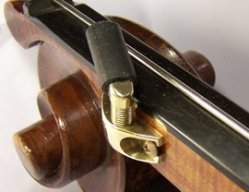
This was the interesting bit for me I think. Doing as DoubleMIDI suggested, I clamped three clamps loosely just below the nut, in the middle, and at the heel of the FB, no real change. Once tightening the clamps, the sound became more powerful, but not in the same way as the clamps/mass on the scroll.

With this three clamp along the neck set up, I can’t play anything other than the E/C string, but the note starts more easily and at softer dynamics—the sound feels more immediate and clearer. The sound doesn’t have the same big bottom as I did when adding mass the scroll, but definitely a more solid and even sound.

When I was adding mass to the scroll, I was getting a big change in the bottom end and response from the bass… it sounded/sounds huge when doing this… I tried putting weight in a few other places (TP), and while I got a darkening of the sound, I lost volume more readily, where when adding the scroll, I didn’t feel like I lost much, if any, real volume. While not my issue in the end, definitely something to explore? And agreed regarding basses that rest on their upper bout and scroll, always worries me.

I’ll try to do a couple of quick iPhone videos (hopefully the compression doesn't make it pointless) tonight for the sake of trying to show this.
 
  • Like
Reactions: robobass
I never got videos up-- When I got home I looked things over again.

With a flashlight, I found the tiniest little gap/hole in the corner where the FB, Neck, and Nut meet on the G string side. I couldn't close it or enlarge it by pushing/pulling on anything, but figured it looked like and issue. I slacked off the strings as suggested here.

Got it down to my luthier, he saw it, pulled the extension and removed the nut, and gently pressed back against the scroll--

Clean separation of the fingerboard and the neck from the nut going about 6 inches down.

I feel silly having missed this, and going down a rabbit hole (though something I will play with once everything else has been made right). It explains a lot. I'll pick it up from him Thursday evening.
 
  • Like
Reactions: 1st Bass and Wasnex
Thought I'd report back here.

Because the board didn't completely separate from the neck, the consensus was don't make more work (removing board, routing and inserting a CF reinforcement, potential geometry issue with the extension). Board was glued down and I picked it up a day or so later.

String instability was no longer present--solid fundamental and the harmonics/nodes are clean and precise (no longer diffused feeling underhand). Bass sounds great (and is loud), and feels great--Grabbing the neck felt immediately different, and, in hindsight, I notice the change in action...subtle, but present.

Some of the other effects of the clamps didn't necessarily carry over-- Solid fundamental and increase in volume is there, but not quite as warm and even as when using the clamps maybe, though both of these did improve after the work--I don't feel it's missing these per se.

I haven't messed with trying to add weight/mass post repair very much-- I quickly did and the effect was minimal, even with the heavier clamp. Plan to play with this a little more perhaps.

Adding the heavy clamp was giving the nut and scroll more inertia, making it more stable in lieu of the neck/fb... So I gained some counterintuitive benefits from adding it (increase in volume...)

Just amazed I missed the issue. It has been going on for at least a year. Post had been moved by two luthiers... TP down and afterlengths adjusted.. several string changed. The nut and extension seemingly were holding the FB in place enough that it wasn't more obvious.
 
  • Like
Reactions: Wasnex