• TalkBass has been independent since 1998. Add your voice.
    Create a free account to reply to discussions, view embedded media, and browse with fewer display ads.
    Join freeLog in
    Want zero display ads or expanded classifieds tools? Compare plans.

intonation and bass building

Hi!
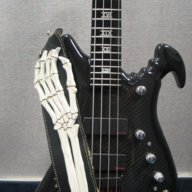
I've been making some basses over the previous last year, a Mustang copy and an original design too. See pic.

On both (shortscales 30") I've come upon an issue where all the notes are a bit sharp. I get the 12th fret intonation correct and the open string is spot on, but the fretted notes are a bit sharp. I'm hoping it just some fine tuning needed? (scratching my head)
The fret-boards I bought pre slotted, then I fretted them. They seem fine, as All the notes are consistently sharp.
But I feel like i'm missing a step of the process or something.

Has anyone come across this issue?
 

Attachments

  • IMG_4305 2.jpg
    IMG_4305 2.jpg
    503.6 KB · Views: 37
If "all the notes are consistently sharp" that would imply that the 12th fret intonation is not correct, because it's one of "all the notes", and is therefore sharp.

So the saddle needs to move away from the nut.

If the 12th fret intonation and open string are both correct and all the other notes are sharp, that would be odd.
 
Hi!
I've been making some basses over the previous last year, a Mustang copy and an original design too. See pic.

On both (shortscales 30") I've come upon an issue where all the notes are a bit sharp. I get the 12th fret intonation correct and the open string is spot on, but the fretted notes are a bit sharp. I'm hoping it just some fine tuning needed? (scratching my head)
The fret-boards I bought pre slotted, then I fretted them. They seem fine, as All the notes are consistently sharp.
But I feel like i'm missing a step of the process or something.

Has anyone come across this issue?

Did you match the open string twelfth fret harmonic, to the note fretted at the twelfth fret,
or did you match the twelfth fret harmonic to the open string?

(The twelve fret harmonic will always be exactly one octave above that open string)
 
Last edited:
Are you using big frets? Maybe you've pressing too hard, or the nut height or string heights are too high, stretching the string when you fret and pulling notes sharp. I had a huge problem with that when I first got a ukulele. Then I realized I was pressing way too hard for those strings.
 
  • Like
Reactions: Riff Ranger
Did you match the open string twelfth fret harmonic, to the note fretted at the twelfth fret,
or did you match the twelfth fret harmonic to the open string?

(The twelve fret harmonic will always be exactly one octave above that open string)
This is THE question to be answered before any more comments or suggestions.
Edit: And then consider nut and string height, etc.
 
Last edited:
If the fretted note at the 12th fret is the same pitch as the harmonic at the 12th fret, you've set the intonation right. If the other notes are off, perhaps the nut is too high, or the action is too high. Or the frets are in the wrong place. If you've made a 24 fret neck, set the intonation there. I've found it to be slightly more accurate than the 12th fret.
 
Did you match the open string twelfth fret harmonic, to the note fretted at the twelfth fret,
or did you match the twelfth fret harmonic to the open string?

(The twelve fret harmonic will always be exactly one octave above that open string)
By ear, normally, the harmonic at 12 fret should be a bit flat vs. the fretted note at 12. Just a bit. That was what I used when I was young. Where the note fretted at 12 fret (with the strength you'll normally use playing) vs. the open string note should be equal.
 
Hi!
I've been making some basses over the previous last year, a Mustang copy and an original design too. See pic.

On both (shortscales 30") I've come upon an issue where all the notes are a bit sharp. I get the 12th fret intonation correct and the open string is spot on, but the fretted notes are a bit sharp. I'm hoping it just some fine tuning needed? (scratching my head)
The fret-boards I bought pre slotted, then I fretted them. They seem fine, as All the notes are consistently sharp.
But I feel like i'm missing a step of the process or something.

Has anyone come across this issue?
Yes, I had exactly the same problem when I put a different bridge on a Bronco 30" scale. I was getting very sharp notes on the 5th fret even though 12th fret was fine and open strings fine. Even when I calculated the bridge spot on from the nut @ 29.5" with g saddle extended at a sensible length (nearly max)out it was just not playing well. If memory serves me correct I moved the bridge back to about 30.25"or 30.4" it seemed to clear the problem. I still don't know what I did wrong as I measured from nut to 12th fret before I fitted the bridge, doubled it and it came out exactly at 29.5". Not able to explain why it didn't work but moving the bridge back a little more fixed the issue. Still doesn't make sense to me.
 
Last edited:
Short scale high pitch instruments, like a Ukulele, need a bit of nut offset to correct for string tension or something. The nut needs to be fractionally closer to the first fret. I had that problem once with a short scale bass. I solved it by shaving a bit off the nut slot and gluing a piece of veneer to the back of the nut.
 
I get the 12th fret intonation correct and the open string is spot on, but the fretted notes are a bit sharp. I'm hoping it just some fine tuning needed?
3 possibilities come to mind

  1. Witness points have not been properly set at the bridge AND the nut;
  2. The nut slots are too high;
  3. The nut slots don't 'fall away' from the front edge, meaning the string sounding length starts at some place in the slot other than cleanly at the front edge.

Any or all of these things can contribute to the problem you describe.

In the case of 1, any number of strange intonation issues can arise. In your picture the break angle over the nut looks very steep which may be hindering good contact with the front edge of the nut - see 3.
In the case of 2, I would expect things to improve as you move up the neck, especially as you say you have managed to set the mid-point intonation.
In the case of 3, and assuming you have set the mid-point correctly, you even might find notes starting to sound a bit flat above the octave, assuming the action is not too high.

Here's a side view of a nut I made for an old P-bass recently. You can see the E string falling away through the slot:
20250129_173058.jpg
 
3 possibilities come to mind

  1. Witness points have not been properly set at the bridge AND the nut;
  2. The nut slots are too high;
  3. The nut slots don't 'fall away' from the front edge, meaning the string sounding length starts at some place in the slot other than cleanly at the front edge.

Any or all of these things can contribute to the problem you describe.

In the case of 1, any number of strange intonation issues can arise. In your picture the break angle over the nut looks very steep which may be hindering good contact with the front edge of the nut - see 3.
In the case of 2, I would expect things to improve as you move up the neck, especially as you say you have managed to set the mid-point intonation.
In the case of 3, and assuming you have set the mid-point correctly, you even might find notes starting to sound a bit flat above the octave, assuming the action is not too high.

Here's a side view of a nut I made for an old P-bass recently. You can see the E string falling away through the slot:
View attachment 7138420
Beat me to it. If done correctly: 12th harmonic = 12th fretted = open string, we're okay. If frets 1-5 are drawing the string sharp, first thing I'd look at is nut slot depth, topography, and witness points fore & aft.

Riis
 
I measured from nut to 12th fret before I fitted the bridge, doubled it and it came out exactly at 29.5". Not able to explain why it didn't work but moving the bridge back a little more fixed the issue. Still doesn't make sense to me.
But the nut to bridge distance should be more than the nut to 12th fret distance. Pressing the string at the 12th fret will stretch it and make it sharp. This is corrected by moving the bridge a little further from the 12th fret so that the note produced will be lower and in-tune. The effect is worse with heavier strings so as a result the bridge is not at 90° to the strings.
 
Things to try are well-covered above, but I'm focused on the location of your bridges. It looks as though they were placed too far towards the nut - ideally you want your saddles extended nearly all the way and then mount the bridge with the G saddle over the G string witness point (scale line). From there, it will move back when intonated. String compensation requires each thicker string to move back incrementally farther, so when you get to your lowest string, which will be the farthest back, it has room to be adjusted fully.

Just a thought :)
 
  • Like
Reactions: eddybuzzard
Wow! There is fantastically great information posted here. It could be compiled and posted as some kind of reference for anyone setting up instruments, especially electric basses.

Has the OP answered the first question about if the 12th fret intonation test was a fretted note when compared to the harmonic?
 
  • Like
Reactions: mcnach
But the nut to bridge distance should be more than the nut to 12th fret distance. Pressing the string at the 12th fret will stretch it and make it sharp. This is corrected by moving the bridge a little further from the 12th fret so that the note produced will be lower and in-tune. The effect is worse with heavier strings so as a result the bridge is not at 90° to the strings.
I see that now you've said that, a dim lightbulb has finally sputtered into life in what I call my brain. :laugh: . I solved my problem but still never fully understood why it happened. I used a Youtube video showing how to place a bridge and deferred to the knowledge of the content creator which is why I ended up so confused. I'll second @DanDBassist suggestion to sticky this as I'll be sure to forget this wealth of knowledge when I come to do this exercise again. :thumbsup:
 
  • Haha
Reactions: ctmullins

Latest posts