• TalkBass has been independent since 1998. Add your voice.
    Create a free account to reply to discussions, view embedded media, and browse with fewer display ads.
    Join freeLog in
    Want zero display ads or expanded classifieds tools? Compare plans.

Intonation Woes Estring Saddle on Pbass running out of room!

Hello Fellow bottom feeders. Greetings from Nashva vah vegas.

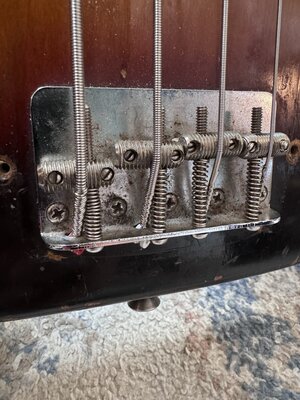
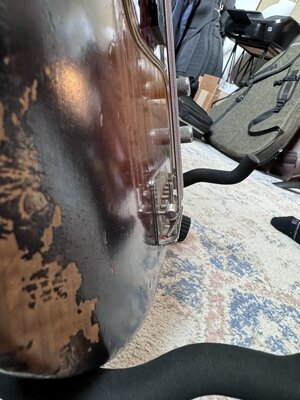
I'm running out of room to move my E string saddle back. I've noticed for years on Pbasses in particular that every three or four months, the Estring's intonation inevitable creeps north, requiring me to move the saddle back aka tightening the screw aka making more room for the string. It works for another three or four months and then again I'm grabbing the screw driver. it's happened on multiple instruments. Anyone else experience this? any solutions? smart ass comments absolutely welcome! :) but also thank you if anyone keep offer any advice! Cheers!
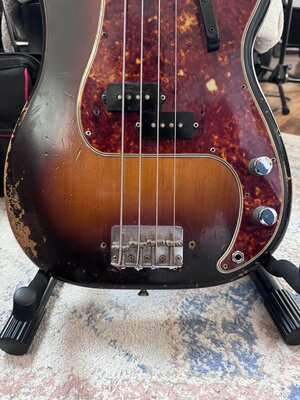
Thanks! Here's a picture;
Never. My current one hasn’t budged in the 20 years I’ve owned it. And I’ve been playing PBs primarily for over 45 years. Just thinking about your issue, I think in order for this to happen, something is moving that shouldn’t be.
 
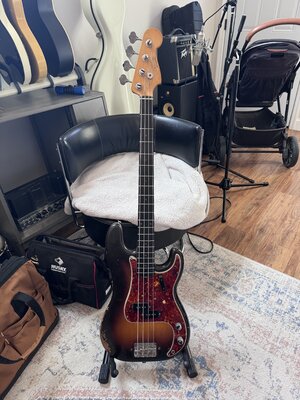
That P bass looks like it’s seen some action!

First question is - are you checking neck relief as well? Seems like you’d notice if it’s bowing more,but that will absolutely cause strings to go a bit sharp. Might be creeping over time.

Easy fix - take that screw all the way out, get your wire cutters out, cut the spring in half. Put it back in, and voila, you’ve got more room! You have
That P bass looks like it’s seen some action!

First question is - are you checking neck relief as well? Seems like you’d notice if it’s bowing more,but that will absolutely cause strings to go a bit sharp. Might be creeping over time.

Easy fix - take that screw all the way out, get your wire cutters out, cut the spring in half. Put it back in, and voila, you’ve got more room! You have plenty of screw thread left, your spring is just fully compressed. I’ve had to do this on many basses with standard bent brid
Love the idea to cut the screw and a lot of other votes for that so I will try! This is my 1960 P so I may buy a new screw and cut it just to keep the original. Neck has very slight relief but not enough to be contributing to this issue. Thank you!
 
It's winter, your neck (the one on your bass) is drying up and bowing a bit more, your action is rising (you may not notice it if it's gradual), and you need to compensate more at the bridge. Adjust the action (you truss rod needs tightening, which will reduce the string height, make the thing easier to play, and fix the intonation all at the same time.

Unless strings get REALLY old (many years), if the action stays put, you shouldn't need to change intonation settings. That fact that your'e seeing that change means something is moving. If you get the setup back to where it was before you started having to move the saddles, your saddle adjustment range will be OK.
Yeah I'm making intonation adjustments quite often because things are constantly moving and it's a lot of wood that we're all dealing with. I've never owned an instrument that I didn't make adjustments on regularly. I'm more curious if folks have experienced running out of room on the E string like I described. I've always chased the E string and am wondering if anyone else has also experienced this?
 
Mr Jamerson, perhaps it's time you tried a new pair of strings....


Failing string is the first thing I think of. (but occurring on more than bass seems to negate that theory)
How much action are your strings seeing and how "heavy-handed" are you?

I've had some strings that intonate a bit wonky out of the pack Dunlops, etc, where the G string is longer than the rest or the E is shorter than the others, but once I set them, the intonation doesn't change.

If you keep the strings,just remove the spring and keep it in tact (especially with a vintage bass) The spring isn't really not doing anything at this point...
I'm changing strings every 12-18months. Definitely agree that if no matter how perfect the machines are that all the companies use to wind strings, there will inevitably be some duds. If you string up a set and a string feels really off, throw it in the trash!
 
The less invasive is cutting the spring. But if you do that and the saddle gets back into the range of the windings that wrap over the bendover inner string part, yeah that will mess with the trueness of the vibrating string. THEN u need some kind spacer at the ball end, OR move the whole bridge back. Honestly, the latter is the most appropriate fix, bc the saddle should have room to adjust and not have to use spacers.
Have you ever moved the whole bridge back on an instrument? This has crossed my mind, but I don't know anyone whoes done it.
 
Remove the string. Slide a spacer (washers, whatever) butt up against the brass ball end. Reinstall the string. This allows you to screw back the saddle without engaging the bulky winding at the string end and probably avoiding having to cut the spring. If the spring is still an issue, get a similar size from the hardware store. Better than mangling a vintage spring, IMO. Props to Duck Dunn for this approach.

BBB
Did Duck Dunn use spacers?! That's awesome and a great idea. I'll have to try that
 
To add to the chorus: Give the bass a proper setup starting with the neck/truss rod, then string height, then pickup height, then intonation.

Trying to set the intonation on a bass that hasn't had all the other bits properly set up is like trying to build a straight house on a crooked foundation.

Also, if it's one string that keeps going out, could be that string has an issue and is either slipping or the winding is slipping on the core. New strings might be in order before doing the setup and then the intonation.
Yeah it's not a set up issue. I have my basses regularly tuned up by a professional tech and do my own intation tweaks, set ups in between those professional set ups. This is an issue I've had on multiple basses but the common theme is that they are all Pbasses and it seems to only happen on the E string which is why I was curious if other folks have experienced this as well. I change strings pretty regularly.
 
  • Like
Reactions: FullumMusic
I've seen two of these intonation threads today and they seem to share total lack of interest from the guys starting them. The only place they're visible is when asking for help, then they ignore/waste everyone's time.
Sorry it took me so long to read through these! I really appreciate everyone's input and suggestions!
 
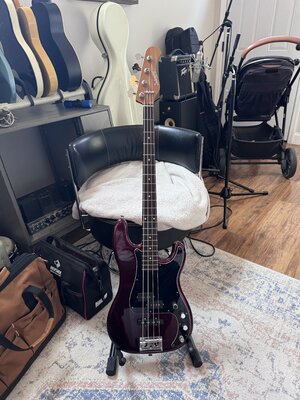
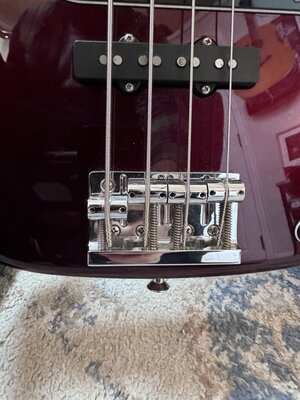
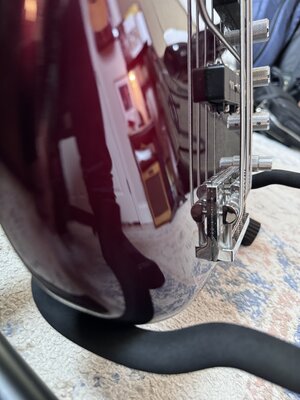
More photos in JPEG format!
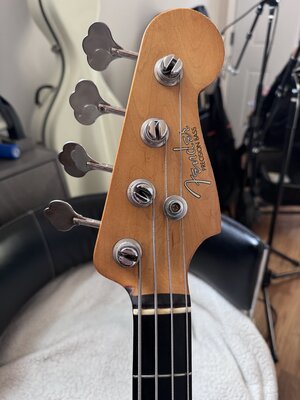
Original post is the Pbass. It's a 1960(april body, July neck for those who are curious). I also posted my Sadowsky PJ as you can see it's a similar thing happening on the E string where it's just inching closer to the back of the bridge. I think removing/cutting the spring in half is a great option. i'm also going to look into adding a spacer to avoid getting the winding of the string to come up over the saddle. That seems like something someone should market. Maybe if someone knows of some you can buy they could post here? I'm also curious if anyone has ever moved their bridge physically back. I would never try that on a vintage instrument but I've often wondered if anyone had any experience there.
Thanks for reading and commenting!
 

Attachments

  • IMG_3675 copy.jpeg
    IMG_3675 copy.jpeg
    10.1 MB · Views: 9
  • IMG_3681 copy.jpeg
    IMG_3681 copy.jpeg
    9.2 MB · Views: 8
  • IMG_3682 copy.jpeg
    IMG_3682 copy.jpeg
    3.3 MB · Views: 10
  • IMG_3683 copy.jpg
    IMG_3683 copy.jpg
    6.8 MB · Views: 11
More photos in JPEG format!
Original post is the Pbass. It's a 1960(april body, July neck for those who are curious). I also posted my Sadowsky PJ as you can see it's a similar thing happening on the E string where it's just inching closer to the back of the bridge. I think removing/cutting the spring in half is a great option. i'm also going to look into adding a spacer to avoid getting the winding of the string to come up over the saddle. That seems like something someone should market. Maybe if someone knows of some you can buy they could post here? I'm also curious if anyone has ever moved their bridge physically back. I would never try that on a vintage instrument but I've often wondered if anyone had any experience there.
Thanks for reading and commenting!
 

Attachments

  • IMG_3677 copy.jpeg
    IMG_3677 copy.jpeg
    9.2 MB · Views: 7
  • IMG_3680 copy.jpeg
    IMG_3680 copy.jpeg
    7.7 MB · Views: 7
Don't touch the (original) screw or spring. Replace if necessary and keep the original safe.
Nor would I modify anything / move the bridge.


Before any of that - I would try a different set of strings - even if you have used ones laying around.
Everything points to a string issue - and strings are certainly infinitely much less costly than modifying a 1960 P...

Saddle closeups

Also - I'd be curious to see a photo with a tape measure butted up to the nut... s/b ~35" to the back plate (+/- 1/6)

1736004885067.png

1736004944143.png


These photos / measurements are typical of every bass I have - using a fairly large variety of strings.
Occasionally I get an odd string that won't intonate properly - but that's the exception.
 
Last edited:
  • Like
Reactions: mikerooo
I'm also curious if anyone has ever moved their bridge physically back. I would never try that on a vintage instrument but I've often wondered if anyone had any experience there.
Except for a vintage or collectible instrument I'd move the bridge back, but only after seeing if shortening the spring would do the trick.

To date I've always been able to gain enough adjustability by getting rid of the bunched up spring problem by just cutting it in half.
 
  • Like
Reactions: mikerooo