• TalkBass has been independent since 1998. Add your voice.
    Create a free account to reply to discussions, view embedded media, and browse with fewer display ads.
    Join freeLog in
    Want zero display ads or expanded classifieds tools? Compare plans.

Is this a shielding issue?

Hi,
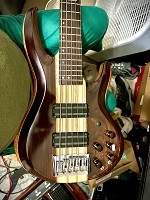
I have an Atelier Z 5 string J Bass. I have Nordie split coil J pickups and I had a Sadowsky preamp installed. The cavities for the electronics and the pickups are coated with black paint and I assumed that was shielding paint. But but my repairguy tested it and found no conductivity. I'm surprized because Atelier Z basses are kind of high end. I don't get any hum because of the slip coils, but I do have a high static sizzle that only goes away when I touch the strings or any metal part on the bass. I had instruments where this high sizzle would change depending on which way I turned. But this is the same with the bass pointed in any direction. I don't know electronics that well. Is this a shielding issue or is it possible that my repair guy might have connected something the wrong way.

 
Sizzle except when touching strings = grounding issue, maybe?? Do you know if there's a wire running from under the bridge to...somewhere in the control cavity, where the bridge can be grounded from? I am not a tech or engineer, but IIRC every time someone mentions electrical noise that changes with string touch it leads to grounding eventually....
 
Sizzle except when touching strings = grounding issue, maybe?? Do you know if there's a wire running from under the bridge to...somewhere in the control cavity, where the bridge can be grounded from? I am not a tech or engineer, but IIRC every time someone mentions electrical noise that changes with string touch it leads to grounding eventually....

This is a common misconception. The fact that buzzing stops when touching the strings means the bridge is grounded and working. OP is describing a shielding problem, if there is no conductivity, it's not shielded. Shielding also got to be grounded to form a Faraday Cage for it work.
 
Last edited:
  • Like
Reactions: DiabolusInMusic
So if it is shielding, I suppose it would be easiest to paint the cavities with conductive paint and ground that. But I'm not sure how good that is. I also have a Moon Bass with the same pickups and an OBP1. I had someone shield it and he did an incredible job because the bass is dead quiet. This guy moved and I don't know anybody in my town who would be able to have that kind of skill. I have tried to shield and instrument with copper foil a long time ago and it was kind of hard to line the cavities and have it look really good. the stuff would just wrinkle or tear if i wsn't really careful. I wonder if there is sheetstock of copper available that is a little thicker that might be easier to work with.
 
Your issue is most definitely a shielding issue, the fact that it goes away when you touch the strings confirms this.

All copper foil will rip and tear, it isn't the best material for cavities but it is required in my opinion. You really don't want the foil too thick, just be more careful and cut pieces prior to laying them in the cavity. I have linked my guide below which details paint and copper tape methods.

http://www.talkbass.com/threads/so-your-bass-has-a-hum.1079579/

If you need any help feel free to PM me.
 
Copper foil absolutely is the best commonly available material to use for shielding. Conductive paint is not better, it is simply more convenient for those who do not want to do a foil job. To be honest, based on your linked thread, you are not the most qualified person to comment on the efficacy of copper foil.

To the OP, there is a shielding thread that is stickied at the top of the Pickup and Electronics forum. I linked you to page 38 to start, as most of the images earlier in the thread have been moved or deleted. And it does sound like a good shielding & grounding job will help you.
 
Copper foil takes longer, takes a lot more effort to leave a clean job, and will eventually lose it's adhesion over time. There really is no difference in terms of the job done, it is whatever the person prefers (and can source easier.) Feel free to dispute my opinion all you want, once again, I have better things to do than get into internet pissing matches with you BlueTalon.
 
Shielding needs to be grounded. Period. End of story.

For the purpose of shielding our basses any conductor will do, no matter how thin. As long as it is grounded and doesn't have holes. thin foil, thick foil, conductive paint, no matter.
 
I use MG Chemicals Supershield, there is a pic of the can in my thread. I can buy it locally from my electronics parts supplier, I don't know your city but I know you are large enough that it can definitely be found locally.

You will need at least two coats, I do three since it really only takes another couple minutes and you do not have to worry if you didn't do enough then. More coats will not improve the shielding and the idea is to get it as thin as possible. Also note that you need to let the paint dry before blasting the next coat, otherwise the coats will bond instead of layer.
 
I just bought this
http://www.ebay.com/itm/261522955041

It is cheap so I'll give it a shot. My Bass has a pretty large cavity for the electronics so this size might make it easy for me. if that ends up looking like crap or not working....Paint!
It will work. And as long as you take your time and are careful, it will look good also. This is the control cavity in my avatar bass:

BrozTone_zps5a35d94c.jpg
 
As an eBay Associate, TalkBass may earn a commission from qualifying purchases.
I just bought this
http://www.ebay.com/itm/261522955041

It is cheap so I'll give it a shot. My Bass has a pretty large cavity for the electronics so this size might make it easy for me. if that ends up looking like crap or not working....Paint!

By the way, I recommend getting a 100' roll of 10mm tape also. It is going to come in very handy when shielding the sidewalls of your control cavity and pickup routes -- it's much easier to cut stips off a roll than to cut a larger sheet to form. (And it's in the U.S., so it will get to you quicker.)
 
As an eBay Associate, TalkBass may earn a commission from qualifying purchases.
This Supershield is available in different flavors. Nickel, Silver,Silver coated Copper, Graphite. which is the right one?

Didn't know it came in different varieties, I use nickel. I am pretty sure it is the cheapest since it is all my local supplier stocks.

That tape should be enough but you might be close once you start cutting it down to odd pieces.
 
I'm not 100% sure how the shielding works. What I'm wondering is if I could do it myself. Does everything have to be shielded to be effective or could I just shield the cavity for the pots and the preamp. Would that alone already make a difference? Where is my biggest source for noise? Does it come more from the pickup cavity or from the cavity with the pots?
Making a tunnel for the pickup wires to the pots seems tricky. If I didn't do that would I get a lot of residual noise? I suppose I could use shielded wire, right? For that I would definitely have to go to a tech. I would be afraid to solder anything on the pickups.
 
What you are trying to do with shielding is to keep unwanted electromagnetic energy from interfering with the signal path from pickups to jack. To do that, you want to have the interior surfaces of the pickup and control cavities to be as conductive as possible, and grounded. Copper is the most conductive material to use, and it is available for cheap on ebay. Just make sure it says it has conductive adhesive, as not all of it does. And the adhesive is quite good, it will do the job and last as long as you own your bass.

To be most effective, you need to shield all surfaces, and that includes the pickup routes and wire channels. You don't need shielded wire if you shield the channel the wire runs through. I prefer to shield the channels than mess with the pickup wires at all.

You can do the job yourself, it's not difficult. You want to give yourself plenty of time though, especially since it's your first. Use the back of your fingernail, or a popsicle stick, or something like that to press down each piece of copper as you lay it down, especially in corners and crevices -- this will seat the adhesive firmly on the wood, and eliminate wrinkles. Don't be afraid to use multiple layers. You can do the wire channels easy by wrapping some tape adhesive-side-out around a dowel, slide the dowel into the channel so that there's an equal amount of copper on both ends, cut four lengthwise slits in the end of the copper, then bend each section to lie against the side wall of the cavities.

That should get you started.
 
As an eBay Associate, TalkBass may earn a commission from qualifying purchases.
I'm not 100% sure how the shielding works. What I'm wondering is if I could do it myself. Does everything have to be shielded to be effective or could I just shield the cavity for the pots and the preamp. Would that alone already make a difference? Where is my biggest source for noise? Does it come more from the pickup cavity or from the cavity with the pots?
Making a tunnel for the pickup wires to the pots seems tricky. If I didn't do that would I get a lot of residual noise? I suppose I could use shielded wire, right? For that I would definitely have to go to a tech. I would be afraid to solder anything on the pickups.

Yes you make steps. First you need to understand that the shielding with a conductor only helps against electric fields (assorted buzzes) and not against the 50/60 Hz cycle hum which is magnetic fields and you must use humbucking to go against those.

Then you make sure that as long as you have incomplete internal shielding you ground the bridge, so that you belly works as a partial shield. Then you shield the electronics cavity and the path to the output plug (the latter can also be done by using shielded wire) and see how that goes.

As you correctly point out, shielding the wires from pickup if they are unshielded wires, can be annoying if it is a tunnel. But you can just use shielded wire if you don't mind cutting off the unshielded one. With this it also helps to have a pickguard shield since then you have the pickguard shield to the front and your grounded belly in the back. If the wire path from pickup to cavity is open you just wrap foil. Grounded foil.

If you shield completely and have humbucking pickups then you can remove the ground wire and put less risk at electrocuting yourself with an old amp.