
Enjoy the benefits of a premium membership!
Upgrade Account
-
TalkBass has been independent since 1998. Add your voice.
Create a free account to reply to discussions, view embedded media, and browse with fewer display ads.
Join free Log in
Want zero display ads or expanded classifieds tools? Compare plans.
You are using an out of date browser. It may not display this or other websites correctly.
You should upgrade or use an alternative browser.
You should upgrade or use an alternative browser.
Just electrocuted myself while changing strings!
- Thread starter Swerve
- Start date
More options
Who Replied?


Perhaps his skin was aided by the thickness of his skull.Different countries have different outlets, here in Australia I saw a guy searching for the inlets under a desk by putting his hand across the prongs and trying to plug it in, got a pretty fat burn on his hand but luckily the resistance of his skin stopped the shock from taking him out.
But, I have no room to talk! Here is my "Close Encounter" that didn't involve electricity.
I was restringing my Martin D-18 and eagerly bringing up to pitch, maybe a little too quickly. One of the higher strings snapped between the nut and the tuning post. The trajectory was an arc back past and over the bridge. The string planted it's tip straight down into the top. I had to use vice-grip pliers and tug a lot to remove it. I didn't loose an eye but I remind my self to keep my face out of the line of fire, especially now that I string double bass.

When I was little, my parents would tell me not to do things, like "don't stick a bobby pin in the outlet" without telling me why I needed to not stick a bobby pin in the outlet. That's essential information! So I had to figure out why they would tell me that. And there's really only one way to do that, isn't there? So there's 4-year-old me in the bathroom, finding a bobby pin and sticking it into the outlet.
What I remember is that for a split second, my arm violently shook from the shoulder down. Apparently I made some kind of noise, because my parents came in to investigate. What they said I said was, "I just kind of shook all over." Experiment successful. I now know why not to stick bobby pins in wall outlets.
Okay, so you know about bobby pins, but are you sure the same holds for knives and forks? Best way to figure that out of course...

So I found this cool accessory for people who want to sit in, what do y'all think? I mean, it is an electric bass after all, right?


I'm going to keep the G string that shocked meas a souvenir.
I’ve kept two old screwdrivers from those bad ol’ days with the arcs and the melted-off parts as reminders. My girlfriend hates them, wishes I would get rid of them. She says they scare her.
The really bad part is, why did it take two of those screwdrivers to serve as reminders….

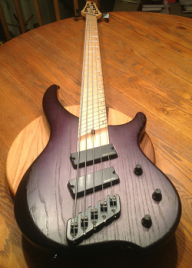
...I was worried those burn marks on my fingers would keep me from playing for a while but once they cooled down they hardened almost like calluses. Doesn't hurt to play at all.
By gum, don't mind me, but I'm off to change some strings.

JUST KIDDING!
Too soon?


I’d say….By gum, don't mind me, but I'm off to change some strings.
JUST KIDDING!
Too soon?
Never!….
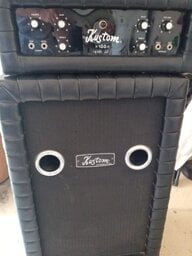
So Anyway, I pulled a live speaker cable out of a cabinet to plug it into another cab. I was wearing my bass at the time, and the 1/4 speaker jack ended up hitting two of my bass strings. Loud pop, and both strings snapped.
I learned something about live speaker cables that day. I have a different routine now for switching cabinets.
I learned something about live speaker cables that day. I have a different routine now for switching cabinets.

You have it wrong, that's for when the mother in law wants to try your Bass out.So I found this cool accessory for people who want to sit in, what do y'all think? I mean, it is an electric bass after all, right?

Did my parents give you that photo?


I can't find the chart for calculating voltage drop on a bass string...I would disagree with that statement, Talking Bass is not a legal courtroom in session where the term has a legal meaning.
I have been electrocuted many times over my career as an electrician, being qualified to work on live equipment has its dangers.
If you go to any medical center or hospital and ask what they would call having an electric shock means they would most likely say you were electrocuted.
People have gone through the electric chair and survived, what were they if they were not electrocuted ?
The burn looks similar to many electric shocks I have witnessed, electricity will leave a burn on the skins surface but it might not always be bad enough to leave visible marks.
Electricity can flow through many paths, most of the current most likely went through the strings and heated them up, but the op would have had an electric shock as well.
One end of the string was most likely at full voltage while the other end was close to zero voltage, otherwise it would not have heated up like an old fashion radiator, so wherever his fingers were the voltage was somewhere between zero and full voltage.
That's just my opinion of course.

That is NO WAY to conduct yourself!

Or better/worse, just tie in to the main lugs in the box. We had insulated gloves, carried rubber mats, used insulated tools, and had one of on standby with a wooden broom handle just in case (and used that handle once!).
Holy
 !
!You guys were savage!


Unfortunately, arc fault breakers are nothing more than a racket to make $80 breakers a requirement per the NEC for nearly every circuit in a new construction dwelling unit. It's the same with the new 2023 requirement for a service disconnect after the meter enclosure- that's just additional materials to buy and more connections to make for some arbitrary requirement to make Eaton Cutler Hammer more money. They petition the NFPA to make changes to the code that will make materials manufacturers more money through what is required by the NEC.The local building code says Arc Fault Circuit Breakers must be installed in bedrooms of new construction. At $80 each, this is not popular. But after reading this I see they can be useful. I'm glad you are OK and now have something to brag about.
Regardless, an arc fault breaker would not trip faster than a standard circuit breaker in a hot-neutral dead short condition, they're intended to detect the micro-arcing that occurs in loose or oxidized connections that get worse over time and burn down houses. Who knows how effective this is in stopping house fires as it was only a requirement very recently. Many homes with wiring prone to these issues such as aluminium wiring or even knob and tube systems have had these circuits replaced or had the arcing risk mitigated- in the case of aluminum wiring replacing all the aluminum terminations with outrageously expensive purple wirenuts that are nothing more than regular connectors with some anti oxidant compound squirted in.
Let's just drive the cost of all new construction through the roof on top of extreme inflation under the guise of "safety" just because we can. Just to get passed on to the consumer at the end of it all. Absolutely ridiculous
Glad nothing bad happened to you, it was definitely worsened by having the bass plugged in and a parallel ground path through the strings, bridge ground and output jack negative

- Jul 7, 2010
- 3,383
- 2,311
- Disclosures
- Endorsing Artist for: Duncan Pickups; Line6, Hipshot, GHS Strings, Somnium Guitars
First I am glad you are ok!
But now I know you really are getting a charge out of life! lol
Oh wait now i bet you automatically now the notes to "You light up my life"
But now I know you really are getting a charge out of life! lol
Oh wait now i bet you automatically now the notes to "You light up my life"
And just what is the life expectancy of savages??…Holy
You guys were savage!
(I know, still not funny. Much….
) 
I have had to perform CPR on an electrician after he had a shock from 240v which is the mains voltage in Australia, he spent nearly 3 months in hospital from 3rd degree burns on his arms and face.
Please do not make statements about electric shock unless you have truly seen what it can do, mains voltage can be lethal and it can cause severe burns to the body.
An electrician can be harmed by a lot of things. 240 volts is not going to cause the kinds of burns you're talking about - I've been hit with 760 volts arm to arm, and nothing was burned.
The resistance of the human body is in the neighbor hood of 10,000 ohms, and if really wet, can get as low as 1000 ohms. If we take that worst case of 1000 ohms, and put 240 volts across it, you get 57.6 watts of power. People regularly take hairdryers, which put out 1800 watts of heat, and aim those at their heads for several minutes, without 3rd degree burns.
He was burned not by the electricity itself, but by the results of things he was working on - 3rd degree burns over a lot of his body is a result of a fauit somewhere - a panel or something overloading - that can shot flames/sparks, but in those cases it's a lot of heat from a LOT of current flowing through something besides the human that does the trick . If there is enough current, the fuses for a building (which can be solid blocks of metal) can vaporize when a fault happens. Yes, I've seen the results of that. If you're in the wrong place, yes you can get burned, but not by the voltage - it's something else that did what you saw.
The OP here has a burn from a similar, but much smaller scale incident - the string (which will pass a lot of current, as it's much lower in resistance than the human) can easily get hot from the current that a house circuit can supply, and the OP was touching it when it did. Having gotten that hot, the string may not be a good one afterwards - it got a random heat treatment, but in the grand scheme of things, that's not a major concern, as the OP is still very much alive.
A final note: Just because electricity is very unlikely to burn you doesn't mean it's safe. You can get electrocuted (where the current stops your heart) long before there is enough voltage to burn you.
Last edited:


