• TalkBass has been independent since 1998. Add your voice.
    Create a free account to reply to discussions, view embedded media, and browse with fewer display ads.
    Join freeLog in
    Want zero display ads or expanded classifieds tools? Compare plans.

Kappalite 10LF in this cab?

basscooker

Inactive
Commercial User
Apr 11, 2010
5,727
10,064
Northern KY
Disclosures
Cab fan, hobbyist
I got my seasonal flyer today from PE. flipped through, saw these.[Invalid or Expired Link Removed]
i'd seen thread titles about the F210 but didn't make the connection that there were new kappalites.

anyway, i have two of these: 2.53 cubic feet, int.
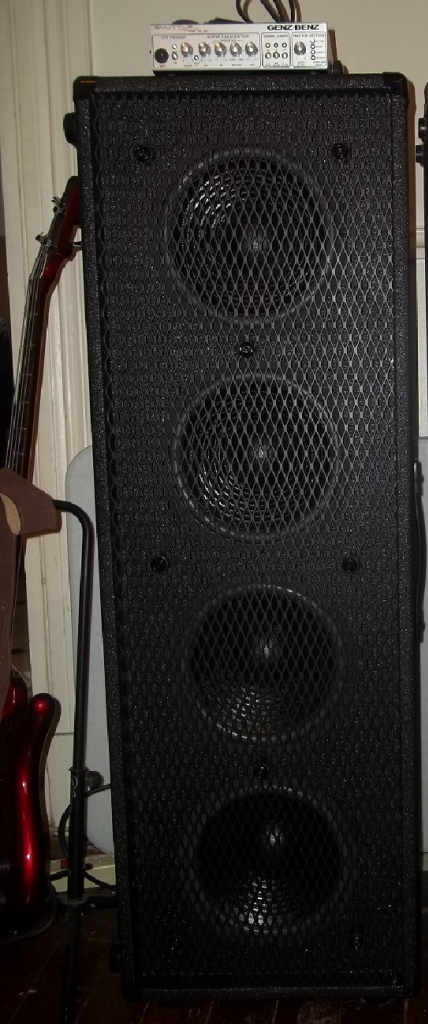
410genz_zps1b0665b1.png


i was curious about doing one with two kappalites and one of these: [Invalid or Expired Link Removed]

but wanted to check out the cab and kappalites first. i got this
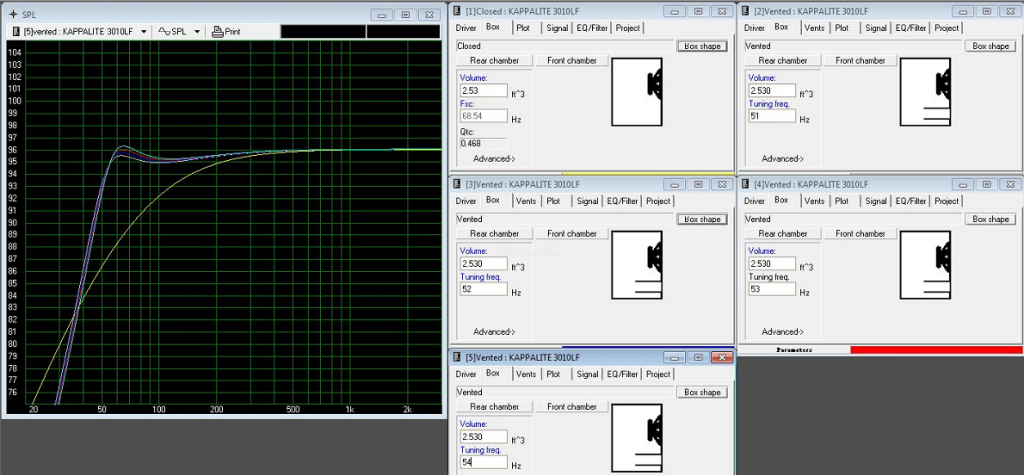
KAPPA210CROP_zps7fd2f922.png


the yellow is the box as it sits, sealed. the others are with a single 4 inch vent, with assorted lenghts and freq.

now the question i have to ask. what do i do with the last empty speaker cutout? is a passive radiator something that shouldn't even be on a bass cab? what is it anyway? should i just close it up?

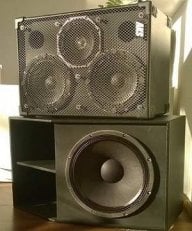
the cabs aren't deep, you know the type, old vocal pa speakers from the 70's. i stripped them and coated them. hardware and grill are metal, feet are heavy and big. overall it's still pretty managable size/weight.

would that mid driver be suitable for this application? sealed back, fits the existing cutout. what would be the ohms like on a cab like this? L-pad ? what effect does the crossover have on the ohms, if any?

would this even work== cost/benefit==

thank you for taking a second to look.:cool:
 
1. yes
2. yes

once i saw the kappalites in the flyer, i looked up the threads i mentioned. i have always known the cabs i have would be better suited (2.53 cuft) for two tens than four. one of the reasons that they have $10 speakers in them and sit in the "occasional" jam spot.

this would leave two empty speaker cutouts on the baffle, once i were to put in two tens. the kappalites wont do the bass guitar's whole spectrum well, so why not a closed back midrange, that fits one of the two remaining cutouts?

the passive radiator idea is just reaching, i think, but i figured i'd ask anyway. closing the last cutout is an option, i'm good enough working with wood to do that. but, twofingers, pretty much, yes, you're right.
i don't think the models look so bad. 51, 52, 53, 54 Hz tunings. under there the lower end was -3below peak. it's got a little dip, but +/- 1dB of a flat line...
 
Have you tried running the numbers on the Eminence Legend or something else designed for a sealed cab? If those numbers work out, 4 of those would knock your teeth in (in a good way), and stacked vertically would be great as a stage monitor.

I don't know about your original idea. It just seems like a reach. I guess with the sealed back speaker not really being part of the equation all that much, the numbers you ran pretty much relied on the Kappa? I might work great. But it might sound like crap. I don't think modeling software has that particular scenario nailed down. But who knows? Worth a shot I guess.
 
if i do anything with those cabs, it would be won't be with 4-10's. doubt there is anything out there that would work sealed 4x10 at 2.5 cuft.
it really would be a 3x10, but with a good crossover. is there some kind of "acoustic whammy" i'm bringing on using a mid driver, on center, the same diameter as the woofers?

traded for the cabs. hardware, grill and coating ran $95 per cab. $10 speakers in them now. two kappas~$400, mid~$75 ($135 in on cabs)=
looking at a little over 600 in if i were to do it. not including the crossover design/build. does that graph show a $600 2x10?
what's the F210 cost? if it's +/- a little i'd rather get one of those. i'd screw up the crossover anyway...
 
Are you planning on using the 10" sealed-back midrange speaker full-range? I hope not :) So long as you run it on a separate frequency range, it would not have any ill-effects on two other [identical] low-frequency speakers in the same box. Think of it as having that 10" sealed back midrange in it's own cabinet sitting atop your low-frequency drivers.

As for the final impedance, the two kappa 3010LFs would present a 4 ohm final load if wired in parallel, yet the beta-10 would be 8 ohms in it's operating range. If both the pair of 3010LF's and the Beta10 are ran simultaneously, then the final nominal impedance would be approximately 2.7 ohms. The impedance while in actual use will be much higher on average since the driver's will not be operating at their impedance minimums the entire time---impedance is frequency dependent. None the less, you'd likely need a stout amplifier that is prepared to handle sub-4ohm loads.

As far as passive radiator, it is a possibility---it serves the same purpose of a port, which is to extend the low-end frequency response about half an octave below what a sealed enclosure would be capable of in the same air space---this is at the expense of a few milliseconds of group delay and some phase shift. Yet I don't think it would be ideal. Usually you need more surface area on the passive radiator than the actual driver to prevent the PR from being driven outside it's linear mechanical travel. This is usually why you see 12" PRs with 10" drivers, 15" PRs with 12s drivers, etc. You'd need one top-notch 10" PR to handle both kappa 3010LFs. IMO a properly designed port would be best.
 
Are you planning on using the 10" sealed-back midrange speaker full-range? I hope not :) So long as you run it on a separate frequency range, it would not have any ill-effects on two other [identical] low-frequency speakers in the same box. Think of it as having that 10" sealed back midrange in it's own cabinet sitting atop your low-frequency drivers.

As for the final impedance, the two kappa 3010LFs would present a 4 ohm final load if wired in parallel, yet the beta-10 would be 8 ohms in it's operating range. If both the pair of 3010LF's and the Beta10 are ran simultaneously, then the final nominal impedance would be approximately 2.7 ohms. The impedance while in actual use will be much higher on average since the driver's will not be operating at their impedance minimums the entire time---impedance is frequency dependent. None the less, you'd likely need a stout amplifier that is prepared to handle sub-4ohm loads.

As far as passive radiator, it is a possibility---it serves the same purpose of a port. Yet I don't think it would be ideal. Usually you need more surface area on the passive radiator than the actual driver to prevent the PR from being driven outside it's linear mechanical travel. This is usually why you see 12" PRs with 10" drivers, 15" PRs with 12s drivers, etc. You'd need one top-notch 10" PR to handle both kappa 3010LFs. IMO a properly designed port would be best.

Yes, crossed over. maybe around 1000? would running the two LF's in series be more desirable? it already looks like a 95/6 dB speaker cab. (those models did not have the mid driver, BTW). would having the impedance up at like 12ohms be too limiting on top of it already being under 100dB?
 
Yes, crossed over. maybe around 1000? would running the two LF's in series be more desirable? it already looks like a 95/6 dB speaker cab. (those models did not have the mid driver, BTW). would having the impedance up at like 12ohms be too limiting on top of it already being under 100dB?

Based upon the Frequency Response graphs provided by Eminence, 1000Hz seems very good, since the 3010LF has a HUGE spike around 1300Hz; from there the Beta10 can take over to about 5 kHz.

The issues with two 3010LFs is that with a 16 ohm impedance it cuts available amplifier power in half compared to an 8-ohm final load.

As for the "12-ohm" load, I'm not sure where you got that from. Care to elaborate?
 
the 16 ohm load parallel to the 8 ohm mid driver (it's around 12 ohms, right?).

AND even as a 4 ohm cab, like i said it's still 96dB at best...but it isn't a plan. i just wanted input on the idea, based on the information i could provide. thanks.
 
the 16 ohm load parallel to the 8 ohm mid driver (it's around 12 ohms, right?).

AND even as a 4 ohm cab, like i said it's still 96dB at best...but it isn't a plan. i just wanted input on the idea, based on the information i could provide. thanks.

Oh ok, I see. No, parallel connected impedances don't work that way; you don't average them. With different impedances, it's always lower than the lower-of-the-two. For identical impedances, it's cut in half.

You definitely would not want 16ohms on the low-end in parallel with 8 ohms on the high end. Nothing bad will happen except that the low drivers will put out 3 dB less than what they are rated, while the high driver will output what it is rated at. So the 3010LFs would be outputting roughly 90 db, while the beta10 would be up near 100 dB (the beta10 receiving 1W, while the pair of 3010LFs would share 1W). This would lead to a HUGE disparity between the low-end output, and the mid-high output levels. In actuality the disparity would be slightly less than 10dB, but none the less it would be significant.


I have several sophisticated enclosure modeling programs (more so than WinISD) that I'm familiar with so let me know if you need any other kind of simulations for different enclosure types.
 
then i would need to attenuate the mid driver.

na. this project wouldn't work. too much cost for not enough benefit. would still be way better than they are now, but no thanks.

i'll let them serve their intended purpose as "meh, but indestructable and cheap cabs for semi-permanant residence in friends' basements".
:) thanks for the input, all.
 
well it kinda makes it difficult with such a disparity between the sensitivity of the low drivers and the mid-drivers. 96 dB isn't too shabby at all considering they are a pair 10" drivers to be quite honest. I've been building enclosures since the early 1990s, and 10" drivers in the low to mid 90dB's with good low-end are generally very well designed speakers.

You could attenuate the mid like you said to even things out, because to get a TRUE 100 dB all the way down to the low-end requires BIG low-end drivers that are naturally more sensitive OR by using lots more enclosure volume---no way around the evil triangle of deep bass/enclosure size/sensitivity; pick two and the other will suffer.
 
The size of that enclosure is to big for the 3010LF, result is muddy lows.
Better would be 1cu ft(30liters) tuned to 44hz.
With 1,5cu ft the tuning needs to be 42hz or lower to prevent muddines.
Edit: I see you want two drivers in 2.53cu ft, that should be doable, tune it to approx 43hz (higher will create mud/boom)

If you want to use a PR make sure it's VD is at least 1.5 times the VD of the driver.
 
I see you want two drivers in 2.53cu ft, that should be doable, tune it to approx 43hz (higher will create mud/boom)

If you want to use a PR make sure it's VD is at least 1.5 times the VD of the driver.


arjank. i was getting a big bump around the tuning if i had it tuned under 50. also the slight dip was more pronounced at tunings below 50. maybe i could reconsider, but i've pretty much written them off as staying janky. they serve their purpose the way they are now, no loss.

mulchor,
whoa i actually knew that at one time... dunno what i was thinking. that 5.3 actually works out better for the project, but it's still not a cost/benefit winner- over $600 without a crossover or l-pad (both would be required) for success, and it still might not be so awesome.

but i was thinking about how greenboy designed the fearful offerings. if i were to make this cab, what if i were to make the second one without the mid driver, basically having a 210+MID AND A 210 SUB, thus maybe not having to attenuate the mid. hmmmm... but both of these NOT SMALL cabs, for basically two 210's?
 
With a crossover between the woofers and mid, I believe the amp will see a 16 ohm load.

i thought i read somewhere that ohms law goes wonky when you throw in crossovers. but i'm far from being experienced with crossovers. that's why i brought it up in the OP.

SO, a 4 ohm 310 full range and a 4 ohm 210sub. could they be run with a series cable? or just a stereo power amp at 4 ohms per channel?
:smug:
its all kinda moot i wouldn't drop that much coin on a what if.:p
 
arjank. i was getting a big bump around the tuning if i had it tuned under 50. also the slight dip was more pronounced at tunings below 50. maybe i could reconsider, but i've pretty much written them off as staying janky. they serve their purpose the way they are now, no loss.

That bump is due to the cab being to big. Tuning lower will indeed not solve the problem but it will make it (probably) less prominent for your ears.
But two drivers in that cab would work better the a single one.
 
i thought i read somewhere that ohms law goes wonky when you throw in crossovers. but i'm far from being experienced with crossovers. that's why i brought it up in the OP.

SO, a 4 ohm 310 full range and a 4 ohm 210sub. could they be run with a series cable? or just a stereo power amp at 4 ohms per channel?
:smug:
its all kinda moot i wouldn't drop that much coin on a what if.:p

It does go wonky because they aren't playing the same frequency range--what I was trying to emphasize is that the low-drivers dominate as to what impedance the amp will see because they are what draw out the most current. So its not so cut-n-dry as simply stating 5.3 ohms. The amp will be primarily see 16ohms because of what you'll be playing: bass frequencies. Check the power output of your amp in the manual @ 16 ohms and its not a pretty sight, lol. So like wcriley said, with a crossover between the low drivers and the mid, the amp will primarily see whatever the lows are wire to--be it 4 ohms or 16.

Think of it kinda like this: in a traditional 3-way speaker with a woofer, midrange, and tweeter that is rated at 4 ohms, what are usually the impedances of each driver? Are they 12 ohms each because they're wired in parallel to get a final load of 4? Nope--they're usually 4 ohms each, even though the final system impedance is also 4ohms! This is again because they are playing different frequency ranges separated by a crossover.

With any dual 8ohm+single 8 you'd get the best sound combination with everything in parallel so long as the amp has the balls for it.

Arjank, I agree that tuning much higher creates peaks in the response causing boominess--ideally the response should be as flat as possible in the simulation because its gonna be jagged in real life anyway. Tuning low does create some "mud" or as its known scientifically, distortion, but that's only if the drivers are driven past their point of staying "linear", meaning maintaining the same accuracy as if they were at low-volume. To investigate this, one has to look at the cone excursion in a program like WinISD and see if the applied power will drive the cones past the Xmax specification-that's what creates distortion. So its not so white-and-black as just saying "you'll get mud"--it's all power-dependent.

It's not moot point to discuss this even if you're not gonna build the particular cab. Sharing and discussing knowledge always helps everyone. :)
 
Why not just stick with a 410 sealed cab. Four 16 ohm Eminence 1020N428 Neo fliptops would give a 4 ohm, 600 watt (rms thermal) cab with a nice punchy bass and highs up to 5500 Hz which is higher than that sealed back mid. The Fliptops are excellent in a sealed cab and at 94.8 dB efficiency, 4 of them would put the efficiency at 100.8 dB/watt. A 500 watt micro would be plenty to pump a lot of sound out. I have both sealed and ported cabs and it surprizes me how solid the bass is on my 610 sealed cab even with its higher F3 point and steeper low freq rolloff.
 

Latest posts