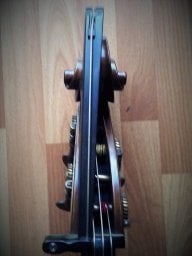
If you appreciate a vintage Kay bass (or not) here is a little gem.
We have just purchased a 1953 Kay C-1 bass. The previous owner was a young lad that was moving to Canada and did not want to take the bass with him so I agreed to give the bass a new home. The classified ad stated all electronics went with the bass I wasnt quite sure what that meant but WOW what a little gem was hiding inside the bass. According to Roger Stowers at Invalid Link Removed this is:
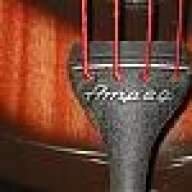
Some of the S-9 basses and a few other basses (special orders) have been documented containing an original sound amplification system. As described by one owner, "it is a high impedance mic on the end of the endpin. The endpin is constructed like a phone plug and is inserted into a socket that sits on the floor. The socket is then connected to an amp. It was manufactured by Ampeg and/or Astatic." The mic is inside the bass, the end pin about 24" long which extends up into the bass and screws into the mic. The outside of the endpin is insulated from the inside and then the jack plugs into the bottom or exterior portion of the endpin. Henry Kuhrmeyer was a leader in putting sound systems in musical instruments
The pick up no longer works (I guess) and it is missing the jack plug that goes to the end of the endpin (the previous owner said he lost is a long time ago) but this is still way cool! A vintage Kay factory installed pick up system that is still fully in tact 55 years later.
The other really unique thing was the original canvas case that came with the bass. When the young man pulled the bass out of the back of his car I saw the case first cool someone had really loved and cared for this bass. There must be 20 different patches of all different shapes, sizes and colors ironed or hand stitched to the gig bag. Okay you say so what? I say people used to have a greater respect for these old basses. You bought them new and cherished them. They were a prized possession. You took responsibility in keeping them looking and sounding good. You had pride in your instrument and the way you carried it even if it was plywood. Today we get a rip or a tear in our gig bag and we are ready to throw it out and get a new one. If the bass gets a ding or a broken neck, we are ready to trade it away because it is damaged. When you look at this bass closely and I say someone really cared for this bass .so much so they proudly put their name and date on the bridge they had great pride in this bass even if it was a student grade plywood bass.
Over all the bass is in good condition. We will give it new strings, new end pin, new bridge and dress the fingerboard. So it will be ready to gig again. Im sure many of you acquire old basses with extra stuff that goes with the purchase (gig bag, bows, old strings, bridges, etc.) but this bass struck me as a statement to a time of frugalness and appreciation that has been lost. Ahhh to be a baby boomer and looking to the past to appreciate the future.
here is a little gem. We have just purchased a 1953 Kay C-1 bass. The previous owner was a young lad that was moving to Canada and did not want to take the bass with him so I agreed to give the bass a new home. The classified ad stated all electronics went with the bass I wasnt quite sure what that meant but WOW what a little gem was hiding inside the bass. According to Roger Stowers at Invalid Link Removed this is:
Some of the S-9 basses and a few other basses (special orders) have been documented containing an original sound amplification system. As described by one owner, "it is a high impedance mic on the end of the endpin. The endpin is constructed like a phone plug and is inserted into a socket that sits on the floor. The socket is then connected to an amp. It was manufactured by Ampeg and/or Astatic." The mic is inside the bass, the end pin about 24" long which extends up into the bass and screws into the mic. The outside of the endpin is insulated from the inside and then the jack plugs into the bottom or exterior portion of the endpin. Henry Kuhrmeyer was a leader in putting sound systems in musical instruments
The pick up no longer works (I guess) and it is missing the jack plug that goes to the end of the endpin (the previous owner said he lost is a long time ago) but this is still way cool! A vintage Kay factory installed pick up system that is still fully in tact 55 years later.
The other really unique thing was the original canvas case that came with the bass. When the young man pulled the bass out of the back of his car I saw the case first cool someone had really loved and cared for this bass. There must be 20 different patches of all different shapes, sizes and colors ironed or hand stitched to the gig bag. Okay you say so what? I say people used to have a greater respect for these old basses. You bought them new and cherished them. They were a prized possession. You took responsibility in keeping them looking and sounding good. You had pride in your instrument and the way you carried it even if it was plywood. Today we get a rip or a tear in our gig bag and we are ready to throw it out and get a new one. If the bass gets a ding or a broken neck, we are ready to trade it away because it is damaged. When you look at this bass closely and I say someone really cared for this bass .so much so they proudly put their name and date on the bridge they had great pride in this bass even if it was a student grade plywood bass.
Over all the bass is in good condition. We will give it new strings, new end pin, new bridge and dress the fingerboard. So it will be ready to gig again. Im sure many of you acquire old basses with extra stuff that goes with the purchase (gig bag, bows, old strings, bridges, etc.) but this bass struck me as a statement to a time of frugalness and appreciation that has been lost. Ahhh to be a baby boomer and looking to the past to appreciate the future.




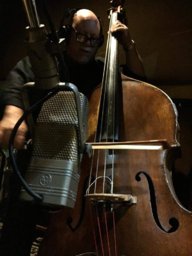

 The pick up doesnt work, a piece is missing and the mic could be a source for a vibration. I dont like to un-do something that has stood the test of time for 55 years but on the other hand it serves no useful purpose other than
its cool. Ahhhh
the decisions
I got to think about this one.
The pick up doesnt work, a piece is missing and the mic could be a source for a vibration. I dont like to un-do something that has stood the test of time for 55 years but on the other hand it serves no useful purpose other than
its cool. Ahhhh
the decisions
I got to think about this one. 




 ), and an ancient Dearmond bass pickup too.