• TalkBass has been independent since 1998. Add your voice.
    Create a free account to reply to discussions, view embedded media, and browse with fewer display ads.
    Join freeLog in
    Want zero display ads or expanded classifieds tools? Compare plans.

Double Bass King Moretone Bridge Height Question

I have acquired a blond '54 King for my next repair project. It will be used for blue grass or such, not bowed.

A major decision is with the neck set. The neck was repaired at least twice and it has been stable for 15+ years according to the two previous owners. It looks like it was first repaired with a wooden dowel through the mid-toe to the block and then again with a screw about in the same place. My metal detector finds metal under a wooden plug. Over stand is about 7/8".

The neck angle is low and as a result the bridge is only 5 3/8". I think it should be 6 to 6 1/4".

My question is will a neck reset to afford a 6" bridge height be worth the effort in terms of acoustical improvement knowing that the repair may have been done with non-hide glue and could be messy? Or does it not matter that much.

BTW, it has rib cracking and ply bubbling and I expect to take the front plate off but I doubt that helps with the neck question.

Pix-

King Moretone pictures by ghbaker - Photobucket


Thanks.
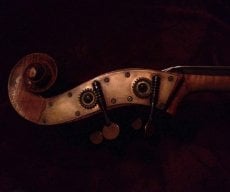
 
My '39 King's bridge is 6 1/4" tall and has 3/4" of overstand. My neck has the same break and three others across the heel held together with a bolt but is behaving so far since i reset it last month. Am I seeing things or is the upper bout on the G side crushed?
 
My '39 King's bridge is 6 1/4" tall and has 3/4" of overstand. My neck has the same break and three others across the heel held together with a bolt but is behaving so far since i reset it last month. Am I seeing things or is the upper bout on the G side crushed?

Thanks for the info KfS. No big problem with the upper g side but the lower has some strange bubbles in the outer ply.
 
I will try to answer my own question by building and fitting substitute bridge feet (there are adjusters already) to afford 6.25" bridge and compare the open string response. The A-B test is still subjective without a lab.

My bridge height was increased to a correct level by gluing blocks to the top of the existing feet [where the adjuster hole is]. This might be a good solution for you, as you wouldn't need to recut/fit the feet to the top. After it was finished, it's lowest adjustment was too high, so my luthier cut down the blocks a bit until it was perfect.

Not the best pic [I was shooting the mic, not the bridge feet] but you can see the lighter wood and the seam of where the new wood is joined to the feet.

IMG_0484.gif
 
I will try to answer my own question by building and fitting substitute bridge feet (there are adjusters already) to afford 6.25" bridge and compare the open string response.

I found an iPhone app that measures sound pressure and has a hold function, which makes it an improvement over my old RS VU meter w/o hold. The iPhone mic reportedly rolls off below 50 hz but will do for a A/B test.

A bridge top (above the adjusters) from the junk box afforded a 6.25" height to compare with the present 5.25" one using the same feet.

I did an A/B test on all open strings at maximum output at 24" distance to the mic. There was measurement overhead available (verified with a closer distance distance not shown below).

I was surprised to only find an improvement with the higher bridge on the G and D.

Since I am not interested in improving output only for the higher strings I decided not to reset the neck.

I tested 3 ply basses just for fun and was surprised how little difference in maximum output there was between them. BTW a 3 dB increase requires twice the acoustic energy.

Data (dB) by string:

- C1 C2 C3 C4 C5
G 86 90 87 87 87
D 87 90 89 87 88
A 86 85 84 88 86
E 85 86 84 86 85

Key to Columns -
C1 - King 5.25"
C2 - King 6.25"
C3 - King 6.25 at 36"
C4 - 1950 Kay
C5 - 1960 German Flat Back
All at 24" plate to mic unless otherwise noted.