• TalkBass has been independent since 1998. Add your voice.
    Create a free account to reply to discussions, view embedded media, and browse with fewer display ads.
    Join freeLog in
    Want zero display ads or expanded classifieds tools? Compare plans.

Learning notes on my bass

I try to practice every day, but i never learned the notes on the frets, I follow bass tabs. The tab sheets have music also, and i mostly ignore them, and im tired of not knowing where notes are…

Where is a good place to start, i know youtube is loaded with videos but i would like to ask here first, im a noob, only been playing 7months.

I have a pedal tuner i have used for helping me when im tuning and trying to learn something new…
 
  1. Start by memorizing the names of the open strings on your bass. From thickest to thinnest, the strings are typically tuned to E, A, D, and G.
  2. Familiarize yourself with the fretboard markers, usually found on the side of the neck or on the top surface of the fretboard. These markers indicate specific fret positions (e.g., 3rd, 5th, 7th, 9th, 12th frets) and can serve as helpful visual cues.
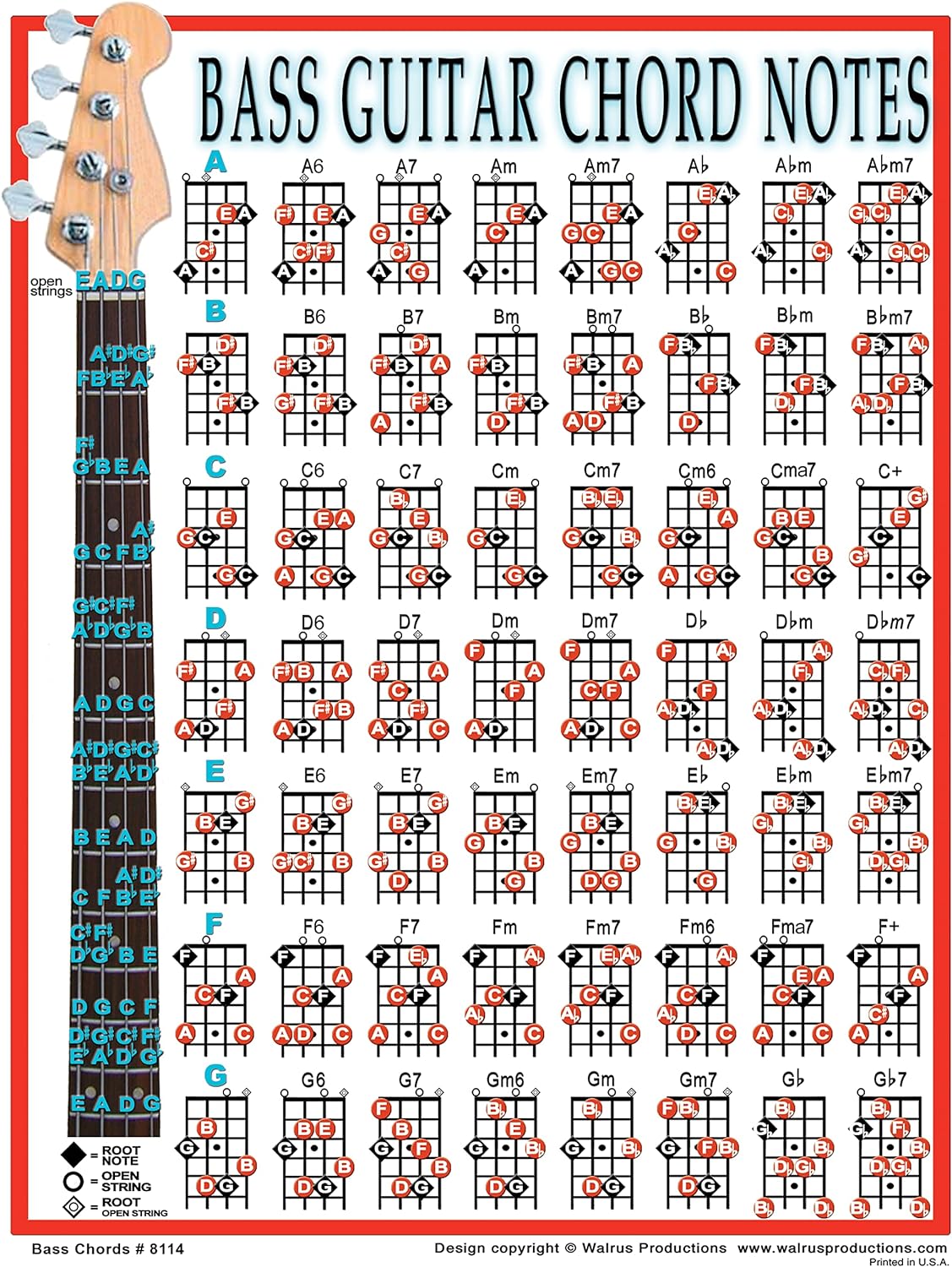
  3. Use visual aids such as fretboard diagrams (easy to find online) or online interactive tools to help reinforce your knowledge of note positions. These resources can display the note names on the fretboard and assist you in identifying them quickly.
  4. Learning and practicing scales is an excellent way to familiarize yourself with the note positions on the fretboard. Start with basic scales like the major and minor scales, playing them up and down the neck while focusing on the note names. Additionally, practice simple exercises that involve playing specific notes in different positions on the fretboard to enhance your familiarity with the notes.
  5. Begin by focusing on a specific region of the fretboard, such as the first four frets or a particular string. Master the note names in that area before moving on to the next section. By progressively expanding your knowledge, you'll gradually learn the entire fretboard.
Hope that helps. There is, unfortunately, no magic but it isn't rocket science, there's only 12 notes, it just takes time and practice. Good luck and welcome to TB!
 
  1. Start by memorizing the names of the open strings on your bass. From thickest to thinnest, the strings are typically tuned to E, A, D, and G.
  2. Familiarize yourself with the fretboard markers, usually found on the side of the neck or on the top surface of the fretboard. These markers indicate specific fret positions (e.g., 3rd, 5th, 7th, 9th, 12th frets) and can serve as helpful visual cues.
  3. Use visual aids such as fretboard diagrams (easy to find online) or online interactive tools to help reinforce your knowledge of note positions. These resources can display the note names on the fretboard and assist you in identifying them quickly.
  4. Learning and practicing scales is an excellent way to familiarize yourself with the note positions on the fretboard. Start with basic scales like the major and minor scales, playing them up and down the neck while focusing on the note names. Additionally, practice simple exercises that involve playing specific notes in different positions on the fretboard to enhance your familiarity with the notes.
  5. Begin by focusing on a specific region of the fretboard, such as the first four frets or a particular string. Master the note names in that area before moving on to the next section. By progressively expanding your knowledge, you'll gradually learn the entire fretboard.
Hope that helps. There is, unfortunately, no magic but it isn't rocket science, there's only 12 notes, it just takes time and practice. Good luck and welcome to TB!

Gotcha, thank you. Im going to add some structure to practicing, i can do fret board knowledge and scales to warm up.

Then practice the song i have been working on. I would usually just practice this new song i’ve been working on.
 
...
i never learned the notes on the frets,
...
im tired of not knowing where notes are
...
Where is a good place to start,

The right answer will depend on what prior knowledge of music you already have. For example, do you know the names of the white and black keys on the keyboard and why there is no black key between B/C and E/F? Do you know the basic notation symbols for sharps and flats? If not, I would brush up on some basic music theory, including the letter-names of the notes on the bass stave and where these are located on the instrument. To get you started, and without knowing what you already know, you might find the attached pdf useful in translating TAB to note letter names.
 

Attachments

What works reasonably well with my students:
1. Learn the names of strings.
2. Learn C major scale (CDEFGABC) on a single string, A string.
3. Learn the two tricks:
- how to find note by the same name octave higher/lower
- how to find the same note on a different string
4. Play the C major scale on a G string.
5. Understand that you can play pieces of the scale (say DEF) on any string by following the same intervals.
6. Take a progressive book without tabs, and try to play the notes. Simple steps yield fastest results. But if you don't like the music the book offers, any book without tabs will do.
 
Here.

bdbnevfbkgfhtcxsfjqq.jpg
download 1.jpg
 

Attachments

  • download.jpg
    download.jpg
    4.8 KB · Views: 39
Exercise that helped me:
  • Set metronome to a reasonable beat (phone app can work great here).
  • Pick a note, say A.
  • Play that note on the E string on a click.
  • Now play an A on the A string on the next click.
  • Now play an A on the D string on the next click.
  • You guessed it, play that note on the G string.
Now pick a different note and repeat. A few minutes a day will really help.
 
At Scott's Bass Lesson's there's a study group that holds people accountable to learn the notes on the bass. It takes 12 weeks. You learn 1 note per week. It is by far the most successful method as hundreds of people have gone through this student led method.

The method was created by Anthony Wellington. You can see him discuss the method in this clinic:

 
  • Like
Reactions: N. Kentucky Bass
I try to practice every day, but i never learned the notes on the frets, I follow bass tabs. The tab sheets have music also, and i mostly ignore them, and im tired of not knowing where notes are…

Where is a good place to start, i know youtube is loaded with videos but i would like to ask here first, im a noob, only been playing 7months.

I have a pedal tuner i have used for helping me when im tuning and trying to learn something new…

Do this:

Buy a book on how to play the double bass. It will teach you the note names and some hand positions.

Plus, if you decide you want to own the coolest instrument ever, you’ll be ready.
 
Eventually you'll know front ways, back ways, and upside down before you really "know it". Initially, I found it easier to look at / learn the board by ONLY focusing on where the B,C - E,F clusters where. Ya already know your alphabet. You can see the relationship in positioning between these 4 notes. This also gave my mind a quick reference of where I was on the fretboard. Once I learned that, it didn't take a lot of thinking to recognize all the notes around the clusters and the repeating patterns.
 
I learned to read music long before bass guitar ever entered my life. So I have solid comprehension and understanding of keys, scales, etc.

First, good for you OP for wanting to become more of a musician - I believe most don't really go there. They figure it out in other ways and don't worry about note values. Fact is, as you've already discovered by using tabs, you don't really need to to get by. And this has always been the reason I'm not a fan of tabs - it takes the music out of music. I'll not argue that they have no place - I have used them to figure out a couple of fingering options. But for a lot of players, that's where they stay.

Having said all that, I find that when I'm playing something I know, I don't think in terms of notes, rather in terms of patterns or in intervals. I pretty much only use note names (in my head) when learning new stuff. When I first started learning bass, and got into learning the fretboard, I used patterns to help ID notes up the neck. There's no reason you can't do that to learn your note names.

As previously suggested, start by learning the notes of your open strings. Then you can establish the relationships between them, the notes between E and A for example. Do this for all the strings. Formally trained bassists tend to live beneath the 5th fret for a long time and that's where they learn the notes. I'd suggest you start there too. Once you have the first 5 frets dialed in, move up to the next 5 frets. You'll quickly start detecting patterns and you'll probably find that the second 5 frets comes very quickly. Keep moving up until you run out of fretboard (or at least up to the 12th fret).

A second concept would be to learn all the notes on one string (say the E string). Once you do that, you can start interval hunting (finding where the octave of each note is, then finding (and identifying) the 5ths and 4th, eventually all of the intervals. Once your comfy on the E string, do it again on the A string, and again, you'll quickly recognize the patterns and it comes more quickly.

I can't recommend any books, but I would thing that anything that does introductory bass lessons will get you started. I'd bet there are plenty of YouTube videos that go over this as well. They may not cover the whole fretboard, but once you get a basic understanding of one section, the rest is just pattern recognition.
 
best thing you can do is dump TABs altogether. Say each note out loud as you play them. Find a good music teacher.
Great tip.
Singing the names of the notes helps with developing the ability to hear the notes before you play them. This helps to advance you to the point where you just play what you imagine.
 
Beyond what noeinstein said in their first post (which is great advice), I'd also start trying to just get familiar with remembering the progression of notes up and down. Like F, F#, G, etc etc then back down. Relative distance is important to know and if you know what some are, you can figure out the rest. Then it's just a familiarity and speed game. Also I found gameifying it when I was in High School helped me practice when I was board in class

Guitar Notes - Fretboard Trainer
 
Since you are relatively new to the instrument, I strongly recommend learning to read standard notation and where the notes are on the instrument AT THE SAME TIME.

It will be a skill that is as beneficial as learning the alphabet before reading some of the greatest literature.

Reading music is learning another language-- common to all musicians around the world.

I began playing bass over 50 years ago. Because of my great teacher, I've played in garage bands, staged rock performances, hotel lounges, big bands, theater shows.....

I have never been paid to read tab. Good thing, because I don't know how.